Fire Officials Ask People to Change Clock, Check Alarms This Weekend
 |
STOW, Mass. — State Fire Marshal Peter J. Ostroskey urges residents across the commonwealth to check smoke and fire alarms when they change their clocks for daylight savings time.
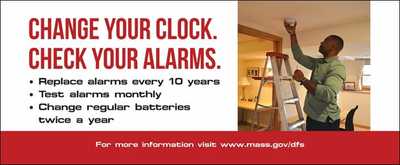
"As we 'spring ahead' with daylight savings time, remember to check your smoke and carbon monoxide alarms," said Ostroskey. "Working smoke alarms are key to surviving a fire. Unless you have newer alarms with 10-year sealed batteries, this is a good time to replace the alkaline batteries in your smoke and carbon monoxide alarms."
"Winter is not over, and our furnaces have been working hard. This is the time of year when something might break causing deadly carbon monoxide to leak into our homes," said Ostroskey. "Working carbon monoxide alarms are the ONLY way to detect that invisible poison."
Replace Aging Smoke Alarms
"Smoke alarms, like other household appliances, don't last forever," said Chief Michael C. Newbury, president of the Fire Chiefs' Association of Massachusetts. "Check the age of your alarms. Smoke alarms usually need to be replaced after 10 years, and carbon monoxide alarms after 5-7. "If they are more than 10-years old, replace the entire alarm."
Replacement Alarms Should be Photoelectric With 10-year Sealed Batteries
The State Fire Code requires replacement battery-operated smoke alarms in older one- and two-family homes to be photoelectric and have 10-year, sealed, non-replaceable, non-rechargeable batteries and a hush feature. Ostroskey said, "Fire officials hope that if we make smoke alarms easier for people to maintain, they will take care of them. We see too many disabled smoke alarms in fires when people really needed them to work."
Time Is Your Enemy in a Fire
"Time is your enemy in a fire. Working smoke alarms give you precious time to use your home escape plan before poisonous gases and heat make escape impossible." said Ostroskey.
"No one expects to be a victim of a fire, but the best way to survive one that does occur is to have working smoke alarms," Newbury said.
In the average house fire, there are only 1-3 minutes to escape AFTER the smoke alarm sounds.
"Take a few minutes to protect those you love by changing the batteries in your smoke alarms this weekend. Then take a step stool and some 9-volts to your parents' or older neighbor's and ask if you can refresh their smoke alarms," Newbury said.
Home Fire Sprinklers
Home fire sprinklers provide residents additional time to escape, but working smoke alarms are still needed to alert people to danger.
Senior SAFE
Two hundred thirty-eight (238) fire departments across the state have grant-funded Senior SAFE Programs. Seniors who need help testing, maintaining or replacing smoke alarms should contact their local fire department or senior center for assistance. Ostroskey said. "Four out of every ten people who died in fires last year were over 65. We want our seniors to be safe from fire in their own homes."
For more information on smoke alarms or the Senior SAFE Program, please go to www.mass.gov/dfs or contact your local fire department.
Tags: fire safety,
.jpg)