Pittsfield Council Again Grapples With Mosquito Control Program's Future
PITTSFIELD, Mass. — The City Council on Tuesday took up the possibility of opting out of the Berkshire County Mosquito Control Project entirely.
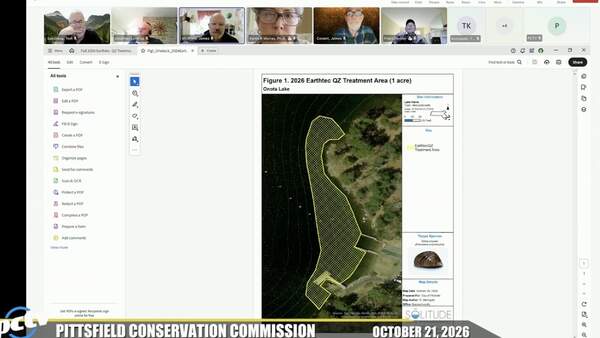
After some discussion, the panel unanimously decided to refer Ward 7 Councilor Anthony Maffuccio's petition requesting the discontinuing of service to the Conservation Commission, the Health Department, and Commissioner of Public Services and Utilities Ricardo Morales.
Maffuccio said he did not intend to opt out of BCMCP with the petition but wanted to get a dialogue started between the councilors to see where they stand on it.
"I intended to send it to two different entities but let's just think, we have five months to do anything because if we're going to opt out we've got to do it before May, and from now till then, I'm sure we can get some numbers on how the city can do larva control through the public works department and through the health department, being able to subcontract the work out, we can't do it in-house because we're not permitted for that," he said.
"But that's all I'm trying to look for, we're spending $150,000 for this program. We are paying over 60 percent of the budget of this program. So if we can do it for less than $150,000 and not pay over 60 percent of the mosquito control budget at $150,000 I think we owe it to yourselves to do that."
In 2010, the City Council voted to contract with BCMCP, and the Board of Health has overseen the project since 2012. Included in the service are surveillance methods and treatments for both adult and larva mosquitos.
In April, the City Council voted to opt out of the spraying portion of the project but the pre-emptive larval control and catch basin operations remained.
Last week, the Public Health and Safety subcommittee voted to discontinue service with BCMCP as a whole.
Councilor at Large Earl Persip III pointed out that there was a communication received from the city's conservation agent asking that the petition be referred to the Conservation Commission because of the work that the program does for it.
"I think it's important that we hear from the Conservation Commission and I also think it's important that we look at doing some of this extra work that we can kind of know about, trying to know about in house what the cost is there versus the cost of the Berkshire mosquito program," he said.
"So I think those two things should happen before we opt out of anything, I've supported opting out and non-spraying in the past but I think knowing all the information first is key."
Councilor at Large Pete White brought beaver dams into the conversation. Superintendent Chris Horton clarified that the BCMCP is authorized to handle the dams through a city drainage mitigation plan.
White said this is an important piece of the project and though he does not support the spraying, he supports staying in the contract for such tools. Nonetheless, White fully agreed with sending the petition to the commission.
He later asked Finance Director Matthew Kerwood if opting out of the program would increase local aid, to which he responded that it would not.
Ward 4 Councilor Chris Connell asked interim Director of Public Health Andrew Cambi if inhouse mosquito services will cost the city more than it is paying now and Cambi said that is correct.
Cambi did some research and found that Pittsfield is within the standard for mosquito control costs in the state compared to similar sized cities.
He added that beaver dam mitigation is another component because the city doesn't have the expertise or licensing to handle them.
On the other hand, if the council did choose to opt out of the program as a whole, there might be delays to start a new program because of staffing shortages and the job market.
Morales also revealed that the city would be spending between $30,000 and $50,000 for just the installation of larval stage treatments in the city's 4,600 catch basins.
He said it is important to note that the city does pay 60 percent of the mosquito control budget of $250,000 but Pittsfield, because of its size, pays less per capita than the other communities that are served by it.
Ward 2 Councilor Kevin Morandi highlighted the fact that the Board of Health is against opting out of the program, which the panel stated in a September meeting.
He expressed fear that the council is going to go against the advice of other boards and commissions.
"I don't have a problem sending it off to conservation, but are we gonna waste their time?" Morandi asked. "And even if they vote not to opt out, this council has got the final saying."
This will be on the agenda for the Conservation Commission's Nov. 10 meeting and the council will likely have a response back by its Dec. 14 meeting.
Tags: mosquito spraying,