Pittsfield Hospitalization Rates Not Spiking During Omicron Surge
PITTSFIELD, Mass. — The omicron variant has presented a historically high spike in cases but hospitalization rates are not so far surging in response.
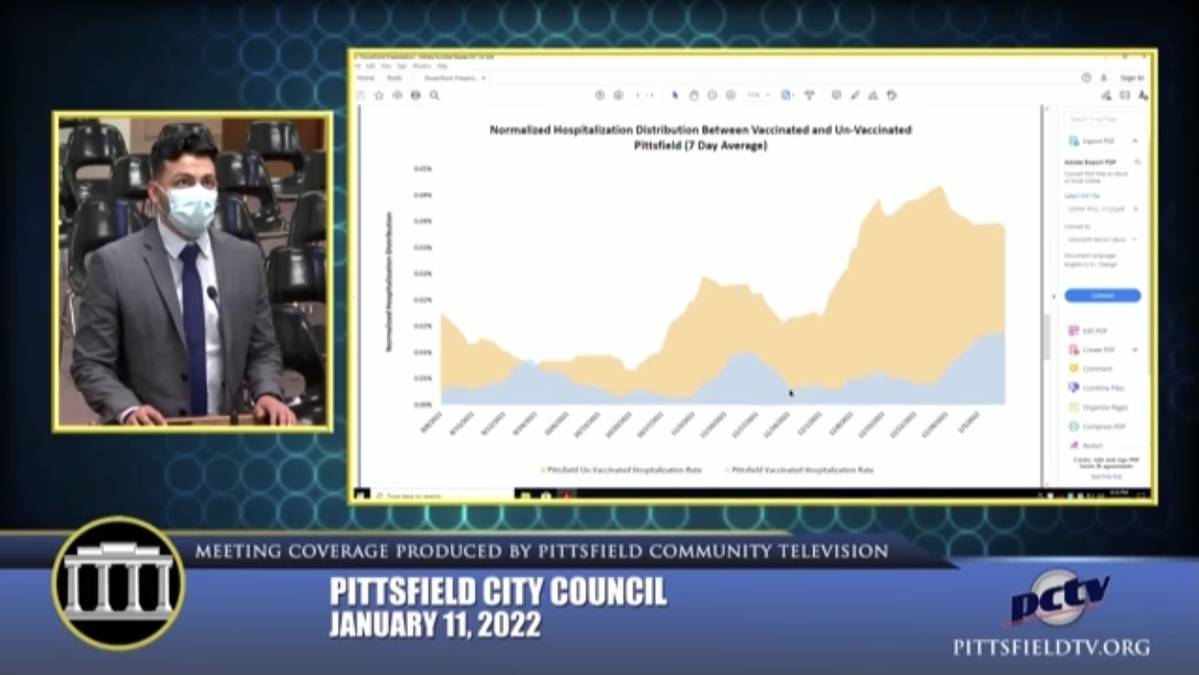
During a COVID-19 update at Tuesday's City Council meeting, Director of Public Health Andy Cambi reported that there are 25 people hospitalized at Berkshire Medical Center for the virus and that a large number of these patients are unvaccinated.
"While we have seen the rise in cases tremendously with omicron, the hospital census has remained in the lower end compared to what we saw before," he said, comparing the current rates to those at the beginning of the pandemic in 2020.
Cambi displayed a chart that compared normalized hospital distribution between the vaccinated and unvaccinated in Pittsfield. With the omicron variant, the unvaccinated rank much higher on the chart than those who are.
Currently, 73 percent of the city's residents are fully vaccinated and 85 percent have had at least one dose (this may include the one-dose J&J vaccine, which counts as fully vaccinated).
"So what we can make of this is that receiving the vaccine has done a lot to help protect our community," Cambi said. "We can see that in the data that we have here from the hospital census."
Pittsfield's average case rate per 100,000 is 244.9, a metric that has sharply risen since Christmas. The positivity rate is 18.8 percent, close to the highest positivity rate of 19.2 that occurred in early April 2020.
There are currently 716 estimated actively contagious cases in the city and there were 114 new cases on Monday. This is an improvement from Friday when there were 163 new cases, the highest daily case rate in the history of the pandemic.
Cambi reported that increase in cases has caused an increase in the demand for testing as well. He commended BMC for ramping up its testing.
He also reviewed the city's Biobot sewage testing, which is used to predict virus trends ahead of time. Based on virus concentration rates, the estimated contagious cases per day are expected to drop in the near future according to the Biobot data.
Ward 1 Councilor Kenneth Warren queried Cambi on the at-home COVID-19 test kits that were provided from the state and Cambi confirmed that they have been allocated and distributed.
"The home test kits were meant for a certain population, people that had financial hardships and access hardships," Cambi explained.
"So we didn't want to just blast out that information so that it would will cause confusion. I took that opportunity to reach out to community partners to to address that."
Ward 2 Councilor Charles Kronick also asked for a breakdown of patients who are admitted for COVID-19 and have tested positive incidental to hospitalization. Cambi said that could be worked into a graph.
Hospitals across the state this week were preparing to differentiate reporting on novel coronavirus cases based on whether patients were admitted because of or related to COVID-19 or were admitted for unrelated reasons and tested positive. All hospital admissions are being tested for the virus.
Tags: COVID-19,
More Coronavirus Updates