March is Massachusetts Maple Month
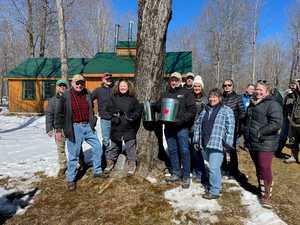 |
| Agricultural Resources Commissioner John Lebeaux, Energy and Environmental Affairs Undersecretary Beth Card, and state and local officials visit Grand Maple Farms in New Braintree to celebrate Maple Month. |
NEW BRAINTREE — Gov. Charlie Baker has declared March as Massachusetts Maple Month in the Commonwealth.
"Our administration is happy to continue the tradition of recognizing our maple sugar producers who have long been a unique and important part of the Massachusetts agricultural industry, contributing over $12 million to the local economy and employing more than 1,000 workers," said Baker. "We are proud to support them and hope everyone will do the same by purchasing locally produced maple products this season."
According to the U.S. Department of Agriculture's 2017 Census of Agriculture, Massachusetts is home to approximately 300 maple syrup producers who produce over 70,000 gallons of syrup each year. Producers help to maintain thousands of acres of open working landscapes across the commonwealth.
Maple sugaring profits allow many farms to stay in business year-round by serving as a secondary crop and supplemental source of income.
As one of the region's unique agricultural foods, visitors come from all over the world to buy products during the sugaring season. Farms, restaurants, bed and breakfasts, country inns, and other tourist businesses share in this income, which primarily flows into small towns and farm communities, helping the local economy.
Massachusetts ranks among the top 10 maple producing states in the nation.
"The start of maple season is always an exciting time, ushering in a new growing season here in the commonwealth," said Lt. Gov. Karyn Polito. "With snow still on the ground, visiting a Massachusetts sugarhouse offers a picturesque New England experience while supporting our local economy by providing a boost that not only benefits our maple producers but also provides other surrounding tourist destinations, such as restaurants and bed and breakfasts, with additional revenue opportunities."
In celebration of this declaration, Massachusetts Department of Agricultural Resources Commissioner John Lebeaux, state and local officials, and representatives from the Massachusetts Maple Producers Association today visited Grand Maple Farms in New Braintree to raise awareness of the state's many maple producers and to encourage residents to purchase locally-produced maple products.
The visit to Grand Maple Farms included a tour of their facility along with a ceremonial tapping of a maple tree to commemorate the start of the sugaring season. Owners Justin and Paul Schur began their business with 23 taps in 2011, which has now grown to over 900 taps including sugar maple and red maple trees.
In the past six years, the Baker-Polito administration, through MDAR, has awarded $341,785 in Agricultural Energy grants to maple producers throughout the state. These grants have been used to offset the costs of installing updated, environmentally friendly equipment, including high efficiency evaporators, heat recovery and reverse osmosis equipment.
"Maple syrup is a delicious local product that is part of our agricultural heritage in Massachusetts and maple sugar producers are true stewards of our land, protecting over 15,000 acres of woodland," said Energy and Environmental Affairs Secretary Kathleen Theoharides. "The commonwealth's maple sugar producers have also been pioneers and innovators, adopting cutting-edge energy efficient and environmentally-friendly technologies for harvesting and managing their maple groves."
Maple syrup has been produced and consumed for centuries in North America and its initial availability during the tail end of the winter season signals the start of the agricultural awakening in Massachusetts and a sign that spring is around the corner.
Tree tapping in Massachusetts can start as early as late January and continue through April, though March is officially Maple Month. Most importantly, the temperatures must be below freezing at night and above freezing during the days for the tree sap to flow. Furthermore, weather, soil, and genetics of the tree can affect maple syrup flavor.
"As we shake off another winter season and as residents are eager to venture out, I can't think of a better way to usher in a new growing season than to bring the family out to a local sugarhouse this month for a pancake breakfast complete with some freshly produced local Massachusetts maple syrup," said MDAR Commissioner John Lebeaux. "Like with so many other aspects of our culture, the history of Massachusetts is tied to the history of maple, and when you buy Commonwealth produced products, you are not only supporting local farmers but you are honoring the history and legacy of our agricultural past."
Tags: maple,