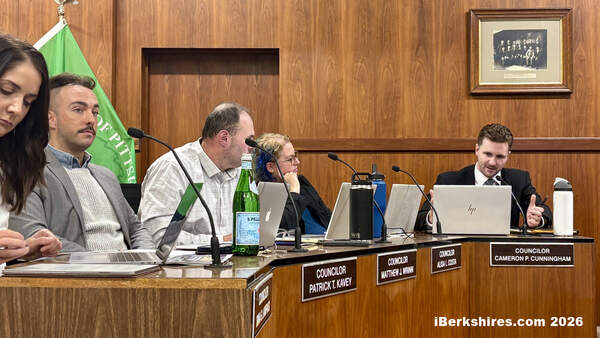
image description

Pittsfield Board of Health OKs Updated Tobacco Ordinance Draft

By Brittany PolitoiBerkshires Staff
Print Story | Email Story

PITTSFIELD, Mass. — With the Board of Health's support on several proposed tobacco ordinance updates, the city now wants to hear from the public.

On Wednesday, the panel approved a slate of changes that extend the document from 16 pages to 18 pages. These include a clarified definition for blunt wraps, a raised minimum price requirement for cigars, and violations that incorporate state law.

This has been an almost six-month effort after Tri-Town Health Department Director James Wilusz came to the board in May to give an update on tobacco control.

Pittsfield's tobacco ordinance was last updated in 2019 before Gov. Charlie Baker signed an Act Modernizing Tobacco Control, which imposed new restrictions on the sale of nicotine vaping, flavored vaping, and tobacco products.

Wilusz warned the panel that such products can slip through the state's regulations without specific guidelines.

Blunt wraps are banned in both the new and old ordinances, though the definitions were tightened.

In the proposed new ordinance, a blunt wrap is defined as "any product wholly or in part from a tobacco product, manufactured or packaged with loose and removable leaves or section of a leaf, or as a hollow tube, that may be used by the consumer to wrap or contain loose tobacco or other fillers."


It also considers tobacco leaf kits or roll-your-own packages as blunt wraps.

The former ordinance's definition was shorter and did not include language about loose removable leaves.

Cigar pricing and packaging regulations were updated to raise the minimum price for a cigar by 40 cents to $2.90 and the minimum price for two or more cigars from $5 to $5.80.

Language from the state's tobacco regulations was added that stipulates:

  • A $1,000 fine for a first violation and a suspension for up to 30 days and no less than one day
  • A $2,000 fine for a second violation and a suspension of up to 30 days and no less than seven days.
  • A $5,000 fine for three or more violations in a 36-month period and a 30-day suspension.  

In the local regulation, the period between violations was changed from 24 months to 36 months and a section was added that allows the BOH to deny a tobacco license renewal if a retailer has sold to a person under 21 three times within the previous year.

The new ordinance also prohibits any new adult-only retail stores from existing within 25 feet of an existing tobacco permit.

There was a previous discussion about explicitly banning smoking bars but BOH members felt that the ordinance already bans them, as smoking is not prohibited in any bars within city bounds.

The town of Dalton has been on a similar path with Tri-Town, which has been administering a tobacco awareness program since 1994.

Pittsfield Tobacco Regulations by iBerkshires.com on Scribd


Tags: tobacco regulations,   
If you would like to contribute information on this article, contact us at info@iberkshires.com.

Dalton Planners Hold Public Hearing on Tiny Homes Bylaw

By Breanna SteeleiBerkshires Staff

DALTON, Mass. — The Planning Board held a public hearing last week on a bylaw for mobile accessory dwelling units (ADU) that will be brought before a special town meeting.

For nearly two years, Amy Turnbull has been trying to amend the current ADU bylaws to allow mobile tiny homes.  

A movable tiny home is defined as a unit under 400 square feet that meets all of someone's daily needs, including sanitation, cooking, and other facilities, and which is also mobile. Most homes considered "tiny" are built on a trailer so they can be towed.

Her proposal defines a movable tiny house as a "residential property with an existing primary house, intended for year-round living," and outlines eight conditions for approval.

Among these conditions: the unit must adhere to accessory dwelling unit regulations, undergo site plan review, be licensed and registered with the state Registry of Motor Vehicles, have approved energy, water, and wastewater systems, and comply with American National Standards Institute 119.5 and National Fire Protection Association 1192 safety requirements.

Additionally, the unit must be certified for ANSI or NFPA compliance by a manufacturer or third-party inspector, including adherence to Appendix Q and the International Residential Code's structural guidelines and energy efficiency standards. The tiny house cannot move under its own power, and its undercarriage, wheels, axles, tongue, and hitch must be concealed from view. Wheels and leveling or support jacks are required to rest on a level gravel or paved surface.

Turnbull has gotten enough signatures for her petition to amend the current bylaws to add her definition of the mobile ADUs. Last Wednesday, the board held a public hearing on the petitions, which will be voted on at a special meeting.

Turnbull says she has two reasons for wanting to add this to the town's bylaws: aging in place and affordable housing.

"We need a variety of housing types in Dalton, and that we also need to address the idea that you know nearly 30 percent of our population by 2035 is going to be over 65 years old, and it's problematic because  ... there's not enough choice for these people to to age in place,"she said. "What movable tiny houses does, is it provides a less restrictive ADU. It's much cheaper to place, and it's easier to place, less time consuming. And what it offers to people is it offers people who are owners a place for their children to come and live, or a caregiver to come and live, or for the people who own their own house to come and live while they rent out their maybe their three bedroom home to a new family who wants to attend to Craneville simultaneously."

She said people need to move away from calling and treating the tiny homes as though they are trailers, as one former Planning Board member has voiced opinions on.

"That is an opinion, and I think we need to get over that, because I want to say that these are foundation homes, and that the chassis is a foundation, and it's a stick-built home on a chassis, and in very many ways it's like a modular house. I think we will not be surprised in the next 10 years if we see the market turn around and start to make smaller, tiny modular homes, but that is not the case right now, and we have a dire need for affordable housing," she said.

At a former Fire District meeting the Water Department drafted regulations for water hook-ups for these types of homes. The superintendent sent a letter to the Planning Board to be read at the meeting stating it will not be a hindrance for sewer system connection.

"The Department of Public Works does not feel that mobile ADUs will be an issue with the town sewer system. The homeowners will be responsible for any issues outside of the sewer main and connect and responsible for connecting in, so that would address any permits, fees, or anything like that would be added to that," the letter states. 

"The Water Department, as we've stated previous, and as you stated, the water department has come up with their own set of SOPs, standard operating procedures, for hooking up a an adu and a mobile adu, which will then have to meet winterization and all those, but they've laid out a plan for that, that they have, so I'd like to point that out," board Chair Robert Collins said.

One concern was raised that if someone can have a mobile ADU could they also have another tiny home on their property, including the main house. That situation is not likely, said Turnbull, as it would cost a considerable amount of money. Town Manager Eric Anderson also stated that in his former community when they adopted similar laws their first one wasn’t put in until a couple years later and then maybe one a year.

View Full Story

More Pittsfield Stories