Pittsfield Licensing Board OKs Hot Plate Brewery License
PITTSFIELD, Mass. — With state and local license approvals, Hot Plate Brewery is nearing the last hurdles before its debut to the public.
On Monday, the Licensing Board granted the taproom a downtown beer and wine liquor license, and last week, it received a pub brewers license from the Alcoholic Beverages Control Commission.
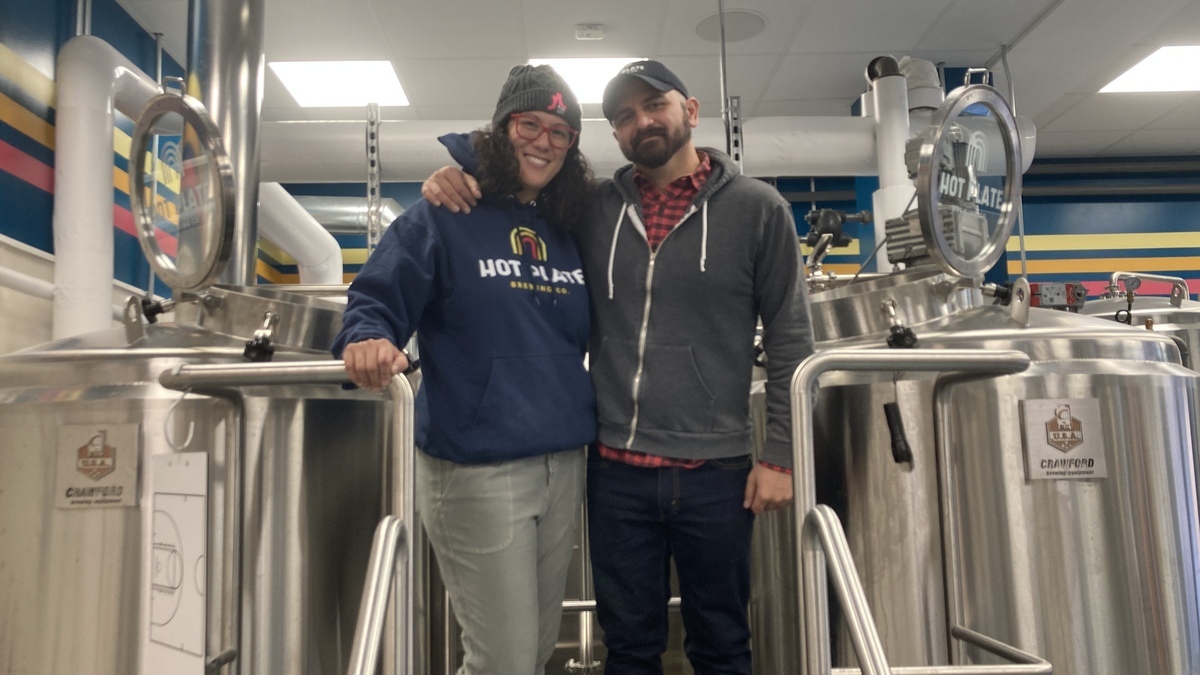
Brooklyn, N.Y., transplants Mike Dell'Aquila and Sarah Real are planning a soft opening in early January but right now, they reveling in the relief of getting the official business done.
"It feels like a major relief. We are still processing it because there is just so much, I think, stress leading up to it," Dell'Aquila said, as the permitting process is not a quick one.
"We understand that once we send it off, you can't control much," Real added.
"It's just sitting around and taking some deep breaths and being like 'We've put our best foot forward, it is what it is, we'll just take it as it comes.'"
The Licensing Board's approval set in motion the last few hurdles to get open, Dell'Aquila said, as it must go back to the state for a final OK before they can open.
Hot Plate is described as a microbrewery, characterized by producing 15,000 barrels or less per year, and will utilize local raw materials for ingredients.
It will have a 12-tap system that includes traditional beers, popular beers such as New England IPAs, and more experimental brews such as a chamomile blonde ale and a jalapeno pale ale.
Real, who is the head brewer, told the board that Hot Plate is a mission-driven community brewery --or brewpub per the ABCC-- with three pillars: craft, conservation, and community.
They plan to highlight artisans and creators of all sorts, partner with local farms and similar crafters throughout the commonwealth, and be a community meeting space where people can also have non-alcoholic beverages.
"Part of what made me want to build this community space is that as a Latina woman, I never saw myself reflected in the gallery space," Real explained.
"In fact, there are 9,200 breweries in the United States and less than 1 percent of those are owned by women of color so this is a huge endeavor, and hopefully a huge sea change. And so I wanted to bring that part to Pittsfield so it could be a meeting place and a gathering place where you can bring your whole self whether you are any color of the rainbow, LGBTQ plus, any sort of person. We want it to be a community place for everyone."
There was some discussion about the food aspect of Hot Plate, as the downtown licenses focus on restaurants and this is a brewery.
Attorney Jesse Cook-Dubin explained that they will have a cooler stocked with food that is prepared by other downtown restaurants such as sandwiches, wraps, and salads. There will also be some commercial kitchen infrastructure with sinks, a dishwasher, food prep spaces, a walk-in cooler, and food heating capabilities though there will not be a full kitchen.
"We look at the ordinance and see a difference between the requirement for an all-alcohol special downtown license, which is a full kitchen, and the requirement for a wine and malt special downtown license which is an on-premises kitchen. And we submit to you that this is an on-premises kitchen," he said.
"But I think more important than the technicality, which we think is met that there's an on-premises kitchen, there is food, you can sit down and have a meal, and this is totally consistent with the purposes behind the ordinance which are to promote downtown development and to make sure that we have an ecosystem of restaurants, cultural venues, and other businesses that support each other and support the downtown."
City Solicitor Stephen Pagnotta said the language allows the board to grant Hot Plate a license.
Board members agreed that they want to promote businesses and pointed to similar licenses that they have supported in the past, such as Thistle and Mirth's operation with a half kitchen.
The owners will come back and give the board an update on the food service soon after the brewery gets up and running.
"I think it's a great thing for the city of Pittsfield, by the way," Chairman Thomas Campoli said.
"We're glad that you're here. Obviously a substantial investment. I think on the street people are excited about it."
Real and Dell'Aquila said that the response has been positive. They have received a great deal of support from Mayor Linda Tyer, who was at Monday's meeting.
The two also received a $140,000 allocation of Pittsfield economic development funds last year to support the acquisition of equipment.
Tags: brewery,