image description
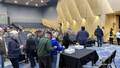
The Homeless Advisory Committee in Pittsfield sees data collected in January on the number of unhoused people in the city.

Count Shows Increasing Homelessness in Pittsfield

By Brittany PolitoiBerkshires Staff
Print Story | Email Story

PITTSFIELD, Mass. — The city had  more than 200 homeless individuals in January, a number that has increased steadily for two years.

On Wednesday, the Homelessness Advisory Committee was presented with data from the point-in-time (PIT) count, which is a count of sheltered and unsheltered people experiencing homelessness on a single night in January.

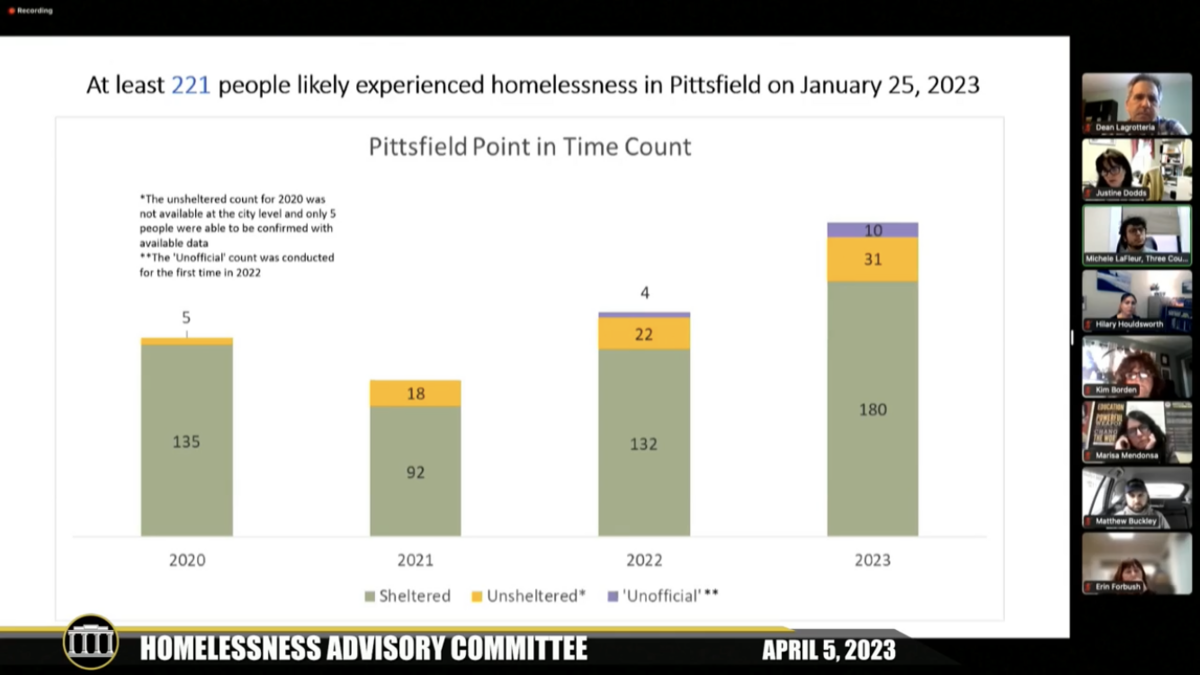
There were at least 221 homeless people on Jan. 25: 180 in shelters, 31 unsheltered, and 10 who were couch surfing or in other temporary shelters.  

"It's obviously concerning," Director of Community Development Justine Dodds said.

"We all know on the ground level that the numbers are increasing but I think this really illustrates kind of in black and white that the numbers are on the increase and that Pittsfield really is the place where services and everything is being housed. You can see the numbers are really less significant countywide and I think that's kind of critical."

Michele LaFleur, data and evaluation manager for Community Action Pioneer Valley, explained that there was a storm on the night of the data's collection that could have affected the number of people outside.

In 2021, the PIT count showed 110 unsheltered people in the city and that number rose to 158 in 2022.

"This, as you can see, is definitely an increase from the past few years, and part of that could be that we kind of had some difficulties conducting the counts at the height of the COVID pandemic but it's definitely even beyond that," LaFleur commented.

"It's just increasing in general, homelessness in Berkshire County and in Pittsfield especially."

Pittsfield's 31 individuals without shelter was a stark difference from other Berkshire County communities that had no more than four.

Of the unsheltered situations, nine people were on the street or sidewalk, eight were in the woods or a camp, six were in a vehicle, four were in a park, three were in an unsafe structure, and one was under a bridge or overpass.


A majority of the people were in the 25 to 34 age range, were individuals not associated with a family, and cited mental health as a barrier to stable housing. They largely reported experiencing homelessness for at least one year.

This preliminary data was collected by the Three County Continuum of Care through local providers and is collected across the state. It will be finalized and submitted to the federal government.

The city has increased capacity at the emergency shelter at the foamier St. Joseph's High School and a new shelter at First United Methodist Church was expected to be finished in late March. It was not clarified whether the new shelter is open or not.
 
Erin Forbush, director of shelter and housing at ServiceNet, said the increased capacity has allowed them to count people a little bit differently than in the past.  

Dodds also gave an update on several housing projects that are taking place in the city.

She reported that the historic White Terrace buildings at 592-596 North St. are almost ready to begin construction into 41 new affordable units. Last year, the project was allocated $750,000 in American Rescue Plan Act funds.

Last week, the Healey-Driscoll administration announced more than $60 million to advance 12 affordable housing projects in the state. This included two Pittsfield efforts: Nine units at Zion Lutheran Church with and 28 units on West Housatonic Street.

Also last year, $6.5 million of ARPA funds were allocated for permanent supportive housing and a housing resource center.  

This includes units of permanent supportive housing on the second floor of Zion Lutheran Church's hall and new units at 111 West Housatonic St., a vacant property that is being donated by John Wendling.

It will also fund a housing resource center for residents at both locations in the rehabilitated, 7,700 square feet lower level of the church. It will have a lobby area with mailboxes, a quiet lounge area, a tech area for computer use and phone charging stations, a commercial kitchen, a community room, laundry facilities, lockers, bathrooms with showers, and office and consulting space.

"I know these projects take a long time to kind of come to fruition, there's a lot of steps that are involved and there's a lot of people that are involved," Dodds said, assuring the committee that there are positive things coming to address some of the issues.

On Thursday, the committee had sponsored its first housing resource fair at the Berkshire Athenaeum  with 10 different agencies offering information on programs and services.


Tags: homeless,   
If you would like to contribute information on this article, contact us at info@iberkshires.com.

Lanesborough Officials Take Road District Dissolution Off Warrant

By Breanna SteeleiBerkshires Staff

LANESBOROUGH, Mass. — The Select Board has removed a town meeting warrant article regarding the dissolution of the Baker Hill Road District.

JMJ Holdings development consultant Tim Grogan spoke in public comment saying the Berkshire Mall owner is currently has purchase-and-sale agreement for the mall. 

Back in February, the Select Board settled a tax dispute with JMJ Holdings by agreeing to move forward in dissolving the district if the company paid $1.1 million to the town. JMJ Holdings had to provide a signed development-and-purchase agreement 30 days before the town meeting. 

JMJ holdings did not submit a payment to be made by May 9. Because of that, the Select Board voted to take the article of the warrant to be voted at the annual town meeting.

Meanwhile, the Baker Hill Road District presented a slideshow defending the district and explaining what it does.

The district currently provides a non-resident-funded revenue stream of around $500,000 per year. These funds help pay for police cars and officer salaries, dump trucks, fire trucks, and more for the town.

"Dissolution would mean the district's three commercial property owners would no longer have to pay for upkeep of the Route Seven/Eight connector road. As a result, the BHRD annual contribution of more than $500,000 to Lanesborough would disappear permanently, since the services and maintenance costs associated with the Route Seven and Eight connector road would still remain," said Tom Caraccioli, PR consultant with AH&M Inc. "Lanesborough would have to absorb these costs and continue to provide emergency services to the mall and Target. The financial burden for these remaining expenses would then fall on Lanesborough taxpayers through higher taxes or the reduction of other important town services."

The proposal with JMJ would affect the town in a negative way Caraccioli claimed. 

"JMJ is proposing a one-time payment of $1.1 million to Lanesborough in exchange, JMJ would never pay BHRD taxes again. The decision to dissolve the BHRD by accepting this proposed $1.1 million would be a permanent choice that would have irreversible consequences," he said. "There will be no official system in place to cover recurring costs once the money from this single payment is spent. Therefore, the proposed one-time payment is not a long-term solution for the town of Lanesborough."

JMJ's dispute was that the Berkshire Mall no longer exists as a functioning entity and it should not be on the hook for protection and maintenance that had been based on the mall's operation in its heyday. The company is seeking to redevelop the site as senior housing and town officials were asking the state to take over the Connector Road. 

District officials said it's not guaranteed that the state would take over the road linking Routes 7 and 8, built to service the mall back in the '80s, and that the state Department of Transportation had historically discouraged the town from asking. Even if it happened, it could take three to five years, during which no BHRD funds would be collected if the district is dissolved. The state would not replace the revenue they support, and they argued the state is facing its own budget issues making it unlikely they would want to take over.

The road district was created by an act of the Legislature and would require another act to dissolve it. The town meeting article asked for voter support for a home-rule petition to start that process.  

After the presentation, it was asked what the current financial status of the BHRD, given that JMJ hasn’t paid in a long time and if the district actually has the money or if it is dependent on the mall sale.

Mark Siegars, attorney for BHRD, reminded the room that the mall is under a purchase and sale agreement and if the sale closes, the district expects to receive more than a million dollars because of the lawsuit and lien, but does not have that cash yet. If the sale does not go through, BHRD will take the mall and sell it. The district still gets payments from Target, which is separate from the mall. 

There were also some questions on the district's history, with Select Board member Jason Breault asking if the mall did not have a high tax rate from the district, would it still be solvent. The exchange became heated between Siegars and BHRD Chair Bill Prendergast.

View Full Story

More Pittsfield Stories