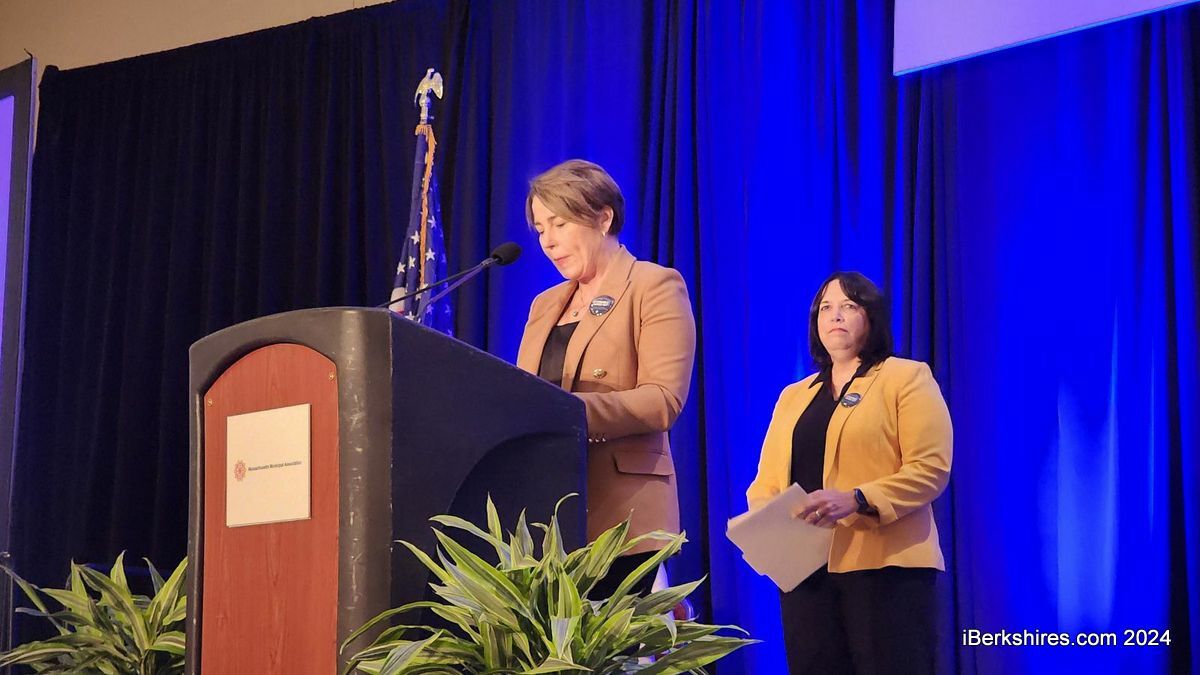
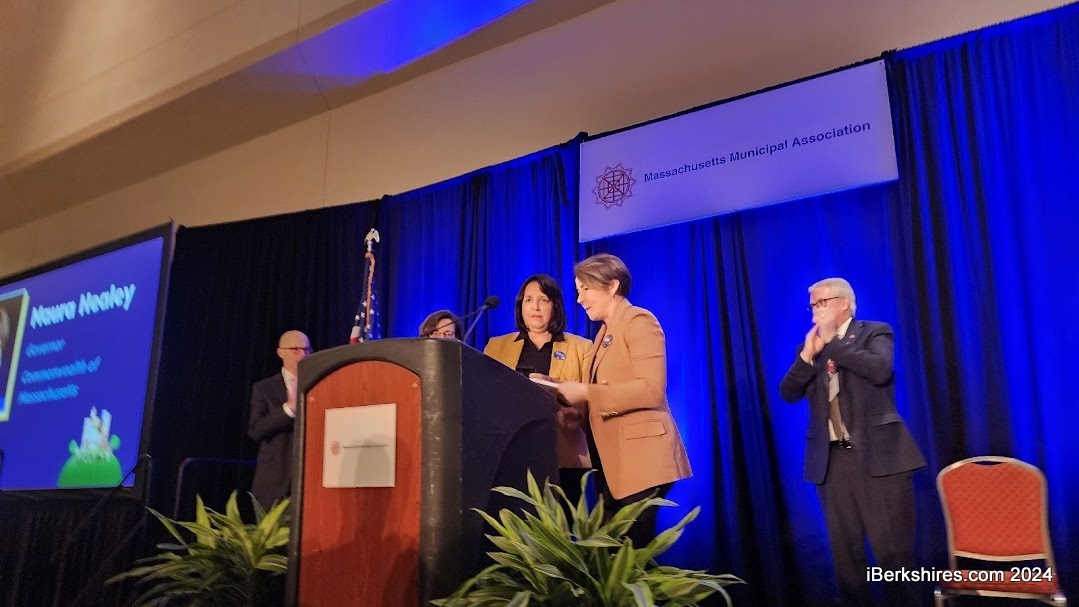
Gov. Maura Healey and Lt. Gov. Kim Driscoll address the annual Mass Municipal Association on Friday morning.
The goals laid out by Healey and Driscoll were met with cheers and applause.
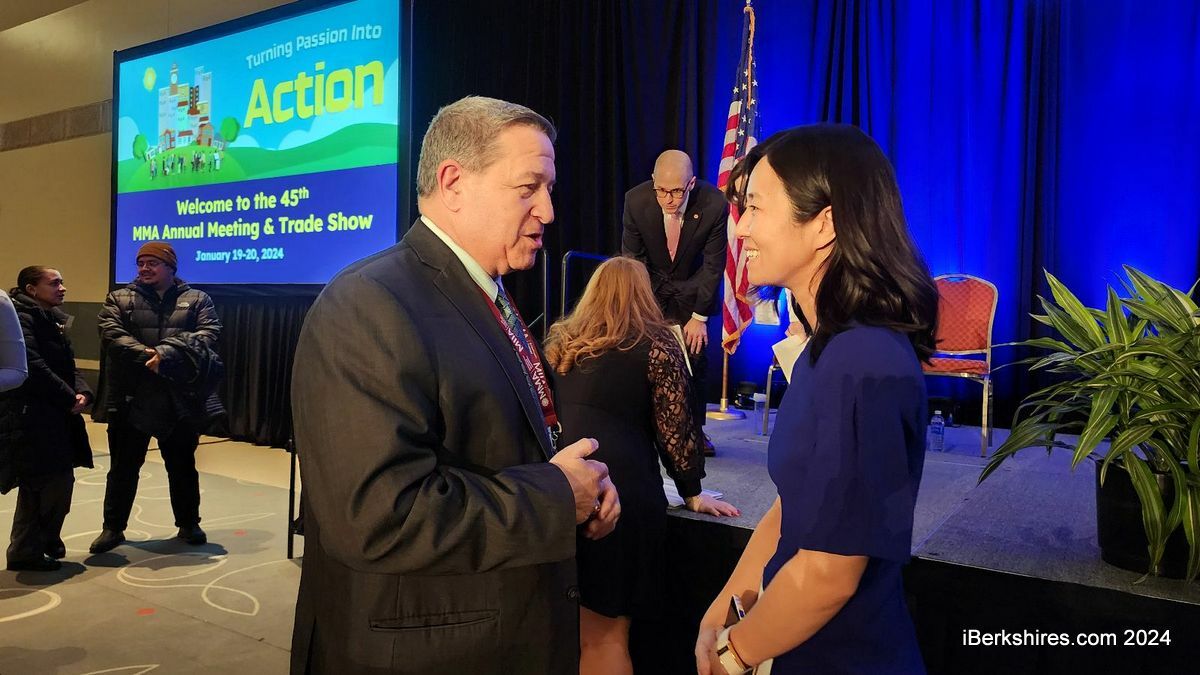
Mayor Michelle Wu speaks with an MMA member before taking the stage to welcome the gathering.
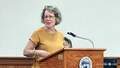
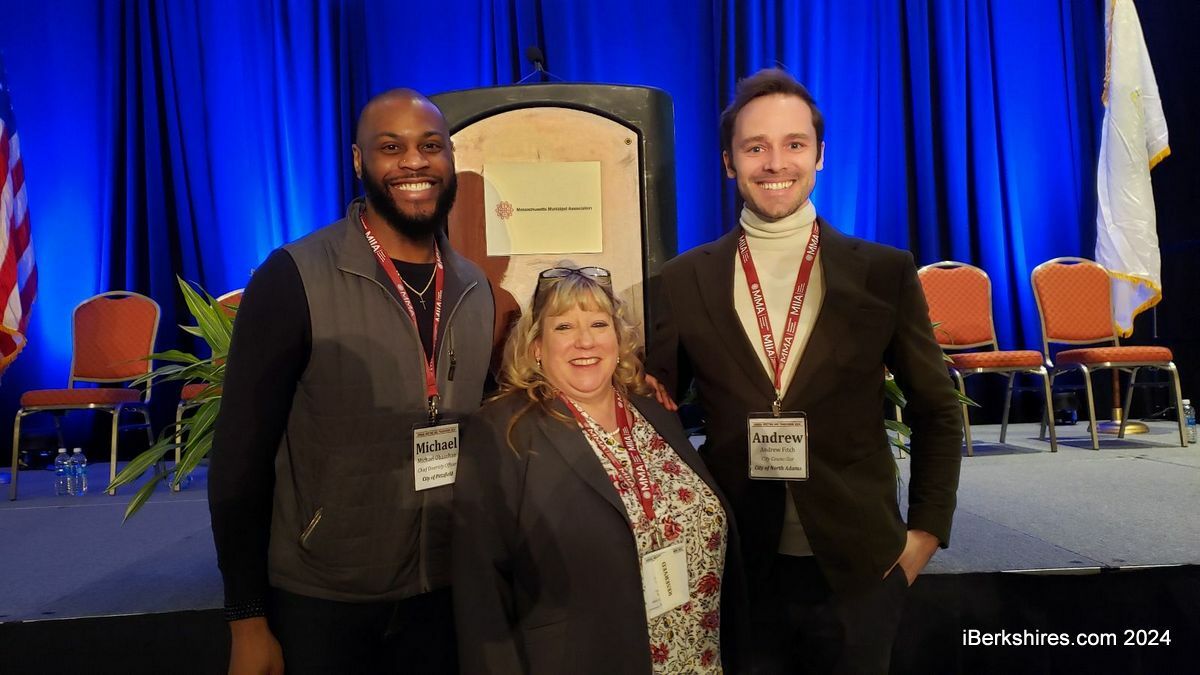
North Adams Councilor Lisa Blackmer, first vice president of the Massachusetts Municipal Councillors Association, with Pittsfield Chief Diversity, Equity and Inclusion Officer Michael Obasohan, left, and new North Adams Councilor Andrew Fitch.
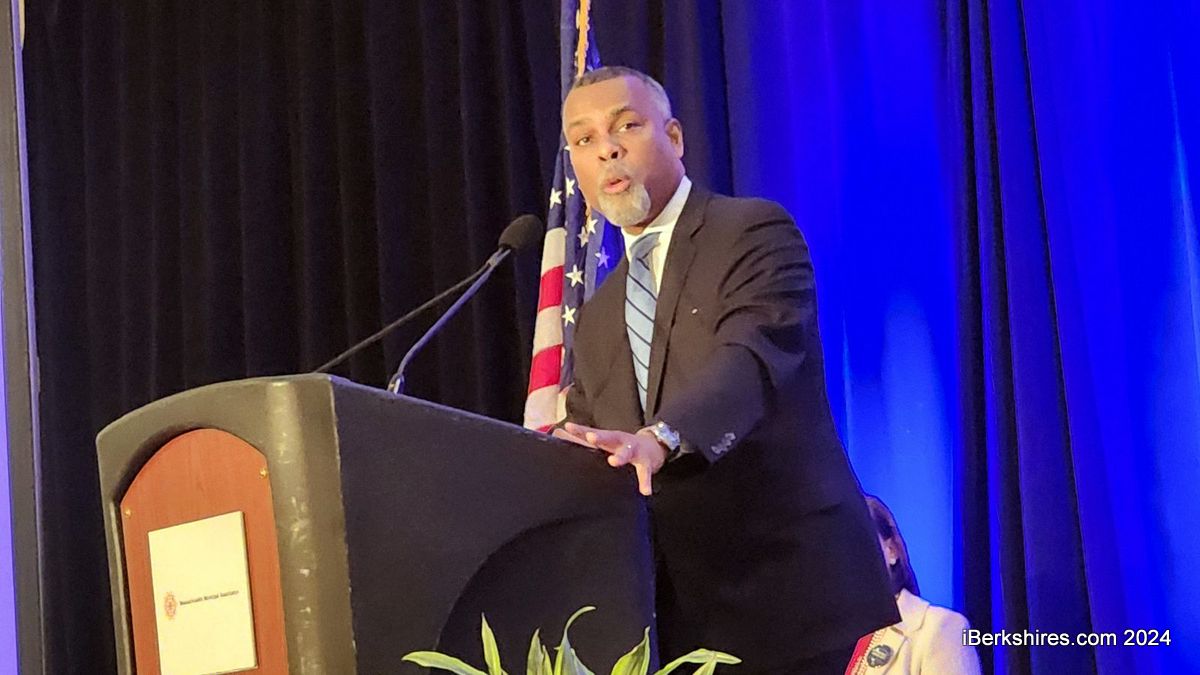
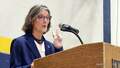
Professor, author and political commentator Eddie Glaude Jr. gives the keynote address on democracy and race.
BOSTON — Municipal officials were presented a bounty of new measures and funding designed to help cities and towns weather the changing economic conditions.
The announcement included raises in unrestricted local aid and Chapter 90 road funds and the filing of a Municipal Empowerment Act to that looks to maintain certain pandemic-era relief, address procurement regulations and raise the caps on local tax options
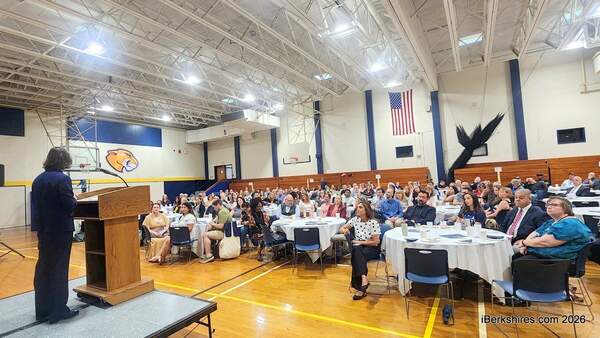
Gov. Maura Healey and Lt. Gov. Kim Driscoll laid out their budgetary and legislative plans to an appreciative audience Friday at the opening of the annual Massachusetts Municipal Association conference.
"We still have revenue growth, but it's not the way it's been," said Healey, with a nod to a falling revenue forecast. "So we recognize that there are real challenges for all of us."
The event at the Hynes Convention Center featured the introduction to the broader membership of MMA's new Executive Director Adam Chapdelaine, a welcome from Boston Mayor Michelle Wu, remarks by outgoing President Jill Hai, a Lexington select board member, and a keynote address on democracy and race by Eddie S. Glaude Jr., a writer, commentator and professor of African American Studies at Princeton University.
The conference includes a trade show, workshops and the annual business meeting on Saturday at which John McLaughlin, a Waltham councilor, will be elected president.
Healey and Driscoll displayed their close-knit working relationship, taking turns at the microphone spelling out their plans. Driscoll joked to laughter that they were a little like Amy Poehler and Tina Fey.
The governor said the budget she will be presenting next week will see an increase of 3 percent in unrestricted local aid — above the 2 percent consensus revenue forecast — including $16 million for rural communities. Funding for Community Compact programs will triple at $6 million and a half-million each will go to two programs for promoting careers in municipal finance.
Chapter 90 funding will come in at $400 million over two years and supplemental funding at $100 million, Driscoll said, "making sure that we're building more resilient, but tackling those things that we know residents really care about."
"Because we know the formula has challenges, we have $24 million in rural road aid," she continued.
If they liked those numbers, the lieutenant governor said, they were going to be "very happy" with the next package.
"We're pleased to announce today that next week along with the FY25 budget and our Chapter 90 proposal, we will be filing significant act reform to strengthen local government known as the Municipal Empowerment Act," she said. "It is designed to provide local government the resources, the tools and the flexibilities we need locally to try and ease this moment. ...
"This is a packet of really great things I'm super excited to be a part of this effort."
The governor said the proposals are a direct result of the many listening sessions held across the state with officials on how some processes and regulations had made it harder to do their work on behalf of citizens.
Among the proposals is a new property tax exemption for seniors with a cost of living adjust; a new look at unfunded liabilities such as other post-employment benefits; integration of regional boards of assessors to address the lack of services in that field; a special valuation of telecom and utility property; easing and streamlining the procurement process in some cases; increasing borrowing on small projects from 30 to 40 years; and addressing "double poles" (when a utility leaves the old pole with the new) which was greeted with whoops and applause.
Revenue generators include increasing the caps for local tax options: up to 7 percent for lodging, 1 percent for meals and 5 percent for motor vehicle excise tax surcharges.
"For the first time that I can ever remember in 20 years, we're going to adjust that motor vehicle excise allocation in a way that's going to deliver real dollars for the needs that you have at the local level," said Driscoll, former mayor of Salem.
Healey pointed to the large of amount of federal funding being made available through measures like the Bipartisan Infrastructure Act.
"When we started, we said we're going put together a team to make sure we are chasing every single last federal dollar and maximizing everything that we can to bring back to the state and municipalities," she said. "It paid off. In one year alone through that effort We brought back $3 billion."
Both officials wore buttons promote the Affordable Homes Act that they and Secretary of Housing and Livable Communities Ed Augustus had testified in favor of on Thursday before the Joint Committee on Housing. Housing has become a focus of the administration with Healey describing the high cost of housing as critical deterrent to workforce development and quality of living.
Driscoll reminded the MMA membership that their support was critical to pushing through these measures.
"It doesn't happen unless we advocate for it. We come together to really showcase how meaningful this is, how important it is," she said. "We're going to need your help together with the whole line."
If you would like to contribute information on this article, contact us at info@iberkshires.com.
Your Comments
iBerkshires.com welcomes critical, respectful dialogue. Name-calling, personal attacks, libel, slander or foul language is not allowed. All comments are reviewed before posting and will be deleted or edited as necessary.
No Comments
Why the Massachusetts Art Community Is Worth Continued Investment
By James BirgeGuest Column
How do we quantify the value of art on society and culture? Even eye-popping figures, like the $100 million estimate for the jewels stolen from the Louvre, or the record auction last fall that saw a piece by Gustav Klimt sell for more than $236 million can't fully account for the value of the history, stories, and emotions behind the creations themselves. But beyond that, there is a measurable financial, cultural and social benefit of the arts that is often taken for granted.
Despite the obvious impact, these figures are under threat. A recent survey by MassCreative compiled recent federal cuts to the National Endowment for the Arts, the National Endowment for the Humanities and the Institute of Museum and Library Services and identified 63 grants canceled and $4.2 million in grant funding rescinded across New England so far this year.
The dollars, of course, are important. But they also only scratch the surface on what they bring to the community. Today, we risk losing part of the culture and identity many now take for granted.
While others choose to look past these less tangible, but just as vital benefits, we're doing the opposite. Massachusetts College of Liberal Arts is all in to ensure the next generation retains their access to works of art, while also being empowered to create themselves.
Last fall, MCLA officially broke ground on the new Campagna Kleefeld Center for Creativity in the Arts, which will serve as a new hub for the campus and the local community for arts programming. When complete in fall of 2027, our students will benefit, but so will all of Berkshire County and artists in the surrounding area.
This exciting new facility is just one of the many forthcomings our region can enjoy in the coming years. Just a few miles away, anticipation builds for the Fall 2027 anticipated opening for the Williams College Museum of Art. Years in the making, the museum likewise grows from an enduring commitment to the arts, both in curriculum and in practice. Exciting times are also underway for the Clark Art Institute with the construction of a new facility to house a collection of 331 works of art, including paintings, sculptures, drawings and other works. Their wing is scheduled for completion in 2028. And listeners will no doubt enjoy the sounds and melodies from Mass MoCA Records, the latest endeavor to foster creativity and artistic pursuits through music launched in October as well. Of course, many are also awaiting the reopening of the Berkshire Museum anticipated this summer, after a tremendous renovation process to rejuvenate the experience for visitors.
So much time, energy, and yes, dollars, have already been invested in taking these facilities from ideas and sketches and making them reality. But they represent much more than new buildings. They represent new opportunities to cultivate and accelerate the thriving arts community in Massachusetts and the northern Berkshires.
Art, regardless of the medium, is a reflection of who we are, where we've been, and what we aspire to be. It can be inspired by hopes or fears and chronicle collective triumphs as well as tribulations. The goal of art is not only to document history, but to inspire those positioned to change it and to feel something new or even to provoke us to revisit our own assumptions or misconceptions.
As unfathomable of a number as $30 billion can seem, boiling down the impact to any number inherently discounts the unknowable downstream effects our graduates will bring to the community and the broader world after they leave our institutions. Likewise, rescinding $4.2 million now removes a huge chunk of that growth potential.
Justification for making these investments today when simply boiled down to dollars and cents still places us on solid ground strictly from a financial perspective that forgoes all of the intangible, but no less valuable, benefits as well.
The arts are still worth our support. And our community will be richer for it.
James Birge, PhD, is president of Massachusetts College of Liberal Arts in North Adams.
Our Friday Front Porch is a weekly feature spotlighting attractive homes for sale in Berkshire County. This week, we are showcasing 74 Washington Ave.
click for more
On Monday, developer Benjamin Crespi of 196 Marine LLC, was back before the Planning Board with a dramatically different proposal: 49 two-bedroom tourists cabins with a restaurant and recreational amenities.
click for more
The City Council on Tuesday approved an appropriation of $256,635 from the Land Sales Account for easements and takings related to the Ashland Street project. click for more