Clarksburg Officials Keep PreK Program Free
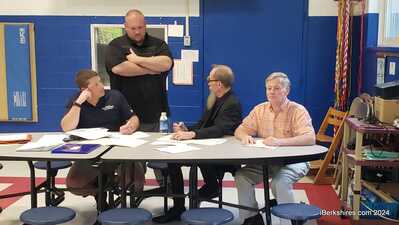 |
| The Select Board at the joint meeting with the School Committee agrees to use free cash to offset the school budget. |
CLARKSBURG, Mass. — Town and school officials came together on Monday in hopes of compromising over a tight budget.
Instead, they ended up agreeing to dip into their reserves to ensure that prekindergarten program will continue free for town residents.
The Select Board had been pushing for the school budget to come in at a 2 percent increase. The School Committee on Monday was prepared to vote a budget up by $128,454, or 4.53 percent.
After an hour and a half of discussion, the school budget had gone up $1,000 to $2,967,609.58 and town officials agreed to commit $72,000 in free cash they'd wanted to set aside for the school roof.
"Your budget's gone up today not down," said Town Administrator Carl McKinney. "That's not the goal here."
"I know that," responded Superintendent John Franzoni. "But we did what you wanted us to do."
School officials had proposed to charge $300 a month for the prekindergarten program for 4-year-olds that was expected to bring in at least $30,000 a year.
That program has been free for residents but residents and non-residents had been charged for 3-year-olds.
"We are doing what we've been asked to do," said Franzoni. "Increase the revenues while trying to get expenses as steady as possible."
He pointed out that the school has been bringing in revenue in the form of Chapter 70 education aid, which will increase by $255,552 for fiscal 2025 while the town's net spending will decrease by nearly $150,000.
The jump in Chapter 70 is from a jump of 20 students to an enrollment of 216 largely from families moving into town over the past year. The School Committee reduced the number of school-choice slots in response.
The budget estimated a total of $56,500 from the preK programs.
But Jamie Boucher, a staff member, said charging parents now for 4-year-olds could be difficult.
"This is hard for me as a school employee and as a parent," she said. "We voted in 2021 to have the preschool program and there was not going to be a charge and I feel like that could be a problem."
Other schools have a nominal fee she said and Franzoni said no other school in the Northern Berkshire School Union charges for prekindergarten.
Committee member Mary Giron said the "town's situation put us in this situation. ...
"We're getting grants and cutting corners as much as we can without sacrificing the integrity of what we do here."
"This is not easy for any of us," said Chair Laura Wood.
Giron asked if the cost could be cut and the committee decided to add another $15,000 to the $250,000 in school choice funds they'd already committed to cover half the program.
Business Administrator Lisa Blackmer said the school choice account was very low and she couldn't confirm if there was $30,000 to fully cover the preK.
Boucher turned to the town officials and asked if that side could put anything toward the program.
"The problem is obviously there's not enough money. We all wish that we had the money to do it," said Select Board Chair Robert Norcross. "We were just doing numbers and it looks like we've got to cut $53,000 out of the town side if you can't cut any more here."
The town's hoping to add a fourth laborer to the Highway Department, increase the accountant's hours and ensure employees get compensated, he said, adding the town was "falling apart" because of the many infrastructure. The school budget as it stood meant a $53,000 cut on the town side.
McKinney said the town was limited by minimal growth, nominal increases in state aid and the restrictions of Proposition 2 1/2.
"You have challenges, too. I clearly understand that," he said. "But at the same time, we're not frivolous with we're good stewards of the taxpayer's dollars."
Newly elected Select Board member Andrew Colton saying he strongly supported keeping it free.
"We talked about how important it was last year to keep it free because the town had voted for it," said Select Board member Daniel Haskins.
McKinney said there was $18,000 in free cash that could be put toward the program. Franzoni questioned the $167,000 in free cash being put away as a match for state money for the roof.
"I appreciate all the hard work you're doing in trying to get money for the roof," he said, but "the direct quote that I got from MSBA is that they are not going to approve us for accelerated repair in this building because we were approved whatever seven-eight years ago for a full renovation."
The Massachusetts School Building Authority had scotched a $500,000 earmark for the roof because the school is not up to educational building standards.
Norcross said he had been assured by members of the current administration that the money could be secured for the estimated $500,000 roof repair.
"I was told directly that they would approve the two-thirds of it," he said. "Then they also told us that they were going to try to find money for us to help with the match."
He strongly recommended the money be put aside but with potential for a roof still years away, the board turned to using some $72,000 to underwrite the school budget and preschool program.
The School Committee cut the high school tuition line by $14,000, a buffer number in case a student decided to go to Drury.
Tags: clarksburg_budget, fiscal 2024,