Williamstown Board Opts for Signage Over Pub Closure
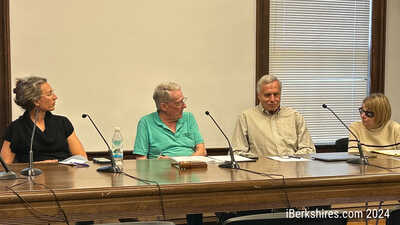 |
| Board of Health members Devan Bartels, left, Erwin Stuebner, James Parkinson and Sandra Goodbody, Ronald Stant via Zoom, declined to close the '06 House over water issues. |
WILLIAMSTOWN, Mass. — The Board of Health on Monday voted unanimously not to revoke the license of a South Williamstown restaurant that has been operating under a boil water order from the state Department of Environmental Protection since December.
Instead the board ordered the '6 House Pub to use more prominent signage to notify patrons of the order, called for more frequent inspections by the town's health inspector and warned the restaurant that even one instance of E. coli contamination tied to the establishment will be grounds for revocation.
Michael Oring, the owner of the '6 House and 1896 House Inn on Cold Spring Road (Route 7) appeared before the board along with his attorney, Thane Preite, and members of the '6 House staff to explain how the restaurant has operated under the boil water order and how it plans to address replacement of a well that serves the restaurant in the short and long term.
The '6 House is one of a handful of Williamstown eating establishments that operate outside the town's water district.
On Dec. 20, 2023, DEP issued a boil-water order for the restaurant, Health Inspector Ruth Russell told the board. Since that time, the restaurant has been serving bottled water and soda, bringing in bags of ice and boiling all water used in food preparation. It also has turned off the water in the sinks in its public restrooms.
Great Barrington Health Agent Rebecca Jurczyk, who has been mentoring Russell since she was hired by Williamstown, said corrective measures like bottled water, etc., generally are temporary. And Jurczyk advised the board that it should pull the restaurant's license rather than allow it to continue with those measures.
"I don't like to close businesses," Jurczyk said. "That's not what we do in Great Barrington. We don't willy-nilly close businesses. I can count on one hand the number of times I've closed a restaurant, and it's always because of a water issue. Most of the time, it's very temporary.
"This is a vastly different situation.
"The 1896 House, I give them the most credit for being very diligent in complying with the boil water order. But I believe there is too much of a risk for error in this situation. Boil water orders are not meant to be six months or a year."
Preite explained that the permanent solution to the problem is to drill a new well on the other side of Route 7, in an area near the well that already serves a different restaurant.
In the near term, the Oring family and its water contractor have a plan to run a pipe from the nearby inn, which is served by a functioning well, to the restaurant to the north. The issue is that the short-term remedy involves running a conduit under a brook on the property, and that, like a new well, needs approval from the DEP.
"As I think Rebecca [Jurczyk] mentioned and Thane [Preite] mentioned, DEP operates on its own scheduled," Oring told the board. "I made it clear to the operator that I'd like to see this done yesterday. I've asked our water system operator to be as squeaky a wheel as he possibly can be.
"Once approved by DEP, there's not a whole lot to it. It's a pretty simple plan to run a pipe from the hotel to the restaurant. The work that needs to be done is pretty straightforward and happens quickly. It's just a matter of getting the go-ahead from DEP."
Oring also told the board that he looked into replacing the well that serves the area years ago, but the DEP rejected several sites suggested by the water system operator for "environmental reasons." Instead, Oring looked into installing a 4-log water treatment tank for the restaurant.
And, he noted, that in the December DEP boil water order, the state agency did not specify a need for a new well but instead said the 4-log system already in progress would be sufficient.
"Halfway through the process of a 4-log water system, our water operator came to me and said they'd had some informal conversations with DEP," Oring said. "Based on some people in management retiring, they seemed to have some new attitudes toward a well.
"I asked what's better, 4-log or a new well? Everyone agreed a new well was the best option for a variety of reasons. And DEP agreed that's a better option."
That was the outcome of a conference call Oring had with people from the agency at the end of February. And even though the well would cost "four or five times" the cost of a 4-log system, Oring chose to go with the new well, he said.
Now, the restaurateur is in limbo, waiting for DEP signoff both on the temporary solution (a pipe from the inn) and the permanent fix (a new well).
"They've been breaking their backs for the time being to protect the public," Preite said of his clients. "They're not using water from the tap. They're using water they bring in. There is safe water there."
Board Chair Win Stuebner verified that there have been no cases of E.coli contamination associated with the '6 House, a factor that appeared to weigh into the board's ultimate decision.
Jurczyk argued that there are no guarantees that track record will continue.
"We, as the enforcement authority, cannot be there 24/7 to make sure no slips happen," Jurczyk said. "Staff come in and are just being trained, don't know the rules or there's a busy part of the evening — accidents can happen.
"We are going into the busy season for Williamstown and Great Barrington. Lots of people are coming through, staying at lodging establishments, wanting to go out to eat. There's greater risk."
Board of Health member Devan Bartels noted that no restaurateur wants to make its patrons sick and that, in fact, the businesses' interests align with the board's.
"Someone could get E.coli from any restaurant if an employee doesn't wash their hands properly," Bartels said. "We have a known potable water issue here. I think informing patrons is very appropriate."
That was an emphasis in the order that ultimately came out.
The board decided that, although not directly required by the DEP order on the record, the town will require prominent signage on the door, inside the '6 House and, perhaps, on menus.
During the more than hourlong public hearing that preceded the board's deliberations, Preite indicated that his client would be amenable to increased signage.
Stuebner, who at one point mentioned that he had eaten at the restaurant a few weeks before Monday's meeting and had no problems, said the signage should explain the corrective actions the restaurant is taking, such as using bottled water for consumption.
At one point during the hearing, Preite suggested that regulating authorities like the board should balance preserving a business with public health concerns with the latter "obviously primary."
Jurczyk took exception with that analysis.
"I think you're solely tasked with protecting the public's health," she said. "Other boards are tasked with balancing those issues."
But after a motion to revoke the license failed on a 0-5 vote, Jurczyk accepted the board's will.
"I appreciate and respect your decision," Jurczyk said. "I fully appreciate how hard this is."
Tags: BOH, drinking water,