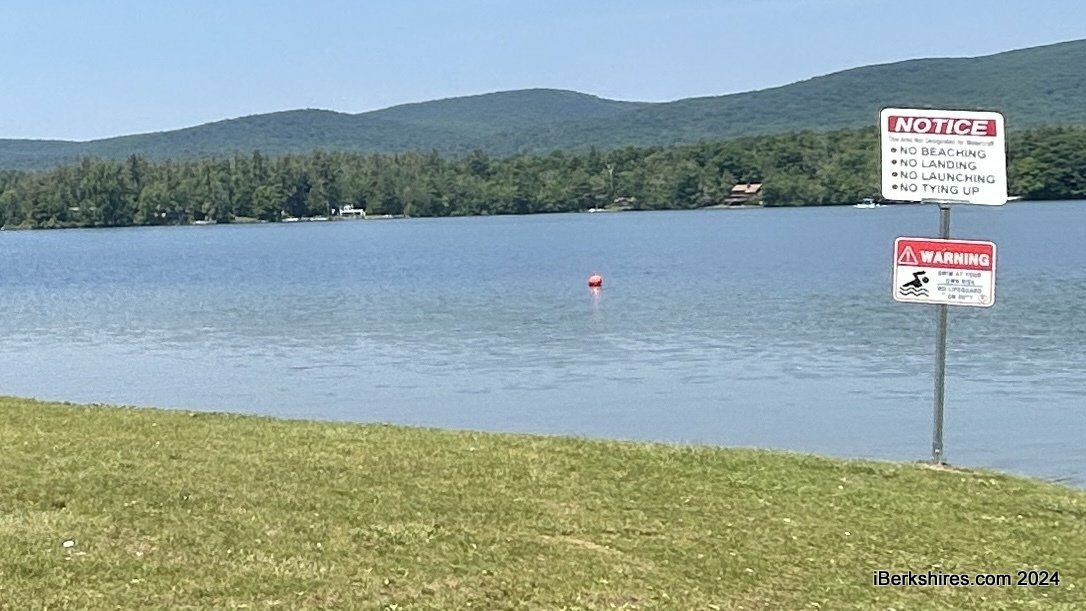
Pittsfield Looking to Increase Safety at Public Beaches
PITTSFIELD, Mass. — The city wants to create a plan that will yield the safest public waterfronts possible.
The Parks Commission on Tuesday discussed a request from resident Daniel Miraglia to require life jackets or floatation devices on all swimmers at city-owned public beaches. His petition was referred to the panel at last week's City Council meeting.
While personal floatation devices cannot be required by law for the general public, the intent is to present a proposal that creates the safest waterfront possible for public beaches that don't always have lifeguards on duty.
"We don't want to create a false sense of security," Park, Open Space, and National Resource Program Manager James McGrath cautioned.
In June, the Berkshire District Attorney's Office kicked off a "summer of water safety" initiative and the city announced that weekend lifeguards would return to Burbank Park on Onota Lake.
Two years ago, an 8-year-old girl was found unresponsive at the public beach and later passed away. In July, a Herberg Middle School student drowned at Benedict Pond in Great Barrington.
McGrath and Recreation and Special Events Coordinator Maddy Brown looked into existing state regulations. McGrath said Miraglia's concern seems to be swimmer safety and "that has been paramount to us as well."
They cited Christian's Law, which sets minimum requirements for personal flotation devices for minor children at municipal and recreational programs and camps.
"It does not apply to the beach at Burbank Park because the city is neither offering a camp nor a program," Brown explained.
"In regards to the drop-in camp that we did take out there for the playground program, we did a lot of the things that the Christian's Law promoted, the buddy checks and having personal flotation devices available to kids that maybe were struggling a little bit, we had lifeguards on duty, there were a lot of safety measures in place for that but as far as generally requiring everyone to wear a PFD wouldn't be something that is required at the beach at all times."
McGrath explained that when the city is directly responsible for swimmers at Burbank Park under a program, it consulted the YMCA aquatics division for its protocols and is implementing a "very strong and rigorous" way to make sure that water safety is promoted.
With kids outside of the park program, he acknowledged that there is a certain amount of parental oversight that needs to play into this.
"We rely on all kids at the beach to have a guardian or a parent, whether or not there are lifeguards there or not. At present, we don't have personal flotation devices available for children to borrow but this is something we are thinking of implementing," he said.
"Certainly when the lifeguards are on duty, we could make available a certain amount of PFDs in various sizes for kids and we could make a sign acknowledging that, like, hey, if you feel more comfortable having them swim with a personal flotation device, ask a lifeguard. We also are considering if we don't have lifeguards on duty and there's still a need for someone to use a PFD, maybe we can make a certain amount of them available in a small kiosk and we would hope that they would be borrowed and returned in good working order."
Commissioner Simon Muil pointed out that it could be a double-edged sword, because if a parent is not paying enough attention to their child in the water, they may pay even less attention if they are wearing a life vest.
"Part of that proposal should be something that we can enforce," he said.
Swim tests on children were also discussed as a possible component.
"We're not trying to reinvent the wheel and some of our best proposals are those that have been modeled on other communities so that will be part of what we'll look at," McGrath said.
"But again, I think we're taking this seriously and this is not something that we would simply say 'We got to file this.' No, this is this important, what the petitioner raised. We want to respect it but at the same time understand that there may be some limitations. I don't think the petitioners complete ask that all children wear PFDs is the right way to go but there's somewhere in the middle, there's something we can get to and promote utmost of safety."
Tags: parks commission, public parks, swimming,