Passenger Rail Advocates Rally for Northern Tier Proposal

Stan Vasileiadis, a Williams College student, says passenger rail is a matter of equity for students and residents.
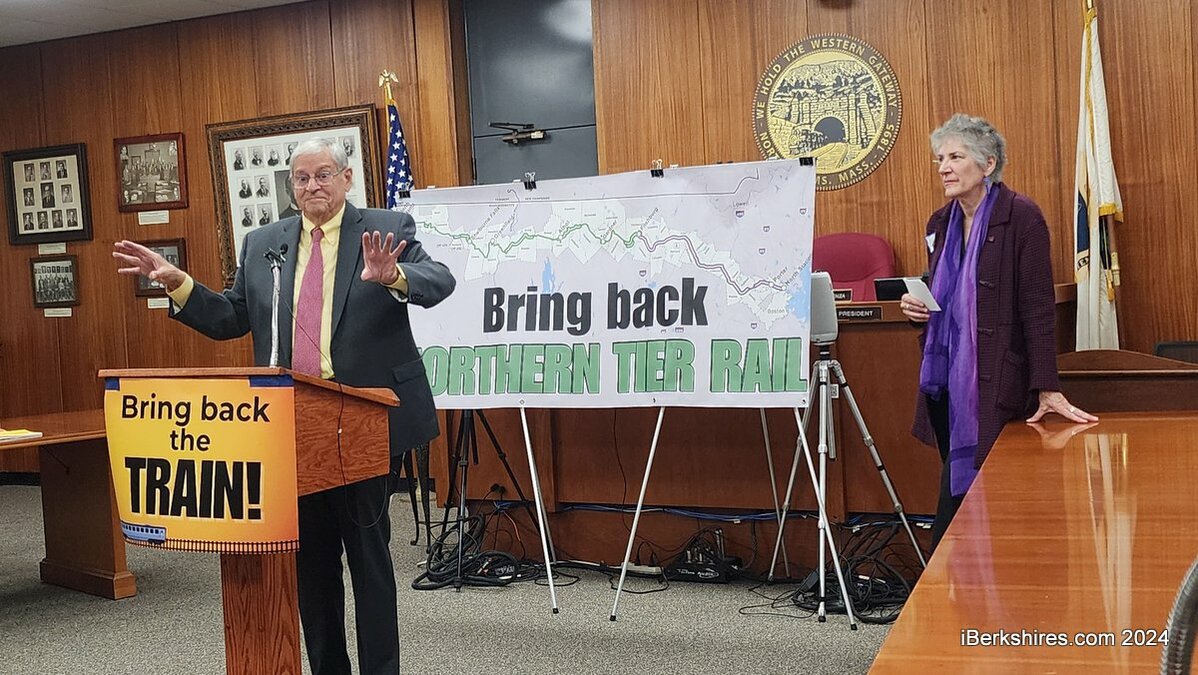
"What today is all about is building support and movement momentum for this project and getting it done," said state Rep. John Barrett III on Monday, standing behind a podium with a "Bring back the Train!" at City Hall. "I think that we can be able to do it, and when we can come together as political entities, whether it's over in Greenfield, Franklin County, and putting it all together and put all our egos in the back room, I think all of us are going to be able to benefit from this when it gets done."
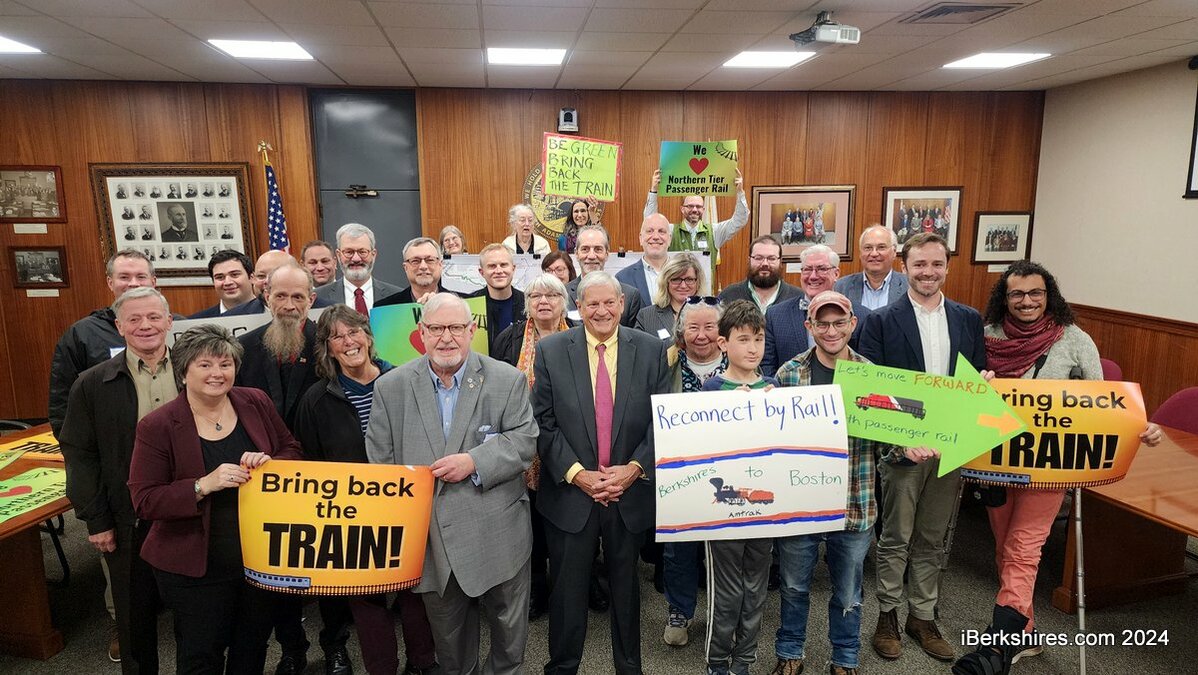
The North Adams rail rally, and a second one at noon at the Olver Transit Center in Greenfield, were meant to build momentum for the proposal for "full local service" and coincided with the release of a letter for support signed by 100 organizations, municipalities and elected officials from across the region.
The list of supporters includes banks, cultural venues, medical centers and hospitals, museums and chambers of commerce, higher education institutions and economic development agencies.
1Berkshire President and CEO Jonathan Butler said the county's economic development organization has been "very, very outspoken" and involved in the rail conversation, seeing transportation as a critical infrastructure that has both caused and can solve challenges involving housing and labor and declining population.
"The state likes to use the term generational, which is a way of saying it's going to take a long time for this project," said Butler. "I think it's the same type of verbiage, but I don't think we should look at it that way. You know, maybe it will take a long time, but we have to act what we want it next year, if we want it five years from now. We have to be adamant. We have to stay with it. And a room like this demonstrates that type of political will, which is a huge part of this."
The Berkshires is due for a "transformational investment" in infrastructure, he said, noting one has not occurred in his lifetime.
"So we should be impatient. We should support this project. We should continue to show up when the rep tells us to," Butler said.
The study of west-east passenger rail, including from Pittsfield east, was made possible by an act of the Legislature in 2022 and some $16 billion was being targeted for the Northeast rail corridor by the Biden administration. The state has $135 million committed to so-called Compass Rail that hinges on Pittsfield to Springfield east to Boston and Springfield south to New Haven, Conn.
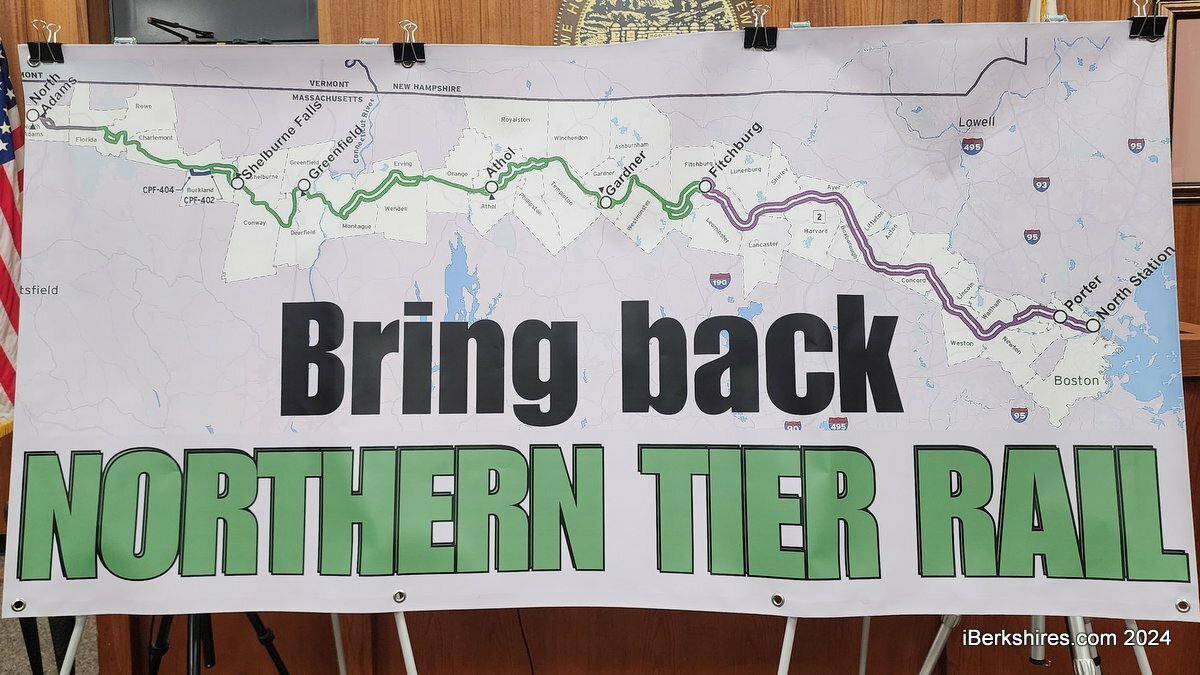
The Northern Tier proposal would run passenger trains through the historic Hoosac Tunnel for the first time since 1958 along existing tracks with stops in Shelburne Falls, Greenfield, Athol, Gardner and Fitchburg, then straight into Boston in less than 3 hours. A draft plan was opened for public comment earlier this year and a final proposal is expected to be released in the coming weeks.
Barrett said there were elements of the draft plan he didn't like, including that the cost might not justify the effort. The six alternatives plans for the Northern Tier ranged from $1.6 billion to $3 billion; the representative pointed out that the state sales tax was sending $1.4 billion to the Massachusetts Bay Transit Authority every year.
"We want the same amount of money up here. We only want it once, and if we get close to that, we'll be enough to move this railroad started within a year or two. That's how quick it can happen," he said. "But we have to have equity, and the only way we're going to have equity with your voices."
The northern rail line could be set up within a short period of time — even if the rail improvements take an estimated dozen years. (This will also depend on negotiations with CSX and the MBTA on track use.)
This was seconded by Ben Heckscher of Trains in the Valley, which has been advocating for passenger rail restoration in Western Mass and the Pioneer Valley since 2016.
The Pioneer Valley Planning Commission did a study in 2009 to extend rail from Springfield to Greenfield and it was up and running six years later, he said, even though the track was in worse shape than the Northern Tier.
"So the possibility to do this is now. We can do this now. We can move this forward, and we just need to find the momentum to come to keep this moving and to get the governor's support," Heckscher said.
Heckscher has been consulting with a group of Williams College students who, under the guidance of Paula Consolini, director of the Center for Learning in Action, has taken on the passenger rail challenge. The students have created a page for the Northern Tier to provide information, updates and ways to advocate for rail. Barrett credited Consolini for spearheading effort and "bugging" everyone.
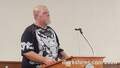
"I grew up in Greece and my whole life, I was used to having public transportation as a guaranteed thing to be able to go to another place," said Stan Vasileiadis, an economics and math student. "Coming to Williams College, I wonder myself, why can I not go to Boston, it's within the state, it's in the same place, I don't have a car. Most students don't have a car. ...
"But more importantly, how can we bring people who have no access to their own transportation to be able to have a doctor's appointment in Boston, to be able to do their jobs in Greenfield in children falls? It's a matter of justice and equity, if you ask me."
The group also pulled in Thomas Green of Williamstown, a retired Citigroup director who had worked on financing for the state Department of Transportation.
"When you hear the phrase 'rail enhancement,' it's hard to imagine a more important project than the Route 2, [North] Tier restoration of passenger rail service in terms of enhancing, not only transportation from North Adams to Boston, the North Station, under three hours, Greenfield under two hours, even as far east as Fitchburg, which already has a T-commuter line, this would, in effect, create five express trains from Fitchburg to Porter square and Cambridge and then to Boston," he said.
"The other thing is, it's very doable. We all know it. We hear the trains at night. This is not a defunct track. This is not a track where you need to take land by eminent domain for right of way. It's running freight trains every day."
Massachusetts College of Liberal Arts President James Birge spoke on rail's importance to the college, noting 60 percent of students come from outside the Berkshires, and Wendy Penner of Williamstown's Cool Committee (CO2 Lowering) of how rail, especially electrified rail, is consistent with the town's climate action plan and would provide better equity for people whose health needs have to be addressed in Boston.
Barrett recalled a great conversation as mayor with former Gov. Michael Dukakis, a train enthusiast, about rail in 1984.
"We realized how important it was for us to have this and lo and behold, here it is, and I'm in a different place than I was 40 years ago," he said. "But the same problem, again, is lack of good transportation, rail service."
Advocates are encouraging residents to contact their state legislator and the governor by letter or email to ask for "full local service" along the Northern Tier and for its inclusion in the Compass model.
Tags: passenger rail,