New Bedford Installing Sculpture of Melville Based on 'Moby-Dick'
PITTSFIELD, Mass. — New Bedford's installing a statue of Herman Melville based on his epic "Moby-Dick," the story of a whaling captain and his nemesis the white whale, inspired by Mount Greylock.
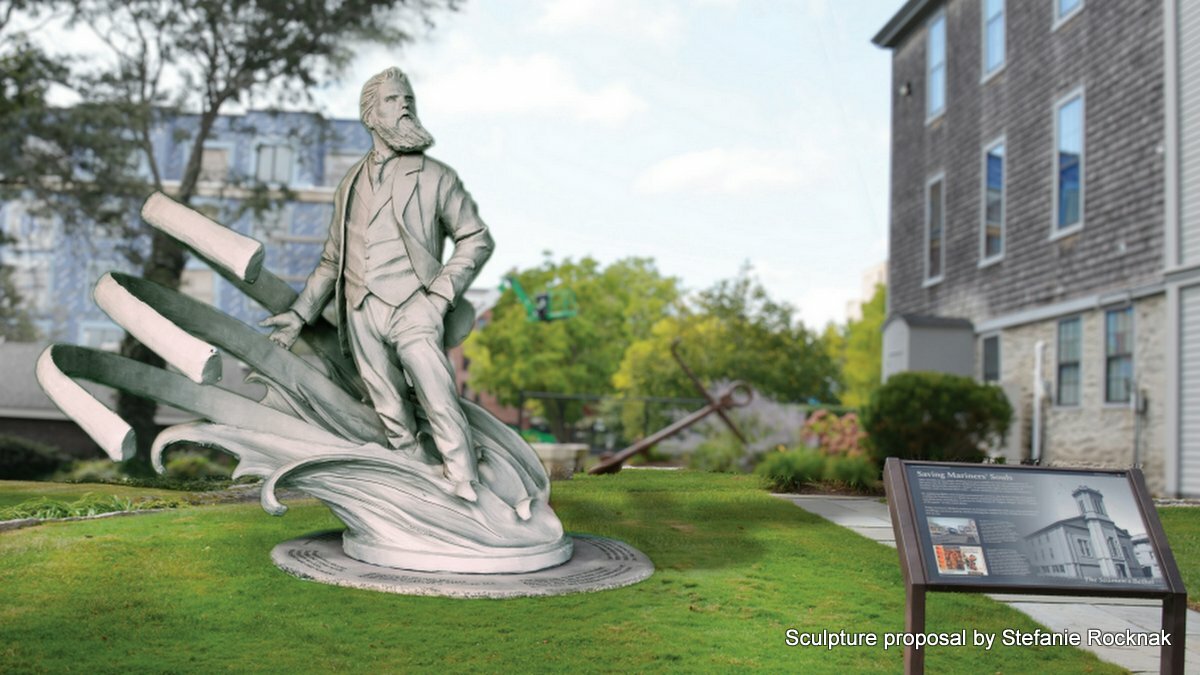
An illustration of the statue titled "Melville and Jonah's Journey" was unveiled on Friday morning at the Seaman's Bethel in New Bedford, where it will be installed on the grounds.
The work by sculptor Stefanie Rocknak shows Melville amidst waves and three whale ribs "representing Melville's own journey into and out of the whale. Yet, Melville rises above them, his mouth open, as though beginning to speak — to tell the story of Moby Dick, this truth," the artist wrote in her proposal.
"Melville, like Jonah, was on a journey of transformation. Just as Jonah was cast back to shore to fulfill his divine purpose, Melville returned from his own voyages to write 'Moby-Dick' — a novel that immortalized not only his personal journey but also New Bedford's whaling heritage."
The elements of the statue come from the sermon in Chapter 9 about Jonah and the whale, and the hymn that begins "The ribs and terrors in the whale, arched over me a dismal gloom, while all God’s sun-lit waves rolled by, and lift me deepening down to doom."
"Moby-Dick" was the story of Melville's experiences in whaling but was written in Pittsfield during the 13 years he and his family lived on Holmes Road. He could see Mount Greylock, the state's tallest summit, from his window and it was said to have inspired his concept of Moby Dick the whale. The house that he dubbed "Arrowhead" is now the headquarters of the Berkshire County Historical Society.
A New Bedford committee comprised of artists and city planners selected Rocknak's proposal out of 41 submitted by American and international artists. Mayor Jon Mitchell unveiled the design and introduced Rocknak on Friday at Seamen's Bethel, which is the inspiration for Melville's Whaleman's Chapel in the novel.
The call for artists went out a year ago on the same day and the project will be supported with public and private funds, including up to $50,000 from the New Bedford Port Society, which maintains the 1832 Seamen's Bethel and the adjacent 1787 Mariners' Home within the New Bedford Whaling National Historical Park.
Rocknak, also a professor and chair of the philosophy and cognitive science department at Hartwick College in Oneonta, N.Y., is the sculptor of "Poe Returning to Boston," which shows the author striding along Charles Street with a raven emerging from his open suitcase.
Tags: Melville,