Pittsfield Health Board Considering Nicotine Free Generation
PITTSFIELD, Mass. — Thirteen Massachusetts communities have joined the "Nicotine-Free Generation." Could Pittsfield do the same?
This was the question during the Board of Health meeting earlier this month. The board will discuss a possible path forward that includes community input at its next meeting.
"Clearly, I think, as a board, there's a sentiment that this is attractive as a public health service," Dr. Jeffrey Leppo said, followed by agreement from other members.
Maureen Buzby, tobacco inspection coordinator in Melrose, presented information about the Nicotine-Free Generation movement. The policy adopted by the municipalities prohibits the sale of tobacco or e-cigarette products to individuals born on or after Jan. 1, 2000 or 2004.
A bill filed in the Legislature would prohibit tobacco sales of all but FDA-approved nicotine replacement therapy for anyone born in 2006. Those individuals are now 19, two years under the legal age for purchases. If the bill goes through, they will not be able to buy nicotine products in their lifetime.
The bill does not penalize possession, or current adult users, as its goal is to target the tobacco industry.
"We know that tobacco use is still the leading cause of preventable death in the U.S. Every year, almost half a million Americans die prematurely of smoking-related disease, and billions of dollars are spent on smoking-related illness," Buzby said.
"Over the past several decades, local boards of health have led the way in adopting regulations that improve the health of their residents. No one knows that more than you folks."
She pointed out that local boards made a campaign for a smoke-free workplace law two decades ago against extreme pushback until there was a critical mass and it became the law.
In 2023, the board updated Pittsfield's tobacco ordinance to clarify the definition for blunt wraps, raise the minimum price requirement for cigars, and adopt state guidance on fines for violations.
The ordinance had last been amended in 2019 before Gov. Charlie Baker signed an Act Modernizing Tobacco Control, which imposed new restrictions on the sale of nicotine vaping, flavored vaping, and tobacco products.
Buzby said that while local policies, which she is proud to have worked on, moved the needle a bit, people still smoke.
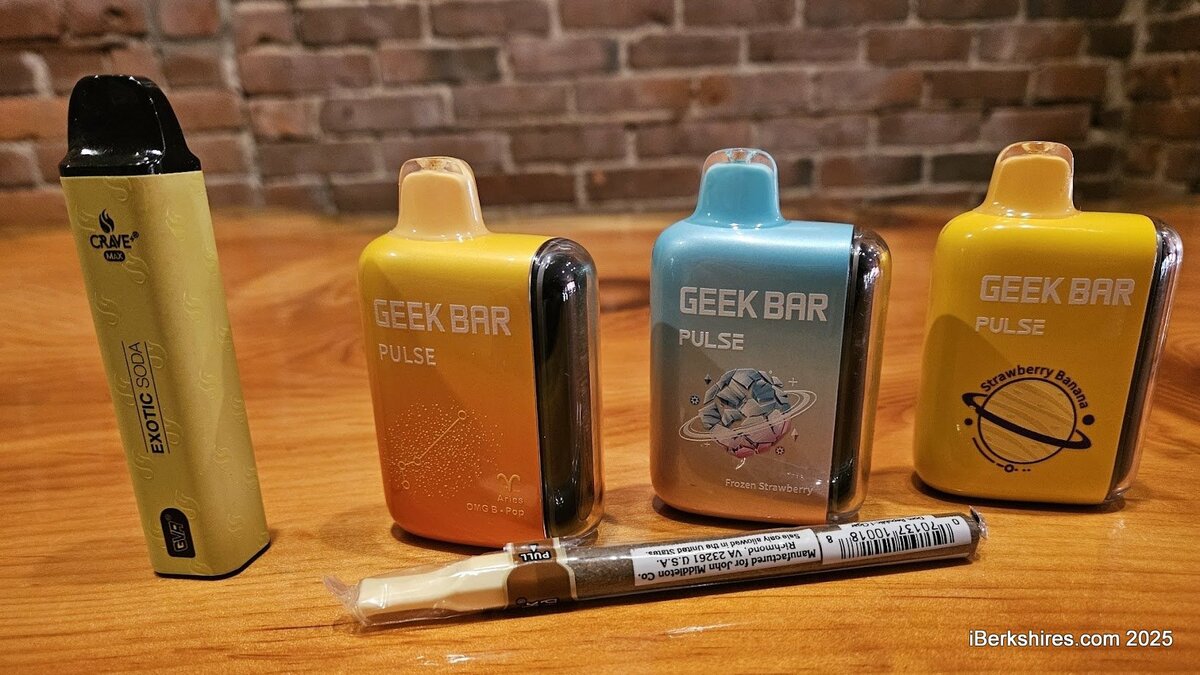
"They're still affected by secondhand smoke, vaping in our schools remains a serious issue, and the tobacco industry continues to develop and market new, appealing, cheap, discrete, and high nicotine content products like nicotine pouches with 14, 15, or 18 milligrams of nicotine in each pouch," she added.
"Compare that to a pack of cigarettes with 24 milligrams in the entire pack, or the vape pen that looks just like a highlighter, or the vape device with an LED screen that tells you how many puffs you have left to trigger you to buy another one or the newest vape with built-in video games — Yes, play Mario Brothers while you vape."
She explained that no one who is already 21 would lose their privilege to buy tobacco products, as this policy only affects those who cannot currently legally purchase the products.
"It's a slow rollout that allows retailers to adjust to slightly lower tobacco sales over an extended period of time, unlike the flavor ban that removed all flavored products from retailer shelves on day one," Buzby said.
Almost two years ago, she started discussing the possibility of introducing this to cities and towns in her collaborative. Communities then held public hearings with as many as 100 attendees.
A lawsuit had been filed against Brookline for its 2020 approval of an NFG bylaw. Last year, the Supreme Judicial Court unanimously decided it was within Brookline's right to pass the bylaw.
Stoneham became the first board of health in the world to adopt NFG, Buzby reported, followed by Wakefield and Melrose.
"The goal, as it was for the smoke-free workplace law, is to get enough cities and towns to adopt NFG that it becomes more likely to be adopted in state law. Those sponsors, one from the Senate and one from the House, are working on language for a statewide bill as we speak tonight," she said.
"This policy starts to move us towards the end of tobacco use and addiction, which has harmed millions and cost billions for decades."
There was some discussion about collaborating with other towns and regional partners partnered with talks of leading Berkshire County by example.
Director of Public Health Andy Cambi said the next step would be for board members to gather education and feedback before the city holds its own hearings.
"My direction is to say that we do this regardless of if other municipalities are on board," he said, adding that cooperation from other county health boards would be great.
During open microphone, local business owner Michael Lipton voiced concern for the ban's effect on overall sales. He owns four retail sites that all sell tobacco products.
"What I want to just stress is that it does affect more than tobacco," he said, explaining that there are additional sales that are a result of people coming in for tobacco products, and if they are only banned in Pittsfield, people will go elsewhere.
"Just to be clear for the record, we're not there yet," Chair Roberta Elliott clarified, as the board is just beginning to look into this.
Tags: tobacco regulations,