HQWD Rescinds Proposed FY26 Budget Over Sludge Disposal Changes
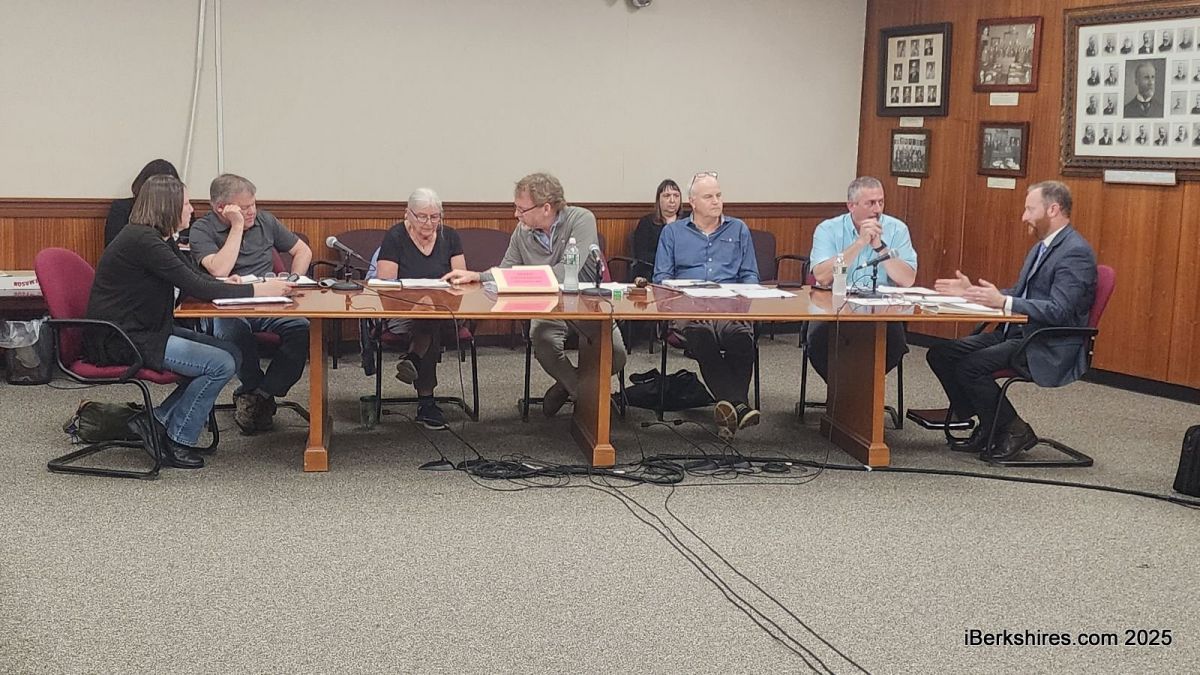
The commissioners also heard from David Irwin Jr., right, on the fiscal 2024 annual audit.
The HWQD's board on Wednesday voted to rescind its approved $1.5 million budget after Casella Waste Management withdrew its option to truck untreated residential sewage from other communities to the Williamstown facility and then distribute the composted product elsewhere.
Secondly, said Bradley O. Furlon, district manager, the state has extended the wastewater district's ability to compost its own sludge by two years.
"With these two changing developments ... I feel that it's not feasible to go with any of the Casella options. It's not feasible with budgeting to go with either of the Synagro options," said Furlon. "Right at this moment, it's most feasible to continue to compost our own sludge, as we've been operating for the past four years at the district."
Processed human solid waste has been found to contain perfluoroalkyl and polyfluoroalkyl substances, or PFAS, which have been linked to cancer. The district's budget had included an option to take possibly contaminated waste from Casella, which would then sell it elsewhere, with an estimated savings of $500,000.
The Williamstown Finance Committee had unanimously endorsed the budget, with the Casella option, but the Select Board voted two weeks ago against recommending it to the annual town meeting. The city of North Adams is the other partner in the wastewater district.
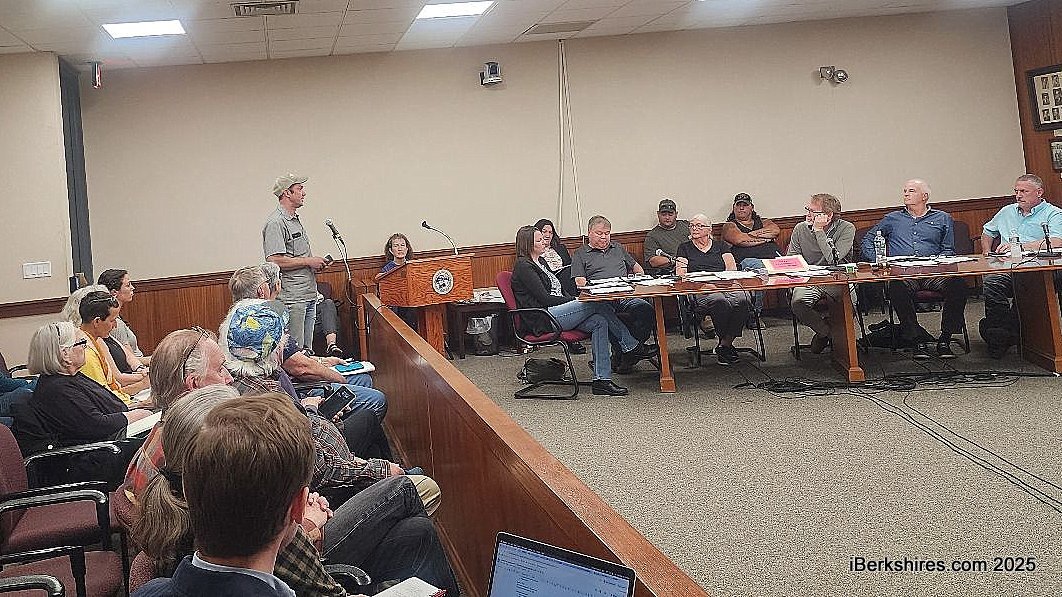
The new developments were a relief to the 30 or so attendees at Wednesday's meeting, held in City Council Chambers because of the expected audience. But they also expected more to be done to prevent the dispersion of PFAS.
"I'm very glad to hear the updates from Casella, I think the most challenging option is off the table. But I do want us to really consider moving to landfill operations as soon as possible," said Stephanie Boyd, one of the Williamstown Select Board members who voted to reject the budget. "I understand that you as the board are representing us, but I think this is also time for us to reflect on what does our community really want? I also think we should think about our community a little broader than just us here."
Brian Cole, on behalf of the Williamstown Agricultural Commission, stated that commission was against land application of biosolid-based compost fertilizer because of concerns around the dangerous PFAs and other contaminated found the material. The commission is in support of landfill disposal.
On his own behalf, Cole said he would like to see the costs of landfill disposal start being built into the sewer rates.
"Because I think options for getting rid of the composted sludge are going to continue to diminish," he said. "I think that PFAs in the sludge that being land-applied is going to prove to be more and more problematic as we learn more and more about the problem."
Furlon agreed, saying companies are anticipating disposal prices for sludge to rocket 500 percent in the coming years as more state begin to restrict where it can be used.
"The minimal amount that the district had for a proposal at this time was $540,000 to ship out the sludge to a landfill in Western New York," he said. "To run our composting facility, it cost us about half of that."
The composted sludge is not sold or recommended as fertilizer, Furlon said, but rather as a soil additive for lawns and horticulture. But he acknowledged the wastewater district has no control what it's used for once someone buys it — or where it ends up when it rains.
"This stuff will be here forever. It will never go away. The only way I see the deal with something like this is, unfortunately, something like landfill and concentrating the stuff so that maybe it can be handled later, or at least limit the dispersion," said Rye Howard, a member of the North Adams Planning Board and a toxicologist who has worked on PFAS.
"The only way I see the deal with something like this is, unfortunately, something like landfill and concentrating the stuff so that maybe it can be handled later, or at least limit the dispersion."
The waste district manager said the problem is that PFAS are in every product people use on a daily basis and there's only three ways to get rid of sludge — landfill, incineration or composting.
"The general public is the problem with PFAs. It's 10s of 1000s of products that this material index is in. There's 42,000 compounds to this chemical," said Furlon. "Once you start to get into the science of it, when you start talking about the long chains and the short chains, how they break down. It gets very complicated. ...
"It's almost impossible for the district or any one of us as a district to inform the general public."
Another member of the audience countered that it's not the public, but the producers that dispersing the contaminants.
"It's the manufacturers that are putting it out. The general public has no control over this except to be aware and to be educated and to seek out and demand of the producers that they get rid of these materials," Susan Abrams of Williamstown said, while acknowledging, "that is a huge education campaign, as some of us have been working on for a while."
Commissioner Timothy Lescarbeau moved to rescind the budget; Chair Hugh Daley said the commission would set a meeting to review an updated budget.
On Thursday, Daley said he expected to meet some time in early June once Furlon had budget scenarios to review. He believed the water rates presented for the Williamstown annual town meeting next week should cover the HWQD budget for fiscal 2026.
"If we continue to compost, it will definitely cover next year's costs. If we don't continue to compost, it will most likely cover next year's operating costs," he responded by email. "There will be a little bit of risk around the how we pay for the removal of the existing compost pile, but we may be able to do that over a couple years."
In other business, David Irwin Jr. of Adelson & Co. presented the annual audit for fiscal 2024.
"We issued a clean opinion, unmodified. So everything was in accordance with the common principles, generally accepted in the United States, no material weaknesses, no significant deficiencies, and it actually accurately represents your financial position," said Irwin.
The district ended the fiscal year on June 30, 2024, with cash at the end of the year, at a minimum of $368,000. It also recently joined the North Adams Retirement System and showed a proportionate liability of $525,000; its percentage in the system is 3.48 percent for its nine employees.
It ended the year with $10.2 million in assets and liabilities of $5.7 million. It met all its debt obligations, paying down $740,000 plus the interest on $4.2 million in debt.
Irwin also noted that District Administrator Kristy Williams had shifted to QuickBooks online and "everything went very smooth with that."
"Kristy does a very good job with the accounting," he said. "So did a very good job. So I think that that's pretty much it. Good, clean opinion."
Tags: composting, contamination, HWQD, PFOA / PFAS,