DA Shugrue Presses for Increased Penalties on 'Upskirting'
PITTSFIELD, Mass.— District Attorney Timothy Shugrue wants proper sentencing for people who record others naked without consent, and to prevent the invasive crime from happening.
It is widely referred to as "upskirting."
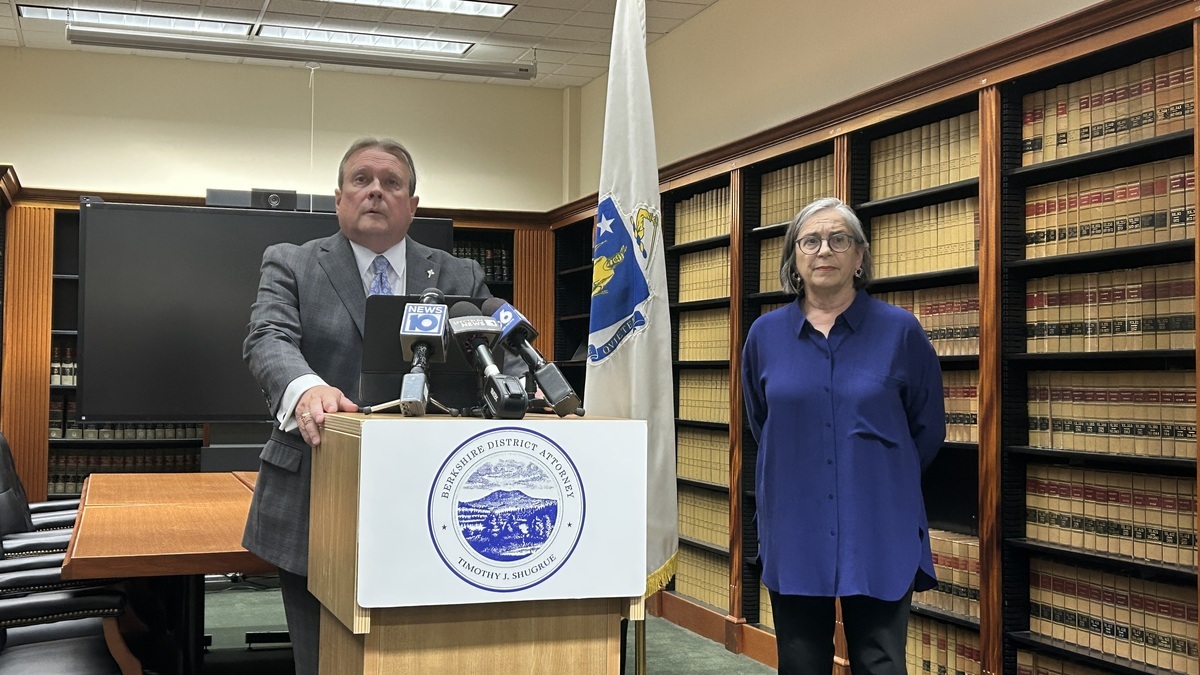
"Let me begin by making one thing clear: This term, while it's still commonly being used, it's outdated. It trivializes this serious, invasive act," Shugrue said during a press conference on Thursday.
"What we're really talking about is non-consensual sexual surveillance, an act legally referred to as electronic recording or surveillance of nude or partially nude persons. The impetus of this press conference today is a recently indicted case involving a young man who implanted a surveillance monitoring device and a gym bathroom."
Yesterday, Maxwell Hall was arraigned for 16 counts of recording unsuspecting people in a Williams College bathroom used for changing on January 16. Shugrue said Hall, a student athlete, planted a small, $23-dollar recording device purchased on Amazon that looked like a USB charging dock in a bathroom used for changing.
Only a portion of the victims have been identified.
The DA said that "Mr. Hall's case, unfortunately, is not unique."
"Recently, Ricci Allessio pled guilty of charges from two separate incidents where he unlawfully recorded individuals in a state of undress. These incidents stemmed from incidents in 2020, and later stemmed from 2023 through April 2024. He unlawfully took almost 800 photographs and over 100 videos of individuals in partial and full nudity. He'll be sentenced in July," Shugrue reported.
"In 2015 and then again in 2021, Sam Wassilie, in the town of Dalton, has twice been found and sentenced for having committed these crimes. Recording not just adults, but juvenile victims as well. In 2015, Wassilie was sentenced to two years and six months in the House of Corrections. For his most recent crimes in 2021, he was sentenced again, but this time, to only a year in the House of Corrections, despite the Commonwealth asking for a more significant penalty. Less time, even though it was his second offense."
He said the despicable nature of these crimes and the fact that it is only a misdemeanor in Massachusetts when the victim is an adult is "abhorrent." He touted the legislation filed by State Rep. Leigh Davis to address this issue, which the Berkshire County DA’s office helped draft.
Davis filed H.1633, An Act updating and clarifying the statute relating to "upskirting," to make it a felony — punishable by up to five years in prison and a $10,000 fine — to secretly record a child or vulnerable person's private parts, whether clothed or unclothed, in any setting.
This aims to address gaps in state law, bring more justice for victims, and deter future offenses.
The DA called for "common-sense" upgrades to state legislation that include: Felony charges for secretly recording any individual —not just children— in states of undress or in sexually exploitative situations, raising the sentence for first offenders to a felony, and adding enhanced sentencing for repeat offenders.
A misdemeanor carries two and a half years in the HOC, and a felony would be a five-year sentence, ten years if the victim is younger than 14.
"If a criminal targets the children, the crime is a felony. However, the minimum sentence still does not match the seriousness of the crime. Today we talk about the Commonwealth’s laws that are not protecting our victims of this crime to the extent that they should be," Shugrue said.
"Right now, if you're 18 or older, the person who violates your privacy in this way may only be faced with a misdemeanor charge. A misdemeanor for using a camera or hidden device to record your most vulnerable moments that you can imagine. In some cases, the sentence might be nothing more than a fine."
To put this into perspective, he explained that a person caught revealing or sharing explicit images of someone else faces felony charges, a much harsher penalty than the person who took the images without consent.
"To me, that doesn't make sense, and it clearly doesn't deliver justice," he added.
"Meanwhile, access to surveillance devices, these tiny cameras, these little devices, microphones, other surveillance tools, are easier and cheaper than ever to get. Technology is advancing quickly. As more perpetrators gain access to this technology, we expect that crime will only continue to grow in nature. Victims of these acts are left traumatized, humiliated, and often without any meaningful protection or recourse."
Jeanne Kempthorne, former chief of appeals and public records officer, has worked on this legislation for over five years after discovering that the peeping tom/upskirting statute was "truly badly drafted."
"It was drafted so that the penalty provisions made no sense, and the elements of the crime were nearly impossible to make sense of. The Supreme Judicial Court urged the legislature to fix the penalty provisions, so I filed a bill in the next session in 2021, filed it again in 2023, and with Representative Davis's endorsement as lead legislator, she filed it at my request, but she endorsed it in this 2025 session. So this is the third time," she reported.
"The new version changes the penalties, and all I did was fix what was truly wrong, and the district attorney and his staff has really updated it so that the penalties reflect modern values, shall we say, about the importance of deterring this crime where the injuries— because electronic surveillance can be so easily and perfectly replicated forever that the victims are over and over at risk of being re victimized, and to live with the fear that who knows when those images are going to surface is a terrible thing."
If the crime becomes a felony, Shugrue imagines that it would be reported on the Sex Offender Registry Board, "because as far as I'm concerned, that should be information the public should know about."
While the office's main charge is to prosecute crime, he said it also needs to see holes in statutes so that legislators can write laws to close them.
Speaking about the Williams College case, he reported that Hall took 58 videos of 16 different people in a state of nudity over a six-hour period. Reportedly, upskirting victims often "don’t forget about it for a long time," struggle to feel comfortable using public restrooms or changing rooms, and are constantly wondering if the footage got out.
"Imagine if we hadn't caught it that day. So to me, the crime itself, the facts, warrant Superior Court consideration. That's why it's indicted. The penalty, unfortunately, doesn't match that. It needs to be changed. It needs to match that," Shugrue said.
"Because, to me, I want to make sure that our values, our morals, are protected for the victims that are there that are just thinking they're in college, going to shower, and you're in a sport and you get yourself in a state of nudity, is filmed without your knowledge, without your consent. That is, to me, requires it to be in the Superior Court and the attention that it needs,"
"And I think that that's another reason why I wanted to address this the day after it, because I'm tired of it. We've had these three cases under my administration that have had to deal with it, and it needs to change. It needs to change now, and I can't just sit back and wait for people to change the statute. Jeanne didn't, and so I had an obligation to do the same thing she did, to pick up that flag and carry it the rest of the way and see if we can get this passed."
Tags: district attorney,