image description
Bud Wobus, in red, leads a program on the granite of the Clark Art Institute.
image description
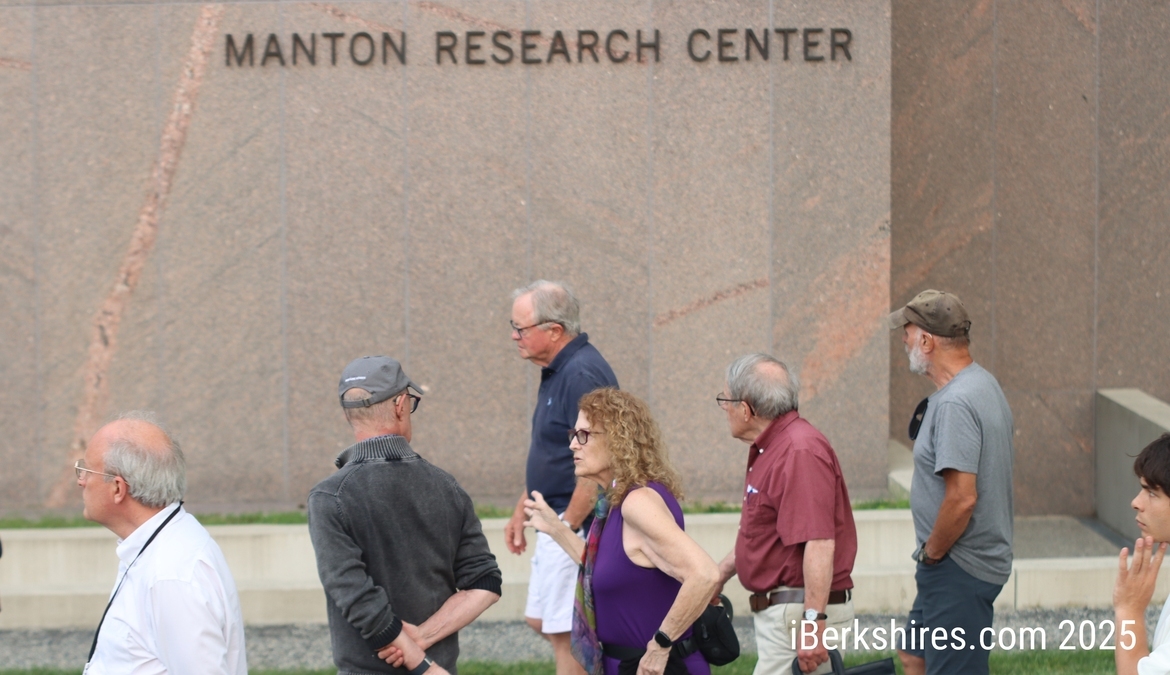
Bud Wobus, right, points out a feature of the granite on the Manton Research Center building at the Clark Art Institute.
image description
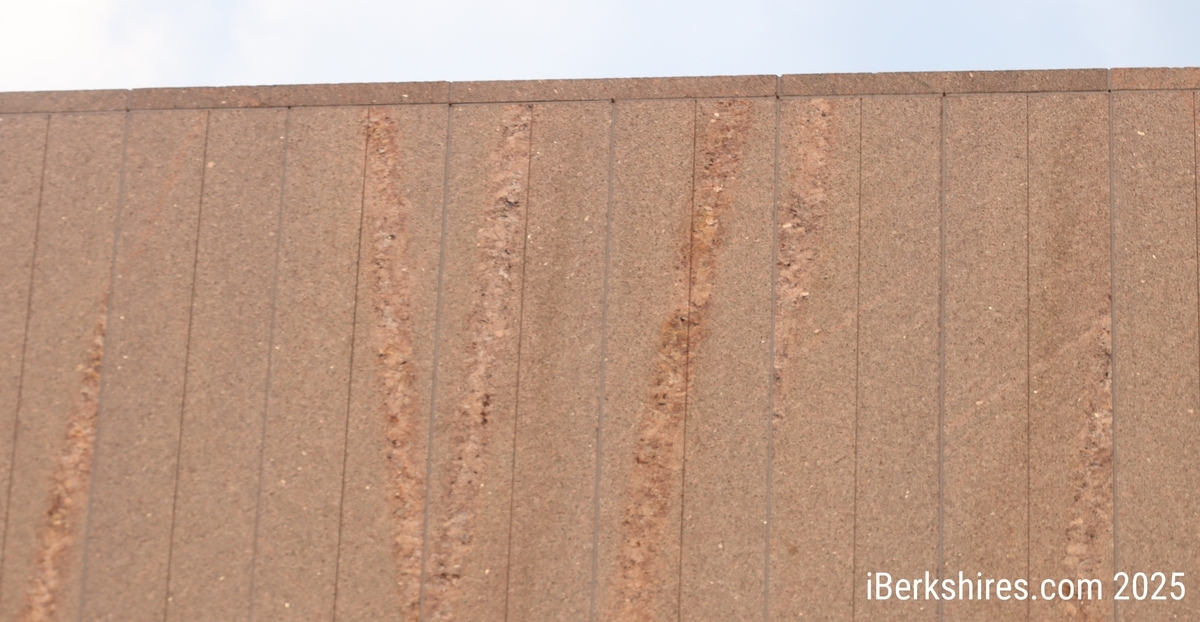
Retired Williams College professor Bud Wobus joked that the west-facing wall of the Manton Research Center is 'pegmatite city' for the prominent streaks in the red granite.
image description
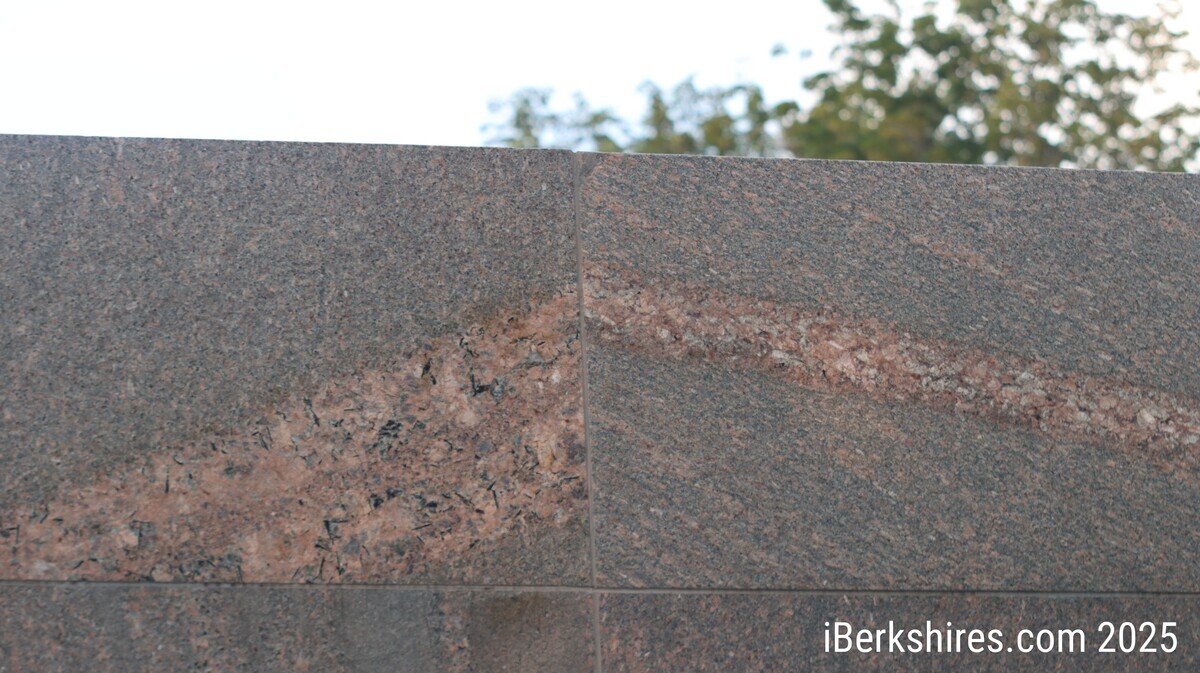
Pegmatites run through the granite of the wall outside the Clark Center.
image description
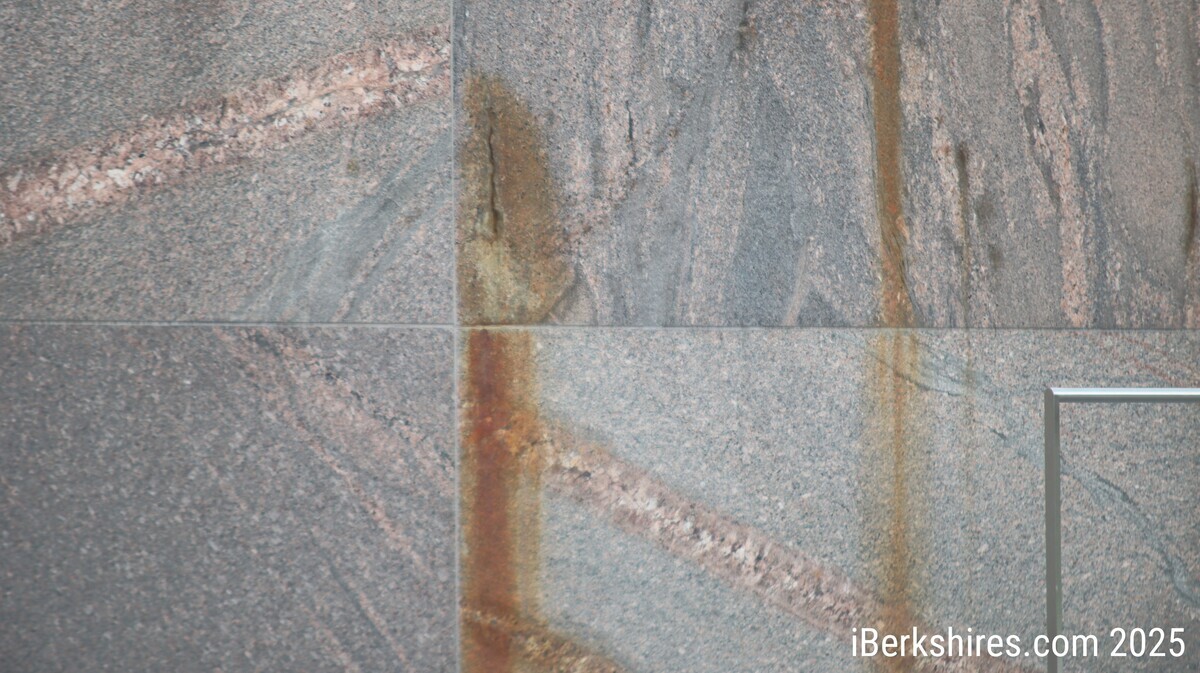
Yellow stains in the granite are evidence of oxidization (rust) of iron pyrite or 'fool's gold' in the granite, Wobus explained.
image description
The group attending Bud Wobus' tour of the Clark grounds looks at benches of white granite mined in Vermont that were created by artist Jenny Holzer.

Clark Art Talk Explores Beauty of its Granite Walls

By Stephen DravisiBerkshires Staff
Print Story | Email Story
WILLIAMSTOWN, Mass. — When the Clark Art Institute opened its expanded campus more than a decade ago, the Tadao Ando-designed Clark Center won acclaim throughout the worlds of art and architecture.

However, according to a retired Williams College professor, at least one glowing review may have understated the beauty of the project.

"You approach the new Clark Center along smooth walls of red granite that can feel a bit daunting. But a reward is imminent," New York Times art critic Roberta Smith wrote in July 2014, going on to discuss everything on the other side of that wall.

Bud Wobus offers a different perspective: The red granite walls outside are part of the reward.

"I tell people, 'Don't hurry in. Don't hurry out,' " he said during his "Granite of the Grounds" lecture at the South Street museum on Tuesday.

Wobus, an emeritus professor of geology, makes a convincing case that the natural beauty of the red granite in the walls outside the Clark is as much a work of art as anything hanging on the walls inside.

Of course, he is a little biased.

"My middle name should be 'granite,'" Wobus jokes. "Most of my career was spent in the study of granite — in Colorado, on the Maine coast, in New Hampshire, and some spots in Western Massachusetts.

"In 2014, the granite came to me. They built this wonderful addition to the Clark. Not only was it nice granite, it was very well exposed and clean."

And it tells a story, once you learn to listen. For several years, Wobus has been telling people how.

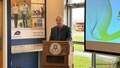
A dozen people gathered in the the Clark's Manton Research Center conference room for Wobus' fifth lecture and walking tour of the museum's exterior. He has plans to do it again in October.

"My goal is to give you enough of a background that you'll look more closely at [the granite] when you come to the Clark," he said.

"It is telling you something about its history."

The rock's history dates back 2.5 billion years when the granite was formed from cooling magma deep beneath what is now South Dakota, Wobus explained. To put that into perspective, the Earth itself is approximately 4.5 billion years old.
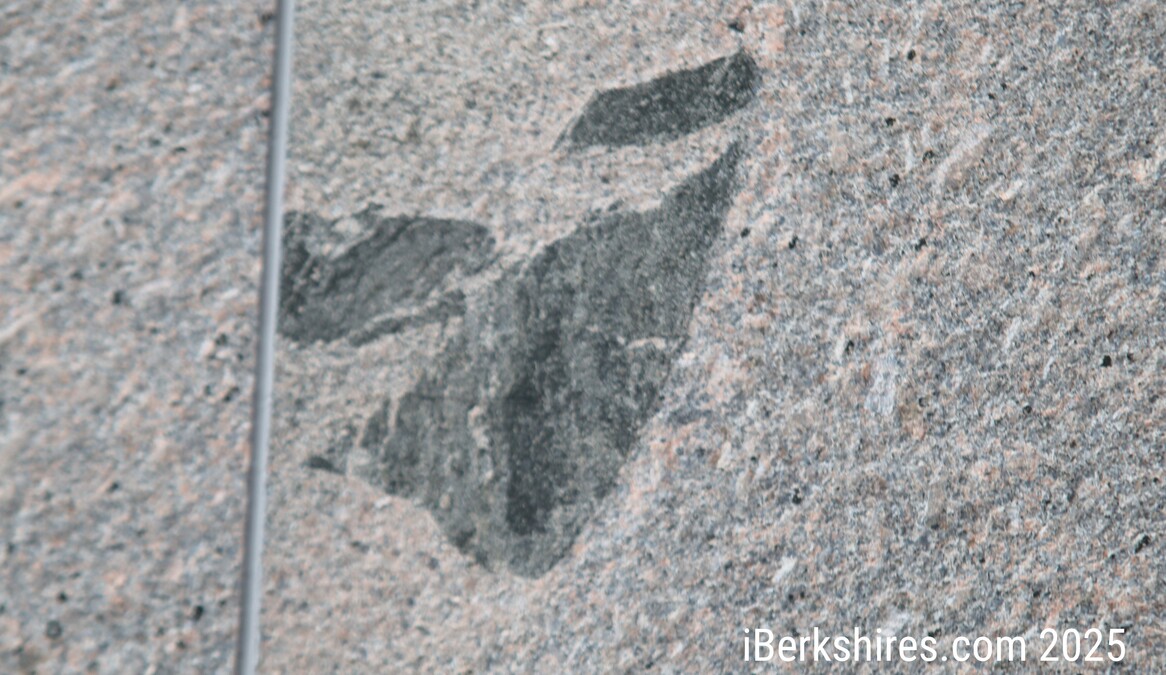

An example of inclusion in the granite at the Manton Research Center 

As the igneous rock formed, magma flowed through the developing granite, bringing along pieces of rock that became lodged in the granite and are now known as "inclusions," Wobus explained.

Meanwhile, variations in the rate of crystallization of magma produces pegmatite, a sort of rock within a rock with distinct properties from the rest of the surrounding granite.

"Inclusions could be hundreds of millions of years older than the [surrounding] granite, and often are," Wobus said, explaining how carbon dating can pinpoint the age of rocks.

Wobus' lecture detailed how inclusions and pegmatites are formed, and he then showed attendees examples of both in the marble of the Manton building and the nearby Clark Center.

It was, by necessity, a crash course at a venue where Wobus has led much deeper dives into the topic.

"My [Williams] students would spend a month in the spring down here," he said. "They would take pictures of a [granite] panel that appealed to them and take a month to study it."

The visual observations would be supplemented by samples of the granite that could be examined both under a microscope — in 30 micron-thin samples — and through chemical analysis.

"We had big slabs of rock the people from the grounds department gave me during construction," Wobus explained.

But you don't have to put granite under the microscope to see its beauty, Wobus said.

"Almost every granite slab will have inclusions in it," he said. "Those are really works of art in their own right.

"I love the Clark. And I rarely even go inside anymore."


Tags: Clark Art,   
If you would like to contribute information on this article, contact us at info@iberkshires.com.

National Grid Hosts Customer Assistance Events In The Berkshires

WALTHAM, Mass. — National Grid will hold a series of in-person Customer Assistance Events this December. 
 
As colder weather sets in, these events are designed to help customers manage winter energy bills and explore cost-saving programs.
 
In Berkshire County:
  • Dec. 4 – Town Library, Williamstown, 4:00pm – 8:00pm, 1095 Main Street, Williamstown
  • Dec. 5 – National Grid Great Barrington Office, 11:00am – 2:00pm, 927 South Main Street, Great Barrington
  • Dec. 5 – Sheffield Bushnell-Sage Library, 5:00pm – 8:00pm, 97 Main Street, Sheffield
Many of these events will continue to take place at local senior centers, making it convenient for older residents to access personalized assistance. Attendees at any location will have direct access to National Grid Customer Service Specialists, who can provide personalized guidance on payment options and energy solutions to meet each household's needs.
 
"As December begins, customers still have opportunities to find support and manage energy costs," said Bill Malee, chief customer officer, National Grid. "We're proud to host many of these events at local senior centers, ensuring customers have easy access to the support they need. Our in-person events are a great way for customers to connect with our team, learn about flexible payment options, and discover energy-saving programs that can help make a real difference this season."
 
Customers attending in-person events will have the opportunity to meet with representatives from National Grid, who will be on-site to assist with billing issues and provide information on:
  • Enrolling in National Grid's new Payment Assistance Bundle
  • Enrolling in Budget Billing
  • Enrolling in the Energy Discount Rate (for qualifying customers)
  • Scheduling home energy assessments and sharing information on other energy efficiency opportunities for homes or businesses 
These events are part of National Grid's broader commitment to affordability and reliability. Customers can also access support by calling 1-800-233-5325.
 
National Grid customers can now sign up for a new Payment Assistance Bundle. The bundle combines three solutions to make it easier for managing energy costs and paying down past due amounts over a 12-month period.
  • Deferred Payment Agreement: Spread out past-due balance into future monthly payments.
  • Automatic Monthly Payments: Automatically deduct payments from your bank account each month and avoid missing due dates.
  • Budget Plan: Break down annual energy costs into balanced monthly payments, making it easier to budget and plan expenses.
Customers interested in enrolling in the Payment Assistance Bundle can do so online by visiting ngrid.com/hereforyou, at an in-person event, or by calling 1-800-233-5325.
View Full Story

More Williamstown Stories