
Historic Yellow Smokestack in Adams Coming Down
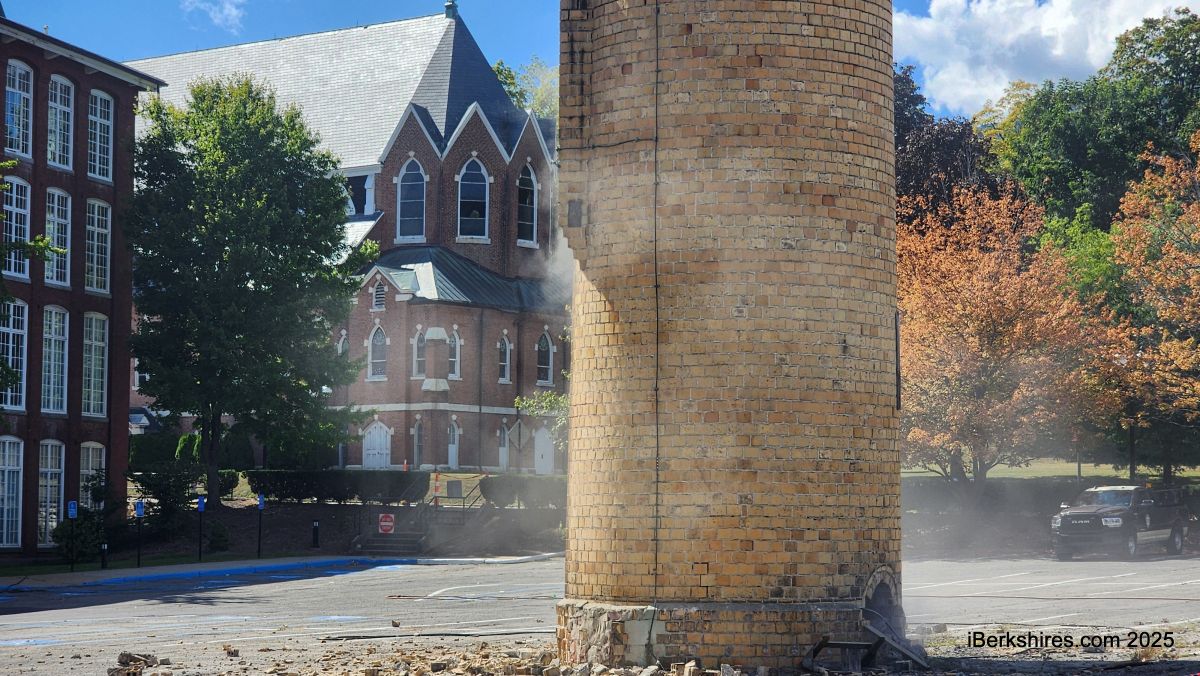
Dust from the brittle bricks blows out from an opening near the base.
Building Commissioner Gerald Garner said the owners of the Berkshire Mill had applied for its demolition after finding serious structural issues with the more than four-story-tall landmark.
The stack with its yellow terra cotta tiles, and its slightly shorter red brick companion, are regularly checked for stability. The red one holds antennae for Verizon at its peak but the yellow was not considered structurally stable enough, and was found to have deteriorated at its recent inspection.
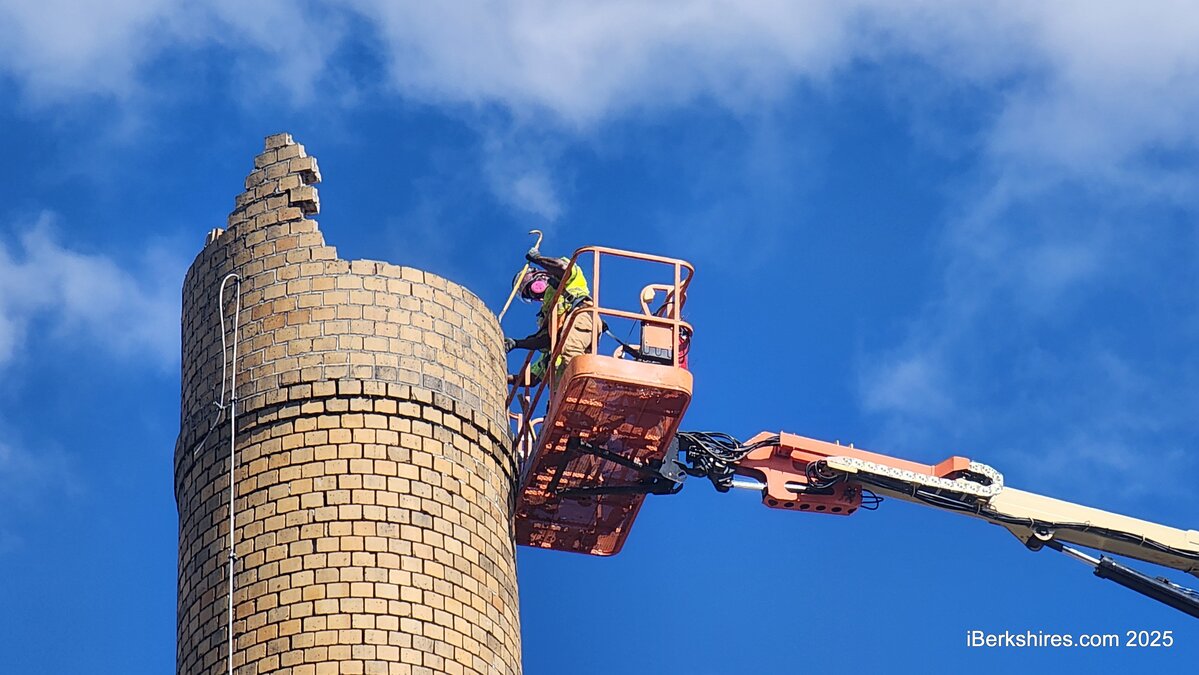
Manafort Brothers Inc. of Connecticut started Tuesday on the demolition, pushing the top bricks into the stack from an aerial work platform. The two workers on the platform are using crowbars — and their hands — to topple the bricks. Dust could be seen coming from an opening near the base; dust was also evident in adjacent Walgreens parking lot.
Once the stack is about halfway down, and not in danger of falling over, heavy equipment will come in to complete the razing. A worker onsite estimated it will take about a week.
Garner said the town has been apprised of the work and that no toxic elements were found in testing the structure prior to the work.
"I just want it done safely," he said.
The parking lot behind the Berkshire Mill, also known as Berkshire Square, will be blocked off during the demolition.
The stack was set to be taken down 40 years ago when plans for the renovation of Berkshire Mill No. 1, a former cotton mill, into a mixed-use development had moved forward. Holes had even been made in the base for the placement of dynamite.
Both stacks were built prior to 1914 and were part of the engine and boiler rooms for Berkshire Mill No. 1.
The National Park Service was already annoyed with the demolition of those two smaller structures and had rejected the developer's application for tax credits. Michael J. Capizzi Planning and Development of Boston had been advised that keeping both stacks would help its next application move forward, and gain it up to 25 percent of the renovation costs.
Residents and town leaders at the time had encouraged the restoration or stabilization of both smokestacks as part of the town's historical legacy. The former cotton mill has been on the National Register of Historic Places since 1981.
Tags: demolition, historic structure, smokestack,