image description
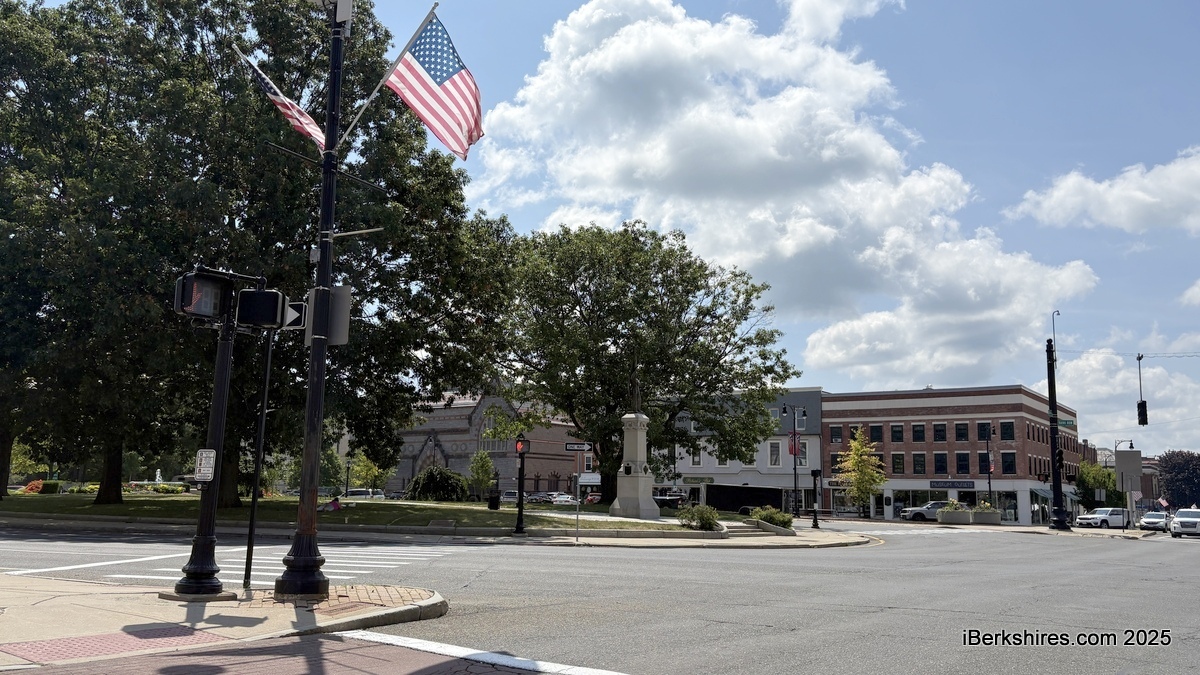
The Historical Commission is looking to establish a historical district to preserve the facade of Park Square.

Commission Mapping out Pittsfield's Park Square Historical District

By Brittany PolitoiBerkshires Staff
Print Story | Email Story

PITTSFIELD, Mass. — Creating a historic district around Park Square would take about a year through the work of a study committee. 

The Historical Commission last week mapped out the first phases of establishing a district for the historically significant city center so its facade is preserved and protected. This includes petitioning the City Council for a study committee, which will eventually produce a final report, and weighing the cost of a consultant against a self-guided process. 

"I think we could do it in-house," the City Planner Kevin Rayner said, pointing to resources available from the Massachusetts Historical Commission. 

Park Square is seen as an obvious location to start. The central area was laid out a few decades after Pittsfield was given a town charter in 1761 and was the site of the first agricultural fair in 1810.

"I don't think anybody is going to argue too hard that the buildings directly around Park Square are historic, and that we should preserve the look of Park Square as it is," Rayner said. 

The historical district is not expected to cover "massive swaths of Pittsfield" and would use National Historic District boundaries as a guide. 

The city has more than 20 locations on the National Register of Historic Places, including the Park Square Historical District, but the designation just allows communities to apply for federal tax credits and doesn't impose restrictions on buildings.

After consulting Somerville's planning staff about its historic districts, it became clear that the city could basically appoint Historical Commission members to the yearlong study committee. Three to seven members would be appointed by the City Council. 

"The Historical Commission could have their regular meeting, and they could open the meeting, do their business, close the meeting, and then if we had study committee business, we can open that meeting separately," Rayner explained. 


"And then in the what's called the preliminary report, which needs to be submitted as a part of the study committee's job, you could suggest to City Council that the Historical Commission become appointed as the local historic district commission at the culmination of the plan, and basically, we would probably rebrand the Historical Commission to something to show its enlarged responsibility at the end of that." 

It was suggested that they hire a consultant for this process, which would come at a cost. 

In other news, the feasibility study for the William Russell Allen House is underway, and the rough goal is to have it completed by the end of the year. 

The Historical Commission has received more than $33,200 in Community Preservation Act funding for a feasibility study on the 1886 home, said to be "the finest example of Queen Anne design in Pittsfield and one of the finest in Berkshire County." Now, its bones are showing in several places, and windows are boarded up. 

The $42,500 feasibility study was funded in the city's $526,548 CPA budget for fiscal year 2025.  The rest of the cost was covered by the Berkshire Historical Society. 

Rayner reported that there was a recent kickoff meeting with the consultant firm, and site visits are scheduled in September to look at the interior of the building. 

The deteriorating historical property is owned by the state's Division of Capital Asset Management and Maintenance, but was built by the son of Thomas Allen, who underwrote the construction of the Berkshire Athenaeum, and great-grandson of Thomas Allen, Pittsfield's first congregational minister. 

In the past few years, DCAMM has indicated it is in support of the property's disposition and redevelopment for productive use. 


Tags: historical district,   
If you would like to contribute information on this article, contact us at info@iberkshires.com.

Youth For The Future: Adwita Arunkumar

By Breanna SteeleiBerkshires Staff

PITTSFIELD, Mass. — Williams Elementary School fourth-grader Adwita Arunkumar has been selected as our April Youth for the Future for her mentoring of a younger child.

Youth for the Future is a 12-month series that honors young individuals that have made an impact on their community. This year's sponsor is Patriot Car Wash. Nominate a youth here

Adwita has cortical visual impairment; she has been working with her teacher, Lynn Shortis, and her, paraprofessional Nadine Henner.

"My journey with CVI means that I learned in a different way. I work hard every day with Miss Henner and Miss Lynn, to show how smart I am," she said.

"Adwita is a remarkable student. She's a remarkable child. She has, as she shared, cortical visual impairment, which is a brain-based visual processing disorder, which means the information coming in through the eyes is interfered with somewhere along the pathways, and we never quite know what's being interpreted and how and how it's being seen," said Shortis.

"So she has a lot of accommodations and specialized instruction to help her learn."

Recently Adwita has chosen to mentor 4-year-old Cayden Ziemba, who is also visually impaired.

"I decided to be a mentor to Cayden so that she can learn some new things. I teach her how to walk with the cane, with the diagonal and tap technique, I am teaching her Braille," she said. "I enjoy spending time with Cayden, playing games and being a good role model."

Shortis said the mentoring opportunity came up when Cayden was entering preschool at Williams, and they introduced her to Adwita. 

"Adwita works really, really hard academically. She's very smart, but there are a lot of challenges in that, because of the way that it's so visual and she's a natural. She's just, it's automatic," Shortis said. "It's kind of like a switch is turned on and she becomes this extremely confident and proud person in this teacher role."

Adwita also has been helping Cayden on how to use her cane on the bus and became a mentor in a unexpected ways.

"Immediately at the start of this year, she would meet Cayden at the bus. She has taught Cayden how to use her cane to go down the bus stairs. Again, Adwita learned that skill, so it wasn't something I had to say to her, this is what you need to have Cayden do. She just automatically picked that up and transferred that information," said Shortis. "Cayden is now going down the bus step steps independently with her cane. And then she really works hard with Adwita in traveling through the hallways, Adwita leads her to her class every morning, helps her put her things away and get ready for her morning."

Adwita said she hopes Cayden can feel excited about school and that other students can feel good about themselves as well.

"I want them to know that Braille is cool to learn. You can feel the bumpiness with your fingers. I want people to know how you can still learn if your brain works differently sometimes. I need to have a lot of patience working with a 3-year-old. I need to be creative and energized," she said.

She hopes to one day take her mentoring skills to the head of the class as a teacher.

"I want to become a teacher and teach other students when I grow up. I might want to teach math, because I am great at it," she said. "I also want to teach others about CVI. CVI doesn't stop me from being able to do anything I want to. I want students to not feel stressed out and know that they can do anything they want by working hard and persevering."

Her one-to-one paraprofessional said she likes seeing the bond that has grown between the two girls, and can picture Adwita being a teacher one day.

"I do see her in the future being a teacher because of her patience, understanding and just natural-born instinctive skills on how to work with young children," Henner said.

Shortis also said their bond is quite special and their relationship has helped to bring out the confidence in each other.

"The beauty of it, there's just something about it their bond is, I don't even really have a word to describe the bond that the two of them have. I think they share something in common, that they're both visually impaired, and regardless of the fact that their visual impairment differs and the you know the cause of it differs," she said.

"They can relate. And they both have the cane. They're both learning some Braille. But there's something else that's there that just the two of them connected immediately, and you see it. You just you see it in their overall relationship."

 
View Full Story

More Pittsfield Stories