Rehabilitation Efforts Reignited for Historical Pittsfield Property
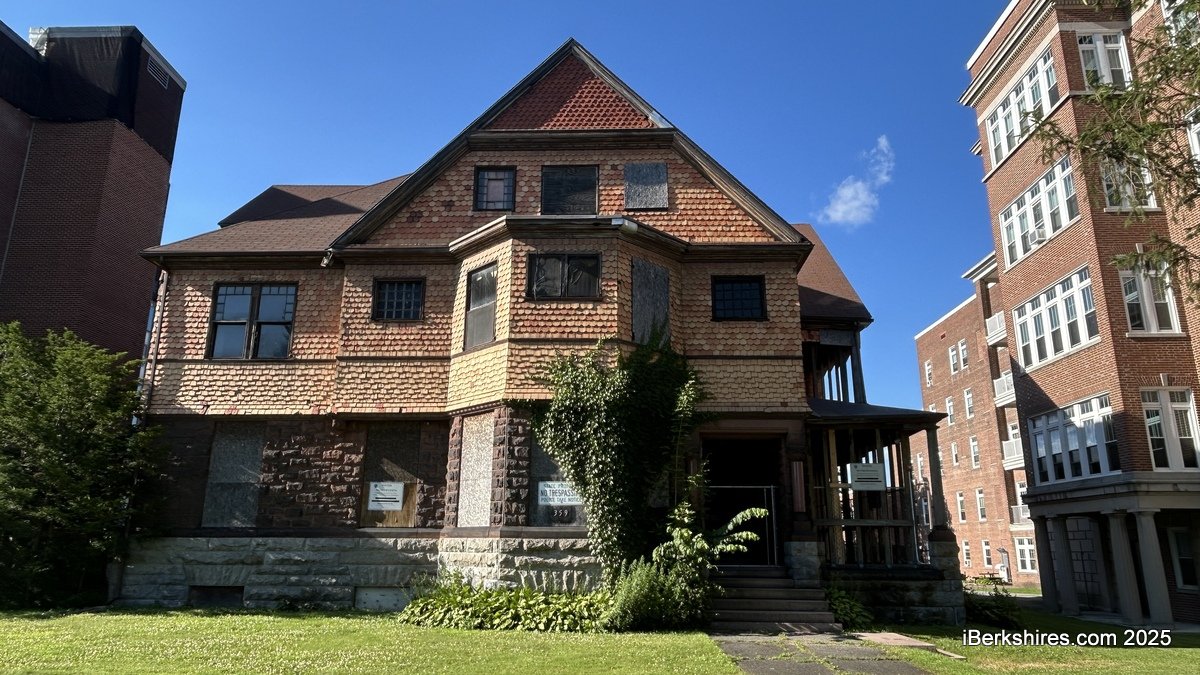
PITTSFIELD, Mass. — Efforts to save the historic William Russell Allen House have reignited with the support of Community Preservation Act funds.
The Historical Commission has received more than $33,200 in CPA funding for a feasibility study on the 1886 home, said to be "the finest example of Queen Anne design in Pittsfield and one of the finest in Berkshire County." Now, its bones are showing in several places, and windows are boarded up.
The feasibility study was funded in the city's $526,548 CPA budget for fiscal year 2025.
The deteriorating historical property is owned by the state's Division of Capital Asset Management and Maintenance, but was built by the son of Thomas Allen, who underwrote the construction of the Berkshire Athenaeum, and great-grandson of Thomas Allen, Pittsfield's first congregational minister.
The application reports that in the past few years, DCAMM has indicated it is in support of the property's disposition and redevelopment for productive use.
"The Pittsfield Historical Commission proposes to conduct a feasibility study, updating a previous one completed over 20 years ago. Such a study would assist any potential buyer or developer to have a full picture of the requirements in preserving and re-purposing this property," it reads.
The study is expected to cost $42,500, which was the original CPA funding ask.
The effort is backed by the Berkshire Historical Society, DCAMM, descendants of the William Russell Allen family, and previous efforts. In 2007, the William Russell Allen House Inc. nonprofit attempted to raise money for rehabilitation but was only able to finance the building's stabilization in 2009.
The William Russell Allen House was also listed in Pittsfield's Community Preservation Plan as a significant historical structure.
Included in the CPA application is a letter of support from Thomas W. Allen reporting that the Allens are "delighted" to learn of renewed interest in restoring the house and strongly support the project.
"You may be aware that in 2017 our family mounted a preservation and restoration effort, together with local community leaders and Preservation Massachusetts, but the difficulties of finding sufficient financial support proved overwhelming at the time. We are pleased that the Berkshire County Historical Society and the local community are working on this project, and that we all may see it come to fruition in coming months," Allen wrote.
"There is no need for me to recite the fascinating history of this house and its historical importance to Pittsfield and the public at large, or the benefits that would accrue from its transformation into a historical and community center. The potential benefits are evident and compelling."
Designed by H. Neil Wilson and added to the National Register of Historic Places in 1980, the property is said to be one of the last structures to embody the look of East Street in the late 19th century. For many people's lifetime, it has sat abandoned between the Registry of Motor Vehicles and Providence Court, the former St. Luke's Hospital.
Finegold Alexander Architects expects to get the feasibility study done in eight weeks, starting with a review of the May 2003 study and an existing conditions assessment. The team will then identify additional deterioration from more than 20 years of sitting and make recommendations with a cost estimate.
The $42,500 price tag breaks down into $24,000 for the architects, $11,500 for a structural engineer, $5,00 for a code consultant, and $2,000 for a cost estimate.
FY25 CPA Awards:
- The Elizabeth Freeman Center Fire House Restoration: $150,000, Historic Preservation
- Greenagers Inc. Barkerville Trail Creation: $53,457, Open Space and Recreation
- Roots Rising Farm Improvements: $90,000, Open Space and Recreation
- City of Pittsfield Conservation Commission, Barkerville Expansion: $13,000, Open Space and Recreation
- Williams Elementary School Playground Restoration: $30,000, Open Space and Recreation
-
City of Pittsfield Parks Department West Part Cemetery Restoration: $9,990, Historic
Preservation - Pittsfield Parks Department Park Signage: $4,850, Open Space and Recreation
- Pittsfield Affordable Housing Trust: $140,000, Community Housing
- Boys and Girls Club of the Berkshires Mural Restoration: $15,000, Historic Preservation
-
Pittsfield Historical Commission Russell Allen House Study: $33,250, Historic
Preservation
Tags: CPA, historic buildings,