Centennial Committee Gives Adams $85K for Anthony Monument Care
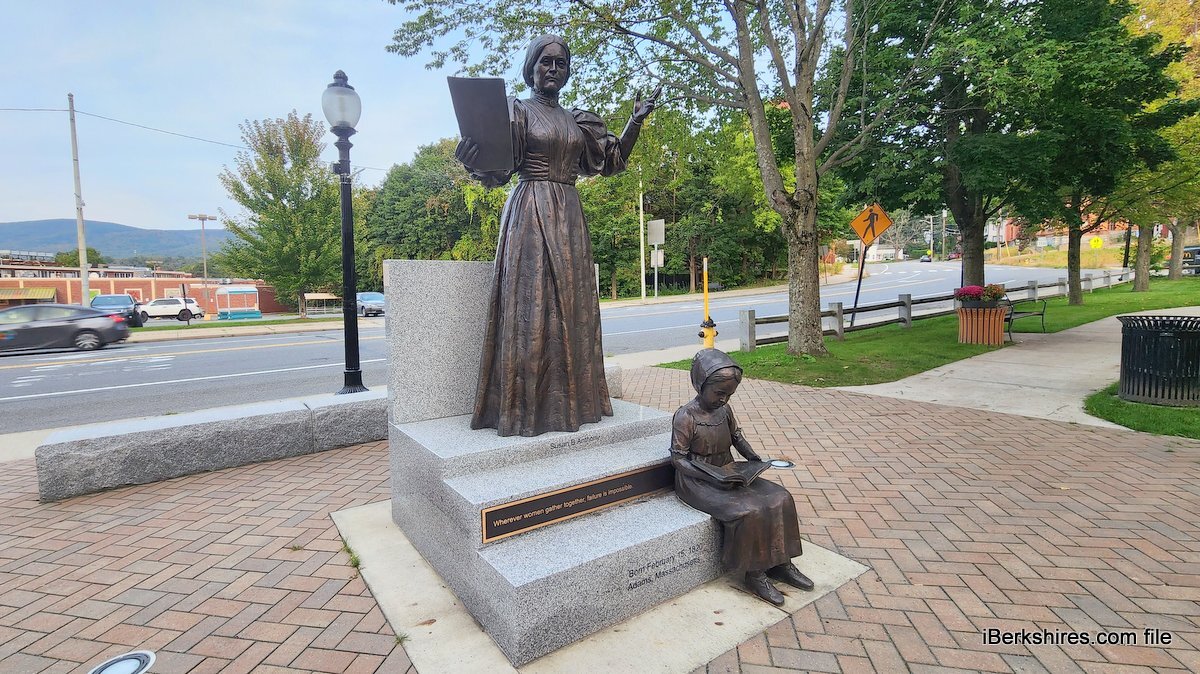
ADAMS, Mass. — The Adams Suffrage Centennial Celebration Committee has turned over nearly $85,000 toward preservation of the Susan B. Anthony monument and related activities.
Chair John Duval last week said the check for $84,667.62 was sent to the town treasurer from Edmund St. John III.
"The community really did come out and support this Susan B. Anthony celebration and the sculpture was completed," said Duval. "Then COVID hit to where the events weren't held and everything pretty much came to a stop."
The centennial committee had big plans to celebrate the 100th anniversary of the Susan B. Anthony Amendment, giving women the right to vote.
Adams' native daughter would not live to see the passage of the 19th Amendment but her efforts and others were critical to its passage in 1920. It also would have been Anthony's 200th birthday.
The celebration was to include a parade, fireworks and other events culminating the unveiling of Anthony's bronze monument on the Town Common. All of that was cut short by the pandemic although the work by sculptor Brian Hanlon was celebrated in June the following year with Lt. Gov. Karyn Polito.
The committee raised more than $300,000 toward the effort but the $85,000 was leftover and needed to go somewhere.
Duval said St. John, the town's former counsel, conferred with current Town Counsel Jeffrey Blake of KP Law on possible uses for the money.
"In my opinion, maintenance of the Susan B. Anthony statue, as well as funding events and educational programming focused on women's issues, may be consistent with the donors intent of the gifted funds as it is directly aligned to the purpose of the ASCCC," Duval read from Blake's response. "This seems especially so given that the ASCCC received comments from the donors suggesting these future uses."
The funds might also be directed to William McKinley's statue on Park Street.
"I am less familiar with the President McKinley's connection to Susan B. Anthony, he hosted her at the White House," Duval read. "And if a connection can be made to the donors intent for the funds, in my opinion, there is likely no issue with using these funds to maintain the William McKinley statue, again, as this was suggested use from the donors, it weighs in favor of using funds in that way."
The chair noted the attorneys had provided more information and recommended the board consider a policy on the use of the funds.
Duval said the McKinley statue could use some maintenance as the town has not provided funding for its care. That monument was erected in 1903, two years after McKinley's assassination, and paid for largely by the Plunkett family, who had been friends of the president. It had undergone some restoration in the mid-1990s with private donations.
Selectwoman Christine Hoyt motioned to accept the funds and place them in a separate account and to request town counsel to write up a recommended policy for discussion. Both motions passed; Selectman Joseph Nowak recused himself from the room as he had been very involved with the centennial committee.
"We'll definitely try to honor that request the best we can," said Selectman Jay Meczywor.
Tags: monument, Susan B. Anthony,