Berkshire Concrete Special Permit Continued; Other Updates
DALTON, Mass. — Frustrations continue to fester with the Planning Board's decision last week to continue the public hearing for Berkshire Concrete's special permit for a third time.
Confusion stemming from a labyrinthine history, questions surrounding the board's legal authority, and illegible documents described as "garbage" by board member Don Davis has delayed the town's yearlong odyssey in mitigating sand from leaving Berkshire Concrete's property.
During the prior two meetings, the board asked Petricca Industries, the parent company of Berkshire Concrete, to provide updated, accurate, and clear plans. However, the documents provided did not answer the questions the board presented during previous meetings.
Board members criticized the documentation provided for the absence of a clear overlay indicating "no-extraction" areas, a lack of information about the proposed work and schedule, unclear depictions of previously worked and reclaimed areas, and the failure to include a definitive reclamation schedule.
Attendees also noted the absence of a sufficient dust mitigation plan, which the town's consultant Berkshire Environmental Consultants, determined was insufficient.
Berkshire Concrete's attorney, Dennis Egan Jr. of Cohen Kinne Valicenti & Cook LLP, asserted that the 1992 permit, which applies to the entirety of its land, is the foundation to all special permit renewals.
He contends that the yearly renewal demonstrates to the board where Berkshire Concrete intends to mine during that timeframe and the reclamation requirements and dust mitigation plan are unchanged from previous modifications that had been modified in 1994, 2000, and 2013.
The board told Berkshire Concrete to provide clear plans that include information from previous agreements with the town.
And "in color ink. Don't be cheap on me," Davis said.
They also advised Egan and the town attorney to get together to confirm what's binding in the historical modifications, determine what the board may lawfully require, and agree on answers to outstanding legal questions.
The way the board maintains the most control over the situation is through new well-thought-out, concise, effective, and reasonable conditions that supersede or fix old ones, Town Planner Janko Tomasic said.
"This is something that we should be doing very carefully, with a lot of discretion, and frankly, this time around should be done with a lot of care, and to make sure that we hear the needs of the community and answer the needs of the community within these conditions," he said.
"So, short of creating new conditions, I'm not really sure how much going into the past and trying to figure out what's going on here and there is really going to move the issue forward.
"Respectfully, I know there's a lot of debate on what's going on back in '92 and '94, I wasn't even born yet. It was so long ago that the time we can control and the things we control are now. And, I think that doing it that way and would be the most strategic approach to situation."
Board member Jarred Mongeon voted against the continuance in favor of going into deliberations and discussing conditions.
"I think we have heard and seen all we needed to. We just need to step up and make a decision," he said.
In other Berkshire Concrete news:
The Select Board sent a letter to the state Department of Environmental protections following what they said is incorrect information in Berkshire Concrete's Limited Plan Approval Application. Select Board member Antonio "Tony" Pagliarulo read the letter during the public hearing.
The letter quotes the application saying Berkshire Concrete's "operation occurs on five parcels owned by BCC-Parcel ID 101-25, 105-12, 105-16, 106-55-1, and 217.3 … The operation includes excavating "bank run fill" in and approved ‘dig area'"
This representation is incorrect, the letter says, demonstrating how its permit only approves aggregate operations for Parcels 106-55-1 and 217.3, not 101-25, 105-12, and 105-16.
"In fact, the Planning Board is currently reviewing the special permit by BCC to conduct operation on these three unpermitted parcels," the letter says.
It explains that Berkshire Concrete minded 105-16 since December 2023, permitting of which has been found to be invalid and outlines recent orders from the Board of Health and Zoning Board of Appeals.
"The statements by BCC in this matter are misleading. I respectfully ask that your office investigate and hold BCC accountable in light of the information provided herein," the letter says.
During a Select Board meeting last week, Pagliarulo informed the board that the Clean Air Committee was awarded a grant for five PurpleAir monitors.
Berkshire Regional Planning Commission also wants to provide the town with five additional monitors, giving flexibility to move the monitors.
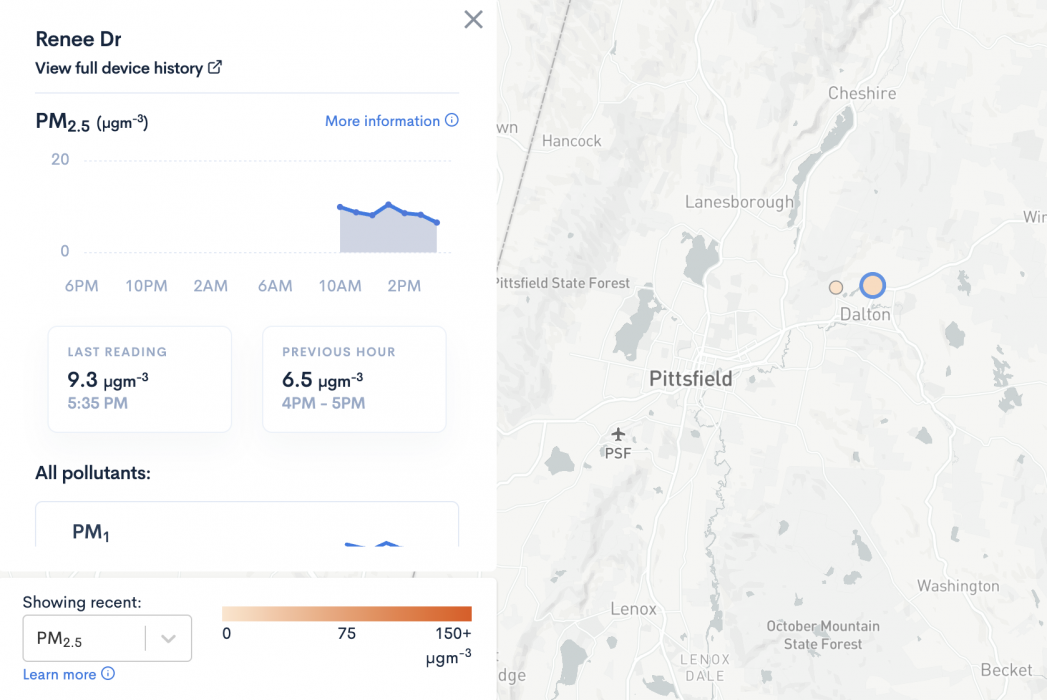
"Residents and owners have expressed interest in terms of placing them at their homes. The cost is minimal, maybe $4 to $5 a year, very little," Pagliarulo said.
A recent newsletter from the Clean Air Coalition provided a link to the real time data for the monitors.
Select one of the particulate matter, PM, options on the dropdown menu, then zoom in to Dalton on map and click on the sensor.
"We do not expect to see high numbers at this time as there is no work occurring on 105-16 and open sand areas are covered with snow," the newsletter said.
Tags: berkshire concrete, dust, debris, Planning Board,