Berkshire Concrete Lawsuit Seeks Damages, Continued Operation
DALTON, Mass. — Whether Berkshire Concrete can continue excavating after its permit was denied —and if the town is liable for damages — will be decided in a lawsuit the company has filed against the town, planning board and its members.
The suit was filed on behalf of Berkshire Concrete Corp., a subsidiary of Petricca Industries, by Jaan G. Rannik of Cohen Kinne Valicenti & Cook in Superior Court on April 13.
Berkshire Concrete is suing for damages and wants the Planning Board's permit denial overturned.
The company seeks permission to operate on its entire property, and to have any future permit applications granted — unless they violate previous permit conditions and fail to fix them after formal written notice, or if the Mine Safety and Health Administration finds a public health danger requiring new restrictions.
It also requests that if a future renewal is denied for a violation and Berkshire Concrete disputes it or claims it didn't have time to fix, operations can continue until a final decision is made.
The company claims the town breached its 1992 contract with Berkshire Concrete and the board exceeded its authority in denying the special permit.
Berkshire Concrete claims that as a direct result of the town's breach of contract it suffered damages of no less than 1.9 million and will continue to incur additional damages.
The lawsuit outlines the long history of its operations in town, dating as far back as at least 1947, prior to the town's adoption of its zoning bylaws in 1951, which requires a special permit as a precondition for certain uses of land including the removal of gravel, loam, sand or stone.
The town has had an ongoing and, at times, contentious relationship with Berkshire Concrete, with prior lawsuits and negotiations to determine what the excavation company is allowed to do based on grandfathered rights.
In July of 1992, the town issued a cease-and-desist letter, alleging Berkshire Concrete violated zoning bylaws.
To address the legal disputes, the town and Berkshire Concrete agreed the company would obtain a one-year renewable special permit with specific conditions, including limited hours, restoration requirements, and designated traffic routes. More conditions were added in 1994 after appeals.
Berkshire Concrete contests that the Planning Board can only deny its Special Permit if there is proof of a violation, and no such violation was found for the years 2024 or 2025.
The lawsuit comes as the town increases pressure on Berkshire Concrete with fines and talks of locking the gate to restrict access.
For over a year, residents have attended meetings to address sand believed to be leaving Berkshire Concrete's unauthorized dig site on 105-16, citing health and nuisance concerns.
During the residents' investigation into the cause of the sand, it was discovered Berkshire Concrete cut down trees, removing a natural barrier, and mined a little farther than 300 feet from the closest residential street, off Prospect Street.
When looking into complaints, town officials determined that the excavation work on 105-16 was not listed on the permit application, even though it was shown on the site map that was submitted, resulting in abutters being improperly notified.
As a result, Berkshire Concrete was ordered to cease work and reapply for a permit. The problem — the dig site was left open so residents claimed sand continued to leave the site.
Subsequently, the company was also ordered to remediate or cover up the site, which it only did partially because of its intention to continue excavation. In March, the Planning Board voted to deny this special permit after five meetings.
The decisions stemmed from recurring concerns raised in previous meetings: the company's lack of clear mitigation plans and ambiguous documentation outlining its work plans.
"The Planning Board's denial of BCC's application has caused and will continue to cause measurable injury to BCC in the form of lost profits as a result of the discontinuation of its operations and due to costs associated with reclamation that would be unnecessary but for the Planning Board's denial," the suit says.
Leading up to this decision, the Zoning Board of Appeals determined that Berkshire Concrete's unauthorized dig site on parcel No. 105-16 needs to be fully remediated or covered to abide by town bylaws
Berkshire Concrete attempted to appeal this but the board maintained the decision and ordered that the digsite be fully remediated or covered to abide by town bylaws. To date, the dig site is still not fully remediated.
The lawsuit said Berkshire Concrete believes the permit was denied to create leverage to impose additional conditions upon its operation, further rendering the denial "arbitrary and capricious."
The suit also coincides with the town's attempts to fine Berkshire Concrete for sand leaving its site. Since the start of spring, the town has already received two dust complaints.
Residents successfully had the town install air monitors which recently showed data that was off the charts.
During a recent storm, the air monitors placed around town showed particulate matter numbers recorded at more than 5,000 units, and at times reaching 10,000, Clean Air Coalition member Lisa Pugh said.
Levels above 155 are considered unhealthy and according to the U.S. Environmental Protection Agency these numbers are considered an immediate public health emergency, she said.
On March 2, the Board of Health issued a $5,000 fine to Berkshire Concrete for creating a public nuisance by allowing sand and dust to leave the property and for failing to submit an adequate dust mitigation plan despite numerous orders
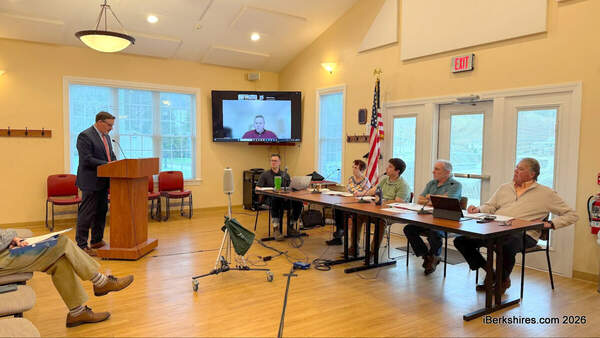
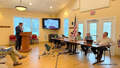
This fine went unpaid and was not appealed. However, Berkshire Concrete did appeal the subsequent fine of $10,000. There will be a public hearing on the appeal at the Tuesday, April 28, Board of Health meeting.
The reported violation of dust in the community opens Berkshire Concrete up to additional fines. It can theoretically be fined up to $10,000 a day for repeated violations, Town Manager Eric Anderson said.
Tags: berkshire concrete, lawsuit, permitting,