Agricultural Officials Urge Residents to Help Limit Spread of Spotted Lanternfly
 |
| Provided photo |
BOSTON — The Massachusetts Department of Agricultural Resources (MDAR) is informing the public about spotted lanternfly (SLF), an invasive insect, as it enters egg-laying season.
SLF has now been confirmed in more than 145 cities and towns across the state and has been found in every region except Cape Cod and the Islands.
Adult SLF are currently active and will soon begin laying eggs. Residents may see the insects gathering on trees and buildings, or notice the sticky substance, known as honeydew, that they produce when they are feeding. In response, MDAR is encouraging residents and businesses to take three steps to help slow the spread of this pest:
- Inspect Vehicles: Motorists and travelers should inspect their vehicles before leaving an infested area to avoid accidentally transporting spotted lanternflies to new locations.
- Manage Property Infestations: Property owners, property managers, and occupants can manage spotted lanternflies by vacuuming up the insects, removing preferred host plants such as tree-of-heaven or setting up targeted traps.
- Destroy Egg Masses: Residents and business owners should keep a close watch for spotted lanternfly egg masses during the fall and winter months and scrape off and destroy any that are within reach.
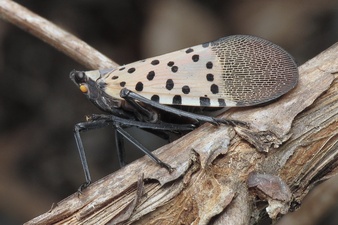
SLF can be identified by their gray wings with black spots and set of red hindwings underneath. Although the insects do not bite, sting, or pose a direct threat to humans or pets, they feed on the sap of over 100 types of plants, and can seriously injure certain species, including grapevines, tree-of-heaven, and small saplings of black walnut.
During late summer and fall, spotted lanternflies are known to congregate in large numbers on trees or the sides of buildings. One of the most noticeable impacts of SLF is honeydew, which can coat trees, decks, cars, and other outdoor surfaces underneath where the insects are feeding, and lead to the growth of a dark fungus called sooty mold. Honeydew also attracts bees, wasps, ants, and other insects that use it as a food source.
"As populations of spotted lanternfly continue to expand, we anticipate that more residents will encounter SLF activity at home or where they work," said MDAR Commissioner Ashley Randle. "We are taking a proactive, targeted approach by focusing our survey and treatment efforts where they have the greatest impact – safeguarding high-value agricultural crops and resources along with monitoring our shared borders with the rest of the New England region. Public partnership is an essential part of this effort, and we encourage everyone living or working in active areas to take a moment and inspect their vehicles before traveling to avoid the accidental spread of SLF."
Beginning in September, female spotted lanternflies lay eggs in masses that are approximately one inch long, flat and gray or beige, often resembling a smear of mud. These egg masses can be found on nearly any flat outdoor surface, but SLF activity is often concentrated around its preferred host plants.
MDAR continues to focus its survey and treatment efforts on areas where this pest poses the greatest risk to agricultural crops, with the goal of limiting its movement into areas where it has not yet been detected.
Due to the widespread nature of the current infestation, agricultural officials request that individuals consult the state's official SLF distribution map before submitting a report. If a sighting occurs in a city or town already designated as infested—particularly within and surrounding Springfield, Worcester, and Attleboro—filing a report is optional. However, if a spotted lanternfly is detected in an un-infested city or town, residents are strongly encouraged to take a photo of the insect and submit a report via mass.gov/slf.
Residents and businesses in established SLF areas should consult MDAR’s Spotted Lanternfly Management Guide for more detailed information about managing this pest on their property. MDAR has also produced a series of animated videos on its official YouTube channel that demonstrate vehicle inspection protocols and pest management techniques.