Philanthropy Massachusetts Talks Berkshire County Needs
By Sabrina DammsiBerkshires Staff
Print Story | Email Story

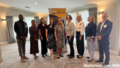
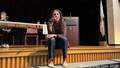
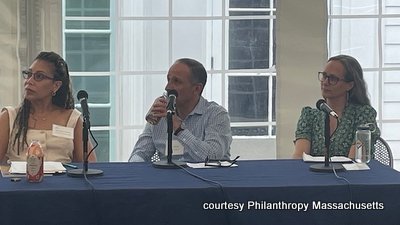
Philanthropy Mass CEO Mary Skelton Roberts, left, Barr Foundation President Jim Canales and Alexandra Russell, co-chair of the Western Mass Funders Network and moderator of the panel. The networking event was held at the Norman Rockwell Museum on July 12.  
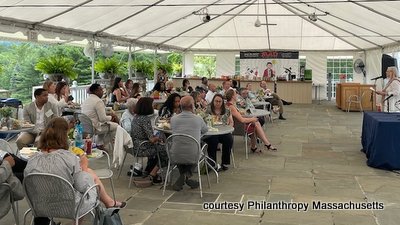
 
STOCKBRIDGE, Mass. — The Norman Rockwell Museum was filled with nonprofit members and philanthropists earlier this month to have a conversation centered around the challenges in Western Massachusetts and how Philanthropy Massachusetts can help. 
 
"Part of what I wanted to do was just get out there and meet who is working on behalf of folks in Berkshire County," said the organization's new CEO Mary Skelton Roberts.
 
"The other goals was to talk with them about ... what are the issues that they're facing, and how were they coming together, to discuss these issues, learn together, and then figure out if there is a next step." 
 
The event featured a panel consisting of Roberts and local nonprofit leaders Peter Taylor, president of the Berkshire Taconic Community Foundation, and Jim Canales, president and trustee of the Barr Foundation.
 
Based on the conversations at the event, it seemed that the attendees wanted to hear what Philanthropy Massachusetts' concerns and priorities are, Roberts said. 
 
Philanthropy Massachusetts was established in 1969 with aims to bridge the gap between funders and fund applicants. 
 
Through its network, it provides a number of resources such as research and technical assistance, and convenes funders and non-profits, Roberts said.
 
"Philanthropy Massachusetts has a deep commitment to equity and inclusion. Our goal is to collectively move the field of philanthropy to be more intentional in advancing equity and justice in the sector and across the Commonwealth," according to Philanthropy's website
 
"Our primary strategy to achieve this goal is to influence, encourage, support and lead institutional and individual funders in MA to advance equity (racial and other forms), diversity and inclusion systems, policies, practices and structures within their organizations and communities served." 
 
The Barr Foundation is one of Berkshire County's largest funders and strong funder, Roberts said. During the event, Canales talked about "how philanthropy is thinking about some of the issues that are affecting not just Massachusetts, but across the country, that have an impact on Massachusetts," Roberts said. 
 
The event was to find out what the community's needs are so, in the future, the Western Mass. Funders Network working group can discuss next steps and develop a strategy.  
 
They will also conduct research on funding trends and data to identify opportunities in the region and explore ways to facilitate collaboration between the nonprofit, for-profit, and public sectors to improve the quality of life in the region.
 
"Our role is to be facilitators, conveners, connectors and the bridge between the for-profit and the nonprofit sector," Roberts said. 
 
"We bring business along, we bring, decision makers, and public policy makers. When we bring them together and we're able to talk and learn and share and act, that's when you start seeing really interesting good things happen."
 
Another thing that Roberts wants to look at that was not part of the event is how much funding from various foundations in Massachusetts goes to Berkshire County and what issues the funders are supporting. 
 
According to the data from 2022, there are approximately 481 nonprofits in Berkshire County, which is 17 percent of the total nonprofits in Massachusetts, and about $90 million in funding went to those nonprofits, Roberts said. 
 
"One of the things that that number tells me is that we have a lot of funders that are not from Berkshire County, that are actually funding the county," she said.
 
Based on this data, Roberts said the county is "doing a really good job at" looking across the state for funding and working in collaboration in ways that are going to make a difference.
 
According to the data the top funding priorities in 2022 were education at $29.6 million, arts and culture at $26.9 million, human services at $14 million, economic development at $9.1 million, and health at $6.3 million, Roberts said. 
 
This data is important because it shows were the money is going, what the area's priorities are, how these priorities align with the state and future opportunities, what can be done to bring more attention to the Berkshires, and where more can be done, Roberts said. 
 
"So I was curious to talk with them and understand more and really learn from them what can  Philanthropy Massachusetts do going forward that is a benefit to you and a benefit to the field," Roberts said. 

Tags: networking,   nonprofits,   

If you would like to contribute information on this article, contact us at info@iberkshires.com.

Sheffield Craftsman Offering Workshops on Windsor Chairs

By Breanna SteeleiBerkshires Staff

Andrew Jack uses hand tools in his wood working shop. 

SHEFFIELD, Mass. — A new workshop is bringing woodworking classes and handmade items.

Andrew Jack specializes in Windsor chairs and has been making them for almost 20 years.

He recently opened a workshop at 292 South Main St. as a space for people to see his work and learn how to do it.

"This is sort of the next, or latest iteration of a business that I've kind of been limping along for a little while," he said. "I make Windsor chairs from scratch, and this is an effort to have a little bit more of a public-facing space, where people can see the chairs, talk about options, talking about commissions.

"I also am using it as a space to teach workshops, which for the last 10 years or so I've been trying to do out of my own personal workshop at home."

Jack graduated in 2008 from State University of New York at Purchase, and later met woodworker Curtis Buchanan, who inspired him.

"Right after I finished there, I was feeling a little lost. I wasn't sure how to make the next steps and afford a workspace. And the machine tooling that I was used to using in school." he said, "Right after I graduated, I crossed paths with a guy named Curtis Buchanan, and he was demonstrating making really refined Windsor chairs with not much more than some some flea market tools, and I saw that as a great, low overhead way to keep working with wood."

Jack moved into his workshop last month with help from his wife. He is renting the space from the owners of Magic Flute, who he says have been wonderful to work with.

"My wife actually noticed the 'for rent' sign out by the road, and she made the initial call to just see if we get some more information," he said. "It wasn't on my radar, because it felt like kind of a big leap, and sometimes that's how it's been in my life, where I just need other people to believe in me more than I do to, you know, really pull the trigger."

Jack does commissions and while most of his work is Windsor chairs, he also builds desks and tables, and does spoon carving. 

Windsor chairs are different because of the way their backs are attached into the seat instead of being a continuous leg and back frame.

"A lot of the designs that I make are on the traditional side, but I do some contemporary stuff as well. And so usually the legs are turned on a lathe and they have sort of a fancy baluster look to them, or they could be much more simple," he said. "But the solid seat that separates the undercarriage from the backrest and the arms and stuff is sort of one of the defining characteristics of a Windsor."

He hopes to help people learn the craft and says it's rewarding to see the finished product. In the future, he also hopes to host other instructors and add more designs for the workshop.

"The prime impact for the workshops is to give close instruction to people that are interested in working wood with hand tools or developing a new skill. Or seeing what's possible with proper guidance," Jack said. "Chairs are often considered some of the more difficult or complex woodworking endeavors, and maybe less so Windsor chairs, but there is a lot that goes into them, and being able to kind of demystify that, or guide people through the process is quite rewarding."

People can sign up for classes on his website; some classes are over a couple and others a couple of weekends.

"I offer a three-day class for, a much, much more simple, like perch, kind of stool, where most of the parts are kind of pre-made, and students can focus on the joinery that goes into it and the carving of the seat, again, all with hand tools. And then students will leave with their own chair," he said.

"The longer classes run similarly, although there's quite a bit more labor that goes into those. So I provide all the turned parts, legs and stretchers and posts and things, but students will do all the joinery and all the seat carving the assembly. And they'll split and shave and shape their own spindles, and any of the bent parts that go into the chair."

His gallery is open Wednesday through Sunday 10 a.m to 2 p.m., and Monday and Tuesday by appointment.

View Full Story

More South Berkshire Stories