image description
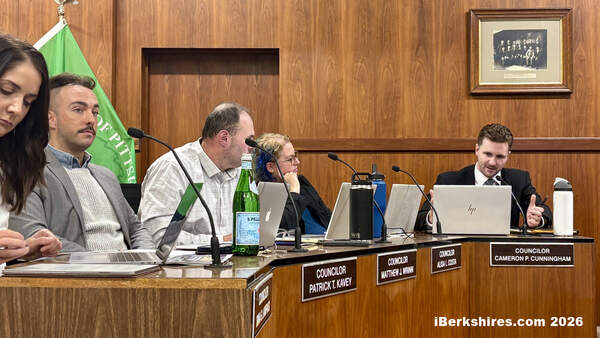
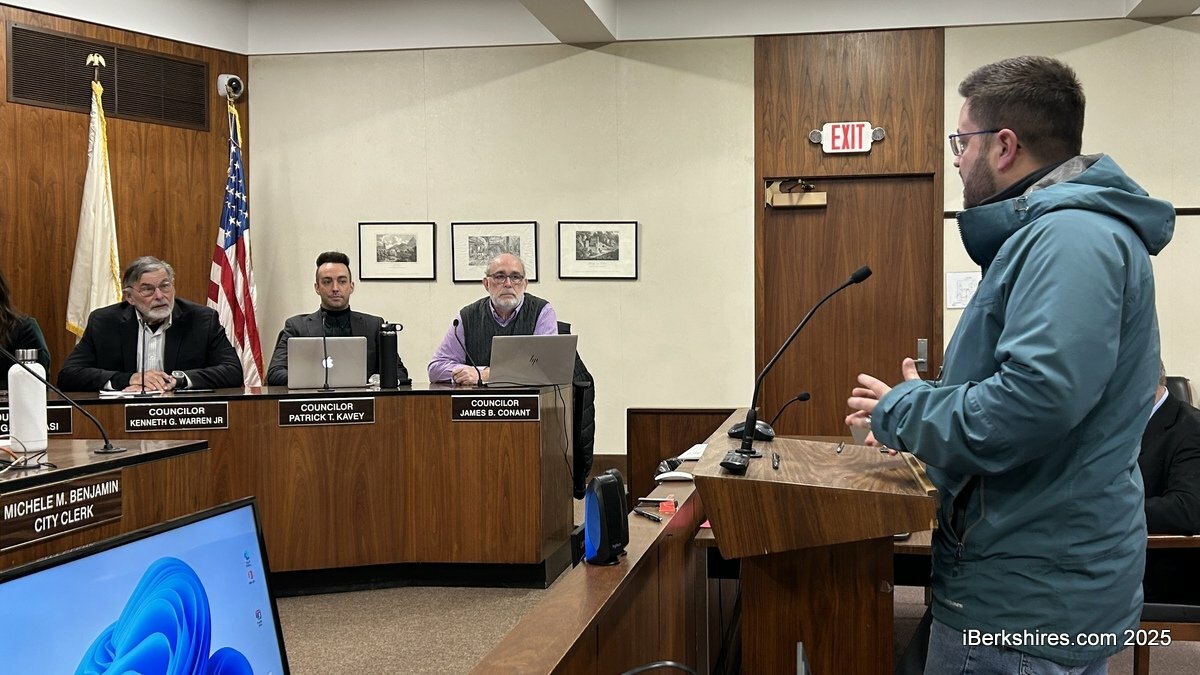
Airport Manager Daniel Shearer explains to the City Council the need for a taxi lane and how it will be funded.

Pittsfield Council OKs Million-Dollar Borrowing for Airport Taxi Lane

By Brittany PolitoiBerkshires Staff
Print Story | Email Story

PITTSFIELD, Mass. — The Pittsfield Municipal Airport will build a new taxi lane with help from federal, state, and local funds.

On Tuesday, the City Council approved a $1,040,000 borrowing for a paved way that enables access to additional developable land. Because the local share is only 2.5 percent, or $26,000, Rule 27 was waived.

A taxi lane is a path that connects aircraft parking areas to taxiways. Airport Manager Daniel Shearer said it will "substantially" open up a new area that is yet to be developed, providing access to a new hangar.

"This is the taxi lane for the development area that we've been working towards and signed a lease for. We had intended to start this a couple of months ago, the federal fiscal year put us a little behind on that so we're trying to get that work underway so we can pave as soon as the asphalt plant opens up in the spring,"

"This will line up with the completion of the first hangar in that area and will provide access to that space."

He added that ground lease revenue will come in as soon as the lane is finished.

Ward 5 Councilor Patrick Kavey pointed out that the current hangar has a dirt floor.

The first lease to construct a new hangar on this land was approved by the Airport Commission and council in 2023. Last year, the council authorized borrowing for the engineering services portion of this project.


This borrowing covers the construction phase and will be funded 95 percent by the Federal Aviation Administration ($988,000,) and 2.5 percent from both the state and city.

"Construction of this taxi lane will be funded principally through grant funds from the Federal Aviation Administration (FAA) and Massachusetts Department of Transportation Aeronautics Division (MassDOT,)" Shearer wrote to the council.

"In this case, the Bipartisan Infrastructure Law (BIL) Airport Infrastructure Grant (AIG) program. These funds have been awarded to the Airport and allocated to this project through the Airport Capital Improvement Planning (ACIP) process with the Federal Aviation Administration (FAA) and Massachusetts Department of Transportation Aeronautics Division (MassDOT Aeronautics)."

The bid for the project comes to $906,960 and combined with engineering services and administrative costs, the grant for the construction phase totals $1,040,000.

"Due to the type of grant, application deadlines, and construction schedules, it is necessary that the project be funded locally through a borrowing authorization before the grant is awarded; however, once awarded the city will only be responsible for its  2 1/2 percent local share," Shearer clarified.

Last year, the Airport Commission approved a new logo with a cleaner design that depicts a jet flying over a green mountainscape. It is a far cry from the former branding, which had more than 10 saturated colors.


Tags: pittsfield airport,   
If you would like to contribute information on this article, contact us at info@iberkshires.com.

BRTA Looks to Another Year of Fare Free

By Breanna SteeleiBerkshires Staff

PITTSFIELD, Mass. — The BRTA is expecting another year of fare free rides.

Berkshire Regional Transit Authority Administrator Kathleen Lambert told the advisory board recently that she expects to receive $1.3 million in state funding to remain fare free. She said RTAs may be given up to $40 million this year statewide, which is $5 million up from last year.

While the state budget is not formally approved yet, the effect will take place on July 1.

The news came at the same time the board approved the BRTA's budget of $13.6 million, which is an increase of 11 percent since last fiscal year.

Some of the increases were in the fixed route area which jumped from $9 million to $12 million. Lambert said this is due to the contractual agreement between the union where they have a five percent raise for all of the drivers and other union members, as well as a seven percent raise for paratransit fleet operators.

Lambert said much of the costs raised were fuel costs because of the ongoing war in Iran. The authority uses about 8,000 gallons of fuel a month and has planned for $5.75 per gallon.

The customer service desk, which currently staffs two employees, will be shut down, she said. The two employees were given notice months in advance and one showed interest in becoming a bus driver and will plan to interview for that. Lambert said two new drivers have started and that the new transit company Keolis, which is taking over for Transdev, will continue to hold recruiting events. The new manager is Mark Moujabber, taking over for Bobby Quintos. 

Lambert told the board she believed there are discrepancies in ridership data. Deputy Administrator Benjamin Hansen, who was in operations before his current role, said the authority has been seeing low ridership because of route cancellations, however, this past month, the numbers did not make sense as demand has stayed the same but ridership seemed exponentially low.

To get the figures, bus drivers must manually push a button on the farebox to record passengers, wheelchairs, and bikes, which might have errors. There are automatic passenger counters (APCs) installed, but they are not certified, so are only used as a rough comparison tool as they are not accurate.

Board member Stuart Lawrence asked if there has been any investigation on if this might be deliberate. Hansen said there is not as he does not know how they could watch for that to happen.

Lambert said she has been working with professor Paula Consolini at Williams College, who will have a group of samplers who will ride the bus and gather a week's worth of data.

In the last meeting, the board spoke about anonymous emails from drivers, and a letter iBerkshires received spoke of unhappy drivers who were considering quitting because of decisions being made without "input from frontline staff," frustration and falling morale, and the removal of the former general manager shortly after Lambert came in.  

Multiple employees had also signed on to a vote of no confidence letter in the BRTA administration spearheaded by Raymond Killeen who is a bus driver and represents Cheshire on the advisory board. Killeen said losing Quintos was hard, stating he was an excellent general manager and not having him there led to hardships on accomplishing many things.

"Once the removal was there, it was difficult to accomplish certain things, because we had lost the general manager. So, the letter was an attempt to get things moving a little bit quicker, so we could provide a better service for the residents of Berkshire County. I don't know if it accomplished that. We were able to do some things, though, but the concern amongst rank and file here is that we're not providing the best service we possibly could, and we're hoping that when the new management team comes in, that can be accomplished," Killeen said.

Killeen said he was unhappy with the progress to a revised driver schedule. The day after the meeting, Lambert and the team had a meeting to discuss and negotiate run schedules, Lambert said it was a very good and productive meeting.

View Full Story

More Pittsfield Stories