Williamstown to Apartment Dwellers: Don't Smoke 'Em if You Got 'Em
WILLIAMSTOWN, Mass. — Town meeting Thursday decided to implement a ban on smoking or vaping tobacco products in apartments with more than four units and to limit the number of days in a year that home can be rented as an "Airbnb."
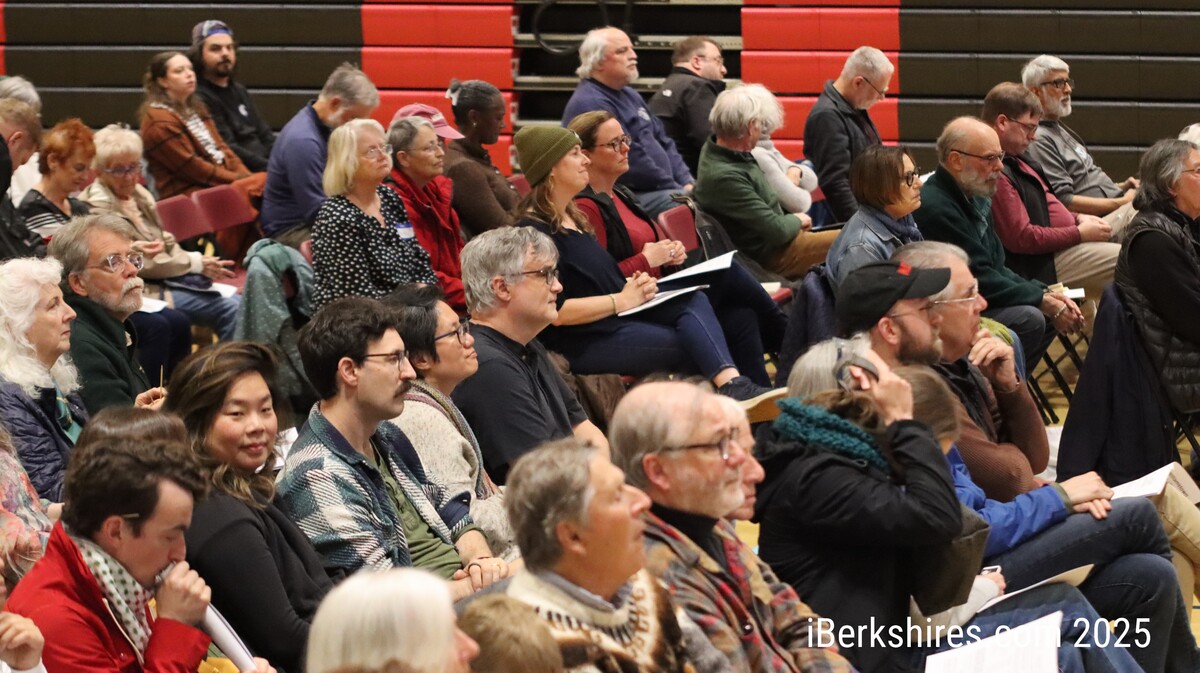
As expected, those were two of the issues that generated discussion in a 2 1/2-hour meeting in the Mount Greylock Regional School gymnasium.
But, in the end, the votes were not particularly close in either case.
The smoking ban, which had the support of the town's Board of Health and Select Board, passed on a vote of 148-56.
The town clerk reported that 308 of the town's 4,677 registered voters, 6.6 percent, checked in to the meeting.
The short-term rental zoning bylaw regulation generated by the Planning Board, which needed a two-thirds majority to pass, passed by a vote of 219-25.
William Raymond, who drafted the smoking ban and submitted it to the meeting by citizens petition, presented the article, No. 30 on a 32-article warrant.
"If [second-hand smoke] didn't come through walls, I wouldn't care," Raymond said in explaining his proposal. "But when it comes through the walls. ... Neighbors have rights, too. They have the right to clean air.
"I understand the point of view of opponents. They say, 'A person can do what they want in their own home.' If it's a single-family home, sure. ... If it's an apartment complex, their smoke becomes an issue for the neighbors."
A couple of meeting members argued against passage of the smoking ban.
Anne Skinner, a retired chemistry professor at Williams College, said the whereas clauses in Raymond's article misrepresented the science around secondhand smoke.
"In order to curtail what someone does in their own home, you have to prove it presents a serious risk," Skinner said. "I would like to suggest this article doesn't meet that test.
"Secondhand smoke exposure is only potentially a problem."
Skinner noted that examples others cited in support of the measure, like increases in health among pub workers in Ireland after a smoking ban in the establishments, were irrelevant because the amount of second-hand smoke inhaled was significantly higher than that affecting neighbors in an apartment setting.
"Life is a series of risks," Skinner said. "I think allowing people to smoke in their own homes is a risk we can live with."
Andi Bryant, meanwhile, argued that implementing the ban would discriminate against those populations with higher incidence of tobacco use, specifically mentioning the low-income people, construction workers and laborers, indigenous people, the LGBTQ community and people battling drug and alcohol addictions.
"This seems like just another way for the town to keep out the riff-raff," Bryant said.
Justin Adkins, who identified himself as a "low-income trans person who has spent most of my life doing diversity, equity and inclusion work," offered a counter argument.
"The reality is that most of our minoritized populations have increased rates of smoking because of anxiety and stress created by the outside world. Being allowed to smoke within a building does not address that or change those numbers. Being able to smoke outside does help a lot of people who live inside. We need to support those who are not heard, and that's often people who are inside their homes trying to live their lives without inhaling second-hand smoke," Adkins said.
A couple of members went to the microphone to argue against the Planning Board's proposal to limit the use of a full residential property as a short-term rental to 90 days per calendar year.
One said the proposal hurts residents who want to use their home as an Airbnb but does not address the lack of housing in town. Another speaker, former Planning Board member Alexander Carlisle, said that the town does not have enough data to establish whether short-term rentals are impacting the housing market.
Carlisle noted that the Select Board surveyed short-term rental operators last year and received responses from just 29 out of 128 operators. He urged the Select Board to try another survey before the town considers a bylaw.
On the other hand, a couple of meeting members took the floor to say they agreed with the idea of a limit on short-term rentals but thought the penalties in the proposed bylaw are not stiff enough.
Planning Board Chair Peter Beck responded that the dollar values can be adjusted in future years if there are enforcement issues.
Other issues that have generated discussion in the months leading up to the meeting received comment on Thursday.
The sewer rate for the Hoosac Water Quality District passed, 145-55, but only after a couple of members argued that the town should push the district to cease all composting to produce biosolids that are then applied in agriculture because of the presence of PFAS chemicals.
All Community Preservation Act grants proposed by the town's Community Preservation Committee passed easily on Thursday night.
But proponents of several of the proposals used the opportunity to speak at length about the value of their projects — a move likely necessitated by advisory votes from the Select Board and Finance Committee that did not support town meeting approval.
In the end, most of the CPA allocations were approved on overwhelming voice vote. The closest was a vote by electronic clicker on a grant to the historic Store at Five Corners that passed, 180-67.
Other than the HWQD rate, most of the fiscal articles on the warrant were approved without any comment. One exception was the Mount Greylock Regional School District appropriation.
One resident asked why the local school budget was up as much as it is. Finance Committee Chair Fred Puddester explained that the main driver is a 16 percent hike in the health insurance rate paid by the district and many other municipal employers in Berkshire County for fiscal year 2026.
Another resident argued that the town is not doing enough to fund public education.
"I believe many of us are in this community because we believe in education," Briee Della Rocca said. "There are many, many needs in our public school system our children are not having met because, we're told, 'We don't have the budget for it.'
"I would like the School Committee and the town to stand behind our schools and support a budget that teachers and administrators say we need to meet the needs of the students in the schools now."
Tags: fiscal 2026, town meeting 2026, williamstown_budget,