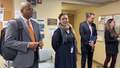
Pittsfield Hub Program Has Served 85 'High Risk' People
PITTSFIELD, Mass. — The Pittsfield Hub has served 85 people since its establishment in 2022, and the need continues.
Last week, Lindsay Cornwell of the Berkshire County Sheriff's Office updated the Homelessness Advisory Committee on the program. Chair Kim Borden said the committee was "very aware of the vital role the hub plays, and can continue to play in our community."
The Pittsfield hub is a team of designated staff from community and government agencies that meets weekly to address specific situations involving clients facing elevated risk levels and develops a mediated, coordinated, and integrated response to the mobilization of resources. (North Adams has a hub, as well.)
"We do not perform case management. Its purpose is to mitigate risk within 24 to 48 hours and connect individuals and families to services. The case management basically belongs to the agencies that are involved in assisting folks in the particular situations in which they are assigned," Cornwell explained.
"We work with families, we work with individuals that are facing complex challenges, and many need services from more than one community agency. So ultimately, it's nice because we have a whole slew of service providers. I think we have roughly 25 to 30 service providers sitting at this table who contribute to providing case management to folks depending on their specific needs."
In three years, the program has served 85 individuals. Cornwell pointed out that about six months of early data from before she ran the hub are not included in those metrics.
The group meets every Thursday, and has so far served 39 females and 46 males from preteens to seniors. This program is modeled after one created by the Chelsea Police Department and uses the same training company.
"For all 85, the top risk factors were housing, mental health, physical health, criminal involvement, and substance use disorder," Cornwell reported.
"Other common risk factors included basic needs, alcohol-use disorder, unemployment, crime victimization, threats to public safety, and public health."
The hub aims to eliminate silos and get everyone at the same table, literally. The goal is to get a person out of acute elevated risk within 24 to 48 hours, which could mean assisting an unhoused individual with sheltering, or helping a victim of domestic violence access the Elizabeth Freeman Center.
"It's mitigating that immediate risk, and then working towards case management after that, with the agencies who are involved in assisting the person," she said.
The group frequently runs into challenges with pinpointing people without an address or cell phone. Last week, there were three new situations presented to the hub, and one was still open from the week before.
"It's not foolproof. Doesn't always work. People relocate. People tell us to kick rocks," Cornwell said.
"Again, this is something that's here to help people, and we do the best that we can. I will say, in a lot of instances and in most, people are willing or at a point where they're like, 'I need help, and I just don't know where to start,' and so this is a really great place for people in that instance."
Tags: homeless,