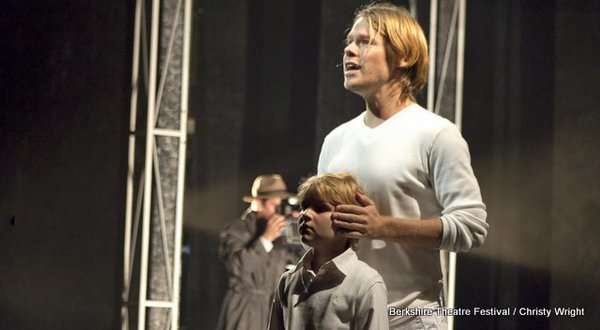
Randy Harrison Rocks Berkshires In The Who's 'Tommy'
PITTSFIELD, Mass. — Sunday night there was a miracle — in more ways than one — on South Street. The Who's "Tommy" is the first production of the newly minted Berkshire Theatre Group and it was more than good, or great. It was heart-thumpingly fantastic.By the time the classic story of Peter Townshend's deaf, dumb and blind boy had been told, the audience was up and out of its seats, whooping, hollering, and dancing in the aisles with complete joy and abandon.
In decades of seeing theater, including the original Broadway version of "Tommy," and its national road show company, I have never seen anything like this response before. My delight with the show was pretty unexpected, too, as I found tears of joy suddenly streaming down my face.
But I am a critic and this is supposed to be an objective review.
So I have pulled myself together to try to give you the reasons why, despite the many "Tommy's" before it, this is the one to see and save in your memory.
 The main reason is that they were true to the concept, the story and the music. Back in 2003, Jared Coseglia directed a violent punk-rock version at Berkshire Theatre Festival's Unicorn Theatre in which Mrs. Walker's lover was a lesbian, and their Tommy was not ours. They created a hate-filled (and hateful) Tommy who was shot and killed by Sally Simpson soon after he had beaten her to a pulp. Sometimes directors get carried away – Coseglia focused on Townshend's penchant for smashing guitars instead of the actual work itself, and thought it clever.
But atonement and redemption has now been achieved since this production was in the hands of those who clearly love the work.
When Townshend (mostly) and The Who (a little) wrote this rock opera, with its overture, underture, afterture and exiture, they were playing with the forms of musical theater and opera. In fact there is little spoken dialogue in the work, most everything is sung, aria and recitative style, both similar to and completely different from opera as most of us know it.
Entering the glorious gilded Colonial Theatre, the sight of the stage stops you short. Where you normally see the theater's lush red velvet and gold-fringed curtain there is no curtain at all. The set simply soars to the top of the proscenium arch, and soaring steel girders tease the eye as they march from upstage to down. A giant tondo screen hovers in the center of it all, with constantly changing projections that amplify the settings or characters we are watching. Gary M. English designed the scenery, and Shawn E. Boyle (with Kim Dowd) the brilliantly original and creative projection images. I especially loved how they incorporated Randy Harrison as Tommy into them as the story progressed. They should do a flip book of the whole image collection and sell them at Massachusetts Museum of Contemporary Art. I'd buy one in a heartbeat.
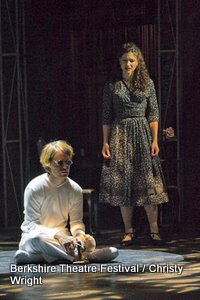
All this before the show even began. After the house lights dimmed, the great music began with its stirring first chords, and the show was under way. At first the story is told through a series of rapidly changing tableau vivants leading to the key moment when Tommy is struck speechless, sightless and unable to hear. We meet his parents, Mr. and Mrs. Walker (a formidable James Barry and most affecting Jenny Powers) and relatives, the alcoholic and pedophilic Uncle Ernie (Christopher Gurr) and his sadistic Cousin Kevin (Ben Rosenblatt).
Later we meet the Acid Queen, played by the unstoppable Angela Robinson.
|
.jpg)
In the first act, Harrison also acts as the narrator, until the second act in which he finally becomes free. From that moment on, the show belongs to him, and indeed the story has the crowd following him like the pinball rock star he has become.
We have seen Harrison in any number of roles over the years, both on the famed television series "Queer as Folk" that first brought him to the public's attention, and in dozens of less visible roles off, off-off and so-far-off-Broadway-you-need-a-transfer.
He was a brilliant male ingenue in "QAF", but his work as a mature actor on stage is actually more riveting. He has earned his bona fides as a master of drama, comedy and musicals, and with this role, he can add rock star to his resume. The voice we heard in the theater was not the same one he used in "Wicked" on Broadway; it was throatier, raspier as is the standard in rock, yet it had the clarity and innocence that was required for this role. One can only guess where this show, this role may lead him in the future.
Still, Harrison is a company man, having spent the last half-dozen summers in this area with the Berkshire Theatre Festival. As is typical for the company that Kate Maguire leads, it has quite a few actors and a creative team that have worked with each other on previous projects.
The big daddy of this "Tommy," however, is director Eric Hill, who is also a master of many styles. He glommed onto "Tommy" much as the audience clearly did, probably from the instant the concept album was first released. In fact, there are millions of us who joined Townshend on his original musical journey in our earlier lives, connecting with its main theme of "See me, hear me, feel me, heal me."
We saw that in the highly emotional reaction of the audience last night, and in the stunning intensity of the performance delivered by the cast of 23. Actually make that 43. Twenty more people filed on stage during the "Come to My House" scene, and with the six-piece band brought the total forces to 50.
The public has not changed in thousands of years; we still love spectacle, and this "Tommy" provided that in spades. Somewhere in the space a fog machine was chugging out clouds of atmosphere that constantly filled the upper reaches, while at times the lights flashed and disco balls whirred filling the theater with sparkling efflorescence.
On stage, the ensemble was hard at work dancing and singing, with the energetic choreography of Gerry McIntyre. Here is the only place where the the truncated rehearsal period showed a few ragged edges. The company had only about 3 1/2 weeks of preparation and previews to pull this show together, basically from scratch. The detail and depth of the final production under Hill's guidance is a wonder to behold. And the dancing is right up there, too, though the repetition of certain combinations (like head nods and hand waves) showed this observer that time was too short to do much more.
In a show as complex as this, there is always the choice between the music, the dramatic, the technical and the choreographic. That the line between where the director ended and the choreographer took over is invisible makes for a seamless performance, and only someone who has watched Bob Fosse at work can understand the depth that dance makers go to enhance a show.
 The musical forces were well-deployed, too, though much smaller than the original Broadway orchestra. That's not a bad thing, since Broadway union rules forced it to have a totally unnecessary string section. But the instrumentation here was a little too dependent on keyboards, while I think some hearing-impaired doofus told the trumpet player to hold back. Wrong, wrong, wrong. Stifling that horn made some portions of the music sound amateurish, weak and timid when it should be loud, clear and forceful. The drumming and guitar work, on the other hand, was pretty hot.
If you have the original concept album you will find the story is much stronger on stage than on the record. And it is hard to believe today that it was originally banned by the BBC and some U.S. radio stations.
Despite my curmudgeonly criticisms, this "Tommy" is a fresh, clean interpretation of the original, and while the set, staging and characterizations are largely new, it respects and honors all the important elements of the original material. Townshend had a large role in adapting "Tommy" for the stage, including writing a new song for the staged version, "I Believe my own Eyes," sung by Mr. and Mrs. Walker in Act II.
Some wonder if "Tommy" is really a Broadway-style musical or a rock opera. Does that really matter? Of course it is not really an opera but more like a rock cantata or rock song cycle. In some ways you could compare it to an oratorio like Handel's "Messiah." (What irony in that concept.) That too originally had no dialogue, but only solos, choruses and instrumental passages.
So, say hallelujah and go get your tickets now. The show will be gone, vanished, disappeared in a week. Followed by the weeping, wailing and gnashing of teeth of all the Tommy-come-latelies who are sleeping though a true miracle of showmanship and rock music on stage.
Larry Murray is a contributor to iBerkshires.com and offers reviews and arts news from around the region at Berkshire On Stage.
Tags: theater,