State Moves Residents 65-and-Older Ahead in Vaccination Line

Map of scheduled vaccination sites. The online map is expected to be updated with this locations later this week.
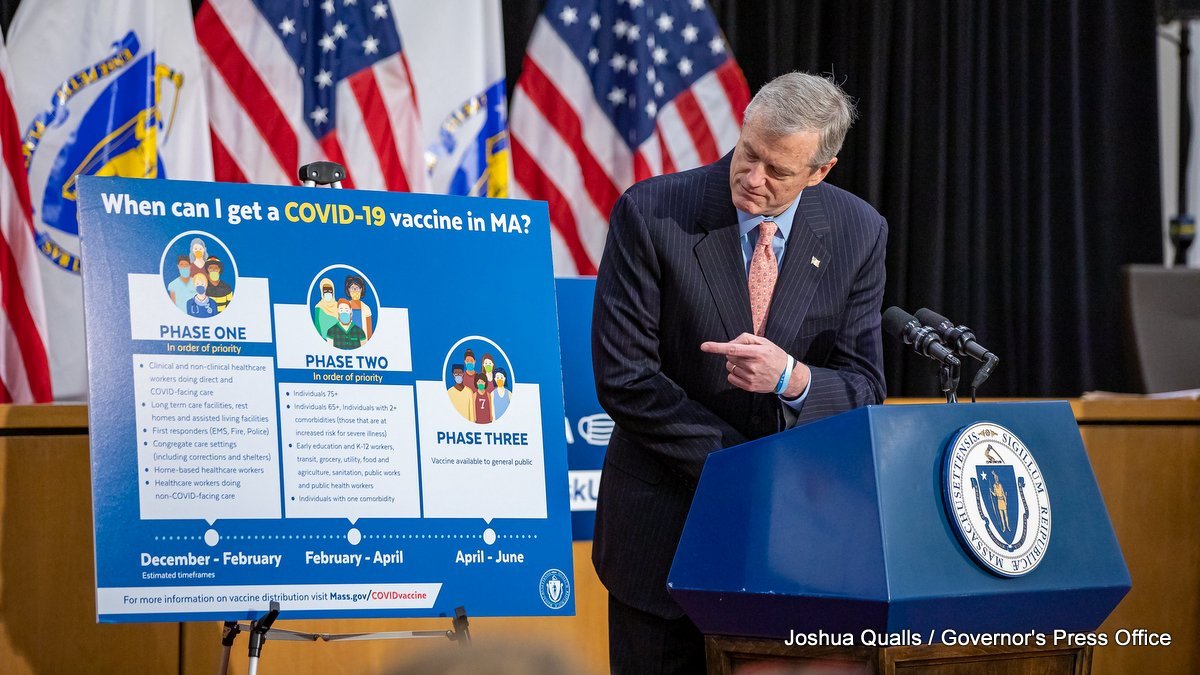
Individuals 65 and older will be moved into the second priority group for Phase 2 of the state's vaccination plan, which is expected to begin on Monday, Feb. 1.
The first priority group in Phase 2 will be residents 75 and older. They can begin to schedule vaccination appointments on Wednesday, Baker said at his daily COVID-19 press briefing.
According to the change in priorities announced on Monday, residents 65 and older will be moved into the same group as residents with two or more comorbidities.
In addition, the governor announced Monday that by the end of the week, the state expected to have 103 publicly available sites to distribute the vaccine and the capacity to administer 242,000 doses per week by next week. By the middle of February, the commonwealth plans to have 165 public sites and the capacity to administer 305,000 doses per week.
But, Baker, emphasized, capacity to administer doses does not translate directly to shots in the arm because the commonwealth relies on vaccine distribution from the federal government.
"It's going to be important for people to go to the website, click on the [vaccination] site that's closest to you and determine if in fact you're eligible and, if you are, make an appointment," Baker said. "But we are overbuilding [capacity] with respect to what we anticipate we're going get from the feds by the time we get to middle of February.
"I certainly hope I'm wrong about that. I hope the feds give us the vaccine we need to ensure every single seat and every single appointment can get filled."
Baker drove that point home repeatedly during an hourlong news conference.
"If we continue to get the same number of doses we're getting now, we may end up with some empty seats and empty appointments, but I think it's better at this point to overplan and hope the feds can get there, then to underprepare," Baker said.
Part of that preparation includes one "Mass Vaccination" site in Western Massachusetts. On Friday, the commonwealth plans to stand up a mass distribution site at Springfield's Eastfield Mall to join sites at Gilette Stadium and Fenway Park along with large-scale vaccination sites in Danvers and Roxbury. Eventually, the plan is to have seven Mass Vaccination sites, which each can ramp up to 5,000 vaccinations per day, Baker said.
Appointments at the Springfield site will be available on Wednesday for residents eligible under Phase 1 (health care workers, first responders and congregate care workers and residents) and the first part of Phase 2 (residents 75 and older).
Lt. Gov. Karyn Polito also announced the launch of an eight-week pilot of COVID-19 testing sites for for child-care providers and families using their services. The Department of Early Education and Care has partnered with the Massachusetts Early Childhood Funder Collaborative and BayCoast Bank on the pilot.
It will consist of eight rotating drive-through testing sites, one of which will be in Dalton. The testing sites will start the first week in February. More information, including how to sign up, can be found here.
On Monday, Baker and other members of his administration were joined by president of the Massachusetts League of Community Health Centers, who talked about the commonwealth's focus on equity in creating a distribution plan for the COVID-19 vaccine.
"Equity is and will continue to be front and center in the state's carefully considered rollout plan," said Michael Curry, who serves on Baker's COVID-19 vaccine advisory board. "We were very clear and quick to acknowledge the virus has not affected everyone equally. We know that our Black and brown communities have higher rates of infections, hospitalizations and deaths from the virus. Too often, up to three times higher rates in ... communities of people of color across the country and here in Massachusetts. With that stark data in front of us, we understood that an equity lens needed to be applied at every stage of the rollout.
"In Phase 2, we focus on seniors and individuals with two or more comorbidities with additional allocation for those communities with higher prevalence of the disease and social vulnerability. We know from looking at the data that the cases of COVID-19 for Black and Latinx individuals are worsened by underlying conditions, such as hypertension, diabetes and asthma -- all related to a historic lack of access to care and structural racism."
Curry cited research that shows 42 percent of Black men and 43 percent of Black women have hypertension, compared to 31 percent of white men and 27 percent of white women. Likewise, whites have lower rates of diabetes than Black and Hispanic counterparts, he said.
"This pandemic has heightened our consciousness about the underlying disparities born out of these inequities," Curry said. "And I've described this as our 'National Katrina.' "
Secretary of Health and Human Services Marylou Suddders said the commonwealth's vaccination distribution plan was based on recommendations from the U.S. Centers for Disease Control and Prevention and the state's vaccine advisory group.
"As we continue to allocate a constrained supply of vaccine, in addition to Mass Vaccination sites, our priority is to ensure that the lens of equity is reflected in the allocation and distribution," Sudders said.
"Phase 1 has prioritized employees and other groups who have been significantly marginalized or have significant representation of communities of color that other states did not prioritize, including individuals who are homeless, home health aides, personal care attendants and the like."
And Sudders reported that the commonwealth is making moves to ensure that the vaccine doses it already has distributed are finding their way into the arms of residents who are eligible.
"Last week, we made it crystal clear that providers have 10 days from the receipt of the vaccine to administration," Sudders said. "All hospitals were contacted last week to review their existing inventory and their administration plans. We are actively monitoring their scheduled clinics and vaccine utilization. This week, hospitals did not receive additional inventory. They need to utilize what they have in hand, and, if we must, we will redistribute these fragile vaccines to other providers."
Later, Sudders said the acceptance rate for vaccines distributed in Phase 1 has been lower than anticipated.
"We're only five weeks into vaccinations," Sudders said. "When we first started to order vaccines for hospitals, the first allocation for Hospital X was [hypothetically] 10,000 doses. We put that allocation in, and if it was Moderna or Pfizer, three weeks later, we put in another 10,000 doses to make sure they had the second dose amount.
"Clearly, hospitals and everyone overestimated what the uptake was for vaccines. … We've seen that in long-term care facilities, where 50 percent of the staff have accepted vaccines. It's a little over 80 percent of residents. I think in the beginning, people were enthusiastic about vaccines and anticipated an amount that turned out not to match what the acceptance rate was. So we've now gone back to folks to readjust it down significantly. That's all part of the maturation of the vaccine program.
"With constrained supplies, we need to get doses out, distributed and into people's arms as quickly as possible."
Tags: COVID-19,
More Coronavirus Updates