Pittsfield City Council Ordains Downtown Creative District Zoning
PITTSFIELD, Mass. — Downtown Pittsfield will now be zoned as a creative district after the City Council's Tuesday vote.
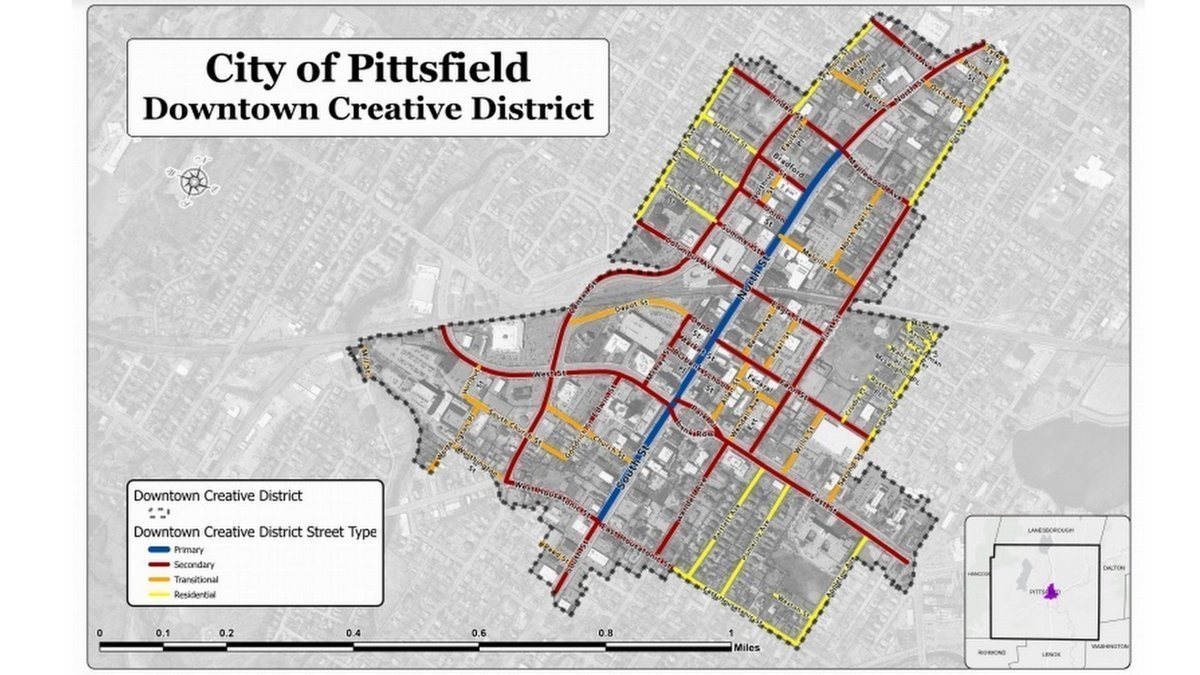
The council ordained a zoning amendment for a Downtown Creative District in a 9-1 vote with Ward 1 Councilor Helen Moon opposed and Ward 6 Councilor Dina Guiel Lampiasi absent. North Street and South Street will be the primary areas affected by this change.
The new zoning district will replace the Downtown Arts Overlay District adopted in 2004 and the more traditional historic zoning districts that are within the downtown area.
"This downtown arts overlay district was adopted at a time when we were trying to understand the roadblocks for development, redevelopment, especially some of the successful mixed-use development we've seen downtown, and it was it was a good balance of trying to allow a lot more flexibility with use and reuse of space but also providing some protections, especially to guard against your more suburban-style developments that didn't necessarily mesh into the downtown area," City Planner CJ Hoss briefly explained as he had presented this project to around four different panels already.
"What we've seen since 2004, is it did all those things really well. But it got to the point where most projects in the Downtown Arts Overlay District require a special permit through the Community Development Board. For most development downtown. I think what we've seen is it's really not necessary, most projects are a positive influence on the types of revitalization. We have been hoping to see downtown."
Moon first motioned to remove the zoning amendment's section that allows housing developers to file for a special permit to be exempt from the 20 percent affordable housing unit requirement. When developers apply for the special permit, there's an intention that they will make a reasonable contribution to the Affordable Housing Trust that is expected to exist by the end of the year.
The council rejected this motion and Councilor at Large Earl Persip lll motioned to allow developers to donate to entities other than the Affordable Housing Trust in order to be exempt from the 20 percent affordable housing unit standard. This passed 8-2 with Moon and Morandi voting in opposition.
Theoretically, the developer could get a waiver to not build the affordable housing units, and also not contribute to the Affordable Housing Trust and or the alternative.
Moon raised concern over equity within the prioritization of market-rate and affordable housing units.
"When I think about the projects that have come to fruition in the past decade or more, none of these projects have included affordable housing units, to my knowledge that I can think of off the top of my head and so I'm trying to juxtapose this against where we are currently with our housing situation, and, and I know, in the past decade, there's been a big push for market-rate housing because of General Dynamics, and BMC, and so on and so forth but we do also have a low-income housing crisis in Pittsfield," she said.
"I feel like we just have a waiver at this time and there's no mechanism for if there is a true need to not if there's a true need, that they cannot afford and they cannot make the finances of a development work based on building 20 percent of the affordable housing criteria there isn't an alternative for them to do anything else, they're just getting a pass at this time because we have this waiver available."
Director of Community Development Deanna Ruffer said Moon's sentiments are not true, referencing the $15.5 million overhaul of the Rice Silk Mill completed in 2012 and the $10 million New Amsterdam Apartment project completed in 2009.
Ruffer said Moon has not heard about affordable housing unit progression because the projects don't come before the council as they are typically getting state tax incentives.
"You're comparing apples to oranges," she added.
Moon asserted that she was not instigating a debate on the topic, but has observed a higher amount of market-rate housing projects in her time as a councilor.
"I am not saying that you are not trying to create affordable housing, I will say though, that as a city councilor, what does come before me and what I have paid attention to are market-rate projects because they're being incentivized with city-funded tax breaks, through TIEs (Tax Increment Exemption) and TIFs (Tax Increment Financing,) and sometimes GE economic development funds," she said.
"And I think that that is kind of a pre-emptive because we don't have an affordable housing spec yet. I would further argue that I think that that contribution or reasonable contribution that's required needs to be a calculated amount, instead of what the Community Development Board reserves, it's very unclear as to how much that looks like."
Hoss said it would be favorable to address inclusionary housing outside of this zoning ordinance, but the city is just "not there yet." That being said, he explained that it is important not to lose the carryover procedures that are in place in the meantime.
He added that there is not an affordable housing requirement for development on Tyler Street but newly approved Reigning Love Church development at 235 East St. includes affordable housing units.
"We are committed to doing this," Hoss said in regard to establishing an affordable housing trust. "We've already applied for technical assistance, twice actually to help with this, this is something that is one of our priorities to see this through. I mean, we all want to make this work. I know that might not totally console you, as far as if you see that as a concern. but we are committed to seeing this through."
Tags: creative district, Downtown Pittsfield,