Fire at Former Great Barrington Gift Shop Under Investigation
Print Story | Email Story
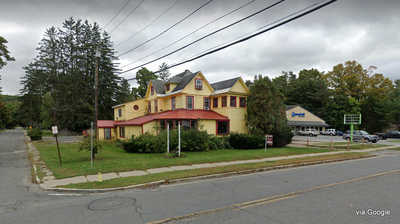
The former shop at 232 Stockbridge Road.
GREAT BARRINGTON, Mass. — A structure fire on Wednesday night at the former Wonderful Things gift shop is under investigation. 
 
The fire was reported just before 8 p.m. as near the Goodwill, which is next to the building at 232 Stockbridge Road.
 
Chief Charles Burger arrived on scene within minutes and struck the first alarm for a working fire. Heavy brown smoke was pouring from every area of the old 2 1/2 story building.
 
Great Barrington's first engine arrived a few minutes later. Hose lines were simultaneously stretched to the basement, first, and second floors where fire was found. The bulk of the fire was quickly taken down. However, fire extended to many void areas in the walls and ceilings of the building and crews works for several hours to ensure all hot spots were extinguished. All crews were back in service by midnight.
 
Great Barrington firefighters responded with three engines, a ladder, and rescue. They were assisted by a ladder from Monterey and an engine from Sheffield. Southern Berkshire Ambulance and the Support Group provided rehab on scene. Additional fire calls in town were covered by Stockbridge, Sheffield, and Egremont fire departments.
 
Stockbridge Road was shut down for several hours. The police worked to detour traffic.
 
"I’m proud of the hard work done by our firefighter's and mutual aid companies to contain fire throughout such and old building," said Burger.
 
The building, a residential structure on just over a quarter acre with downstairs retail space and four apartments, is listed for sale at $299,000.
 
The fire is under investigation by the Great Barrington Police and Fire departments and the State Police assigned to the State Fire Marshal's office.


Tags: structure fire,   
If you would like to contribute information on this article, contact us at info@iberkshires.com.

Lee Wants Bioremediation in Housatonic River Vernal Pool Study

LEE, Mass. — The town has asked the U.S. Environmental Protection Agency and General Electric to include PCB bioremediation in its vernal pool study on the Housatonic River. 

Lee officials are urging the EPA to require GE to add a bioremediation treatment arm to the vernal-pool study or provide the public with a clear explanation for why such testing is being excluded.

"This is exactly the kind of question EPA and GE should be asking before final remedy decisions are locked in," Select Board Chair Bob Jones said in a statement released to the press. "The town is not asking to slow the cleanup. We are asking EPA and GE to make the cleanup smarter, less destructive, and more protective over the long term."

An open house was held in Pittsfield earlier this summer for the Vernal Pool Pilot Study on Reach 5A of the Housatonic River, a five-mile stretch between the river's confluence and Lenox border.

EPA has required GE to conduct a Vernal Pool Pilot Study as part of the Housatonic River Rest of River remediation, comparing excavation and restoration with activated-carbon-based treatments, including a product called SediMite and powdered activated carbon, the town said. 

Ten vernal pools will be cleaned of polychlorinated biphenyls in total, five with excavation and five with active carbon, and seven additional vernal pools will be monitored as controls. Construction will be complete around October, but the pools will be left to their natural processes and monitored with surveys and sampling for three years. 

The Lee PCB Advisory Committee wrote a letter calling for the 21st-century approach it said could reduce long-term toxicity, avoid unnecessary destruction of sensitive habitats, and improve the effectiveness of the cleanup.

It states that Lee supports the study's purpose and agrees that EPA and GE must understand how cleanup activities affect sensitive vernal-pool ecosystems.

"The current pilot includes 10 treatment pools and seven control pools, while local officials understand that roughly 100 vernal pools may occur in the broader remediation corridor," the Aug. 27 letter reads. 

"That makes the pilot study consequential: the methods tested now could shape how many sensitive wetlands are excavated, reconstructed, treated, or left with PCBs managed in place."

View Full Story

More South Berkshire Stories