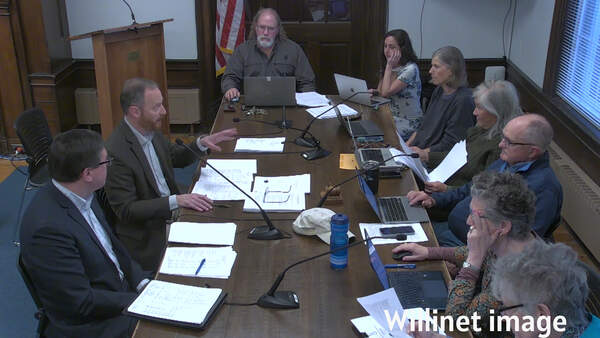
Mount Greylock Committee Defends Handling of Pandemic
WILLIAMSTOWN, Mass. — Several members of the Mount Greylock Regional School Committee last week defended the district's handling of the COVID-19 pandemic against criticism from one of their colleagues.
Following an announcement by Superintendent Jason McCandless that the district would stop requiring face coverings indoors as of March 14, Steven Miller again raised his concern about the way the district has been making decisions during the pandemic.
"I do not believe we are making decisions based on sound science at numerous junctions, and I think some of our policies in the past have been designed more to make us feel like things are being done than to actually be effective in doing things," Miller said.
"We knew Massachusetts was going to remove the mask mandate by Feb. 15, we had prepared policies by MASC, and yet New York City beat us by a week in removing the mask mandates."
Curtis Elfenbein replied that Manhattan, where 88 percent of the population 5 and older is fully vaccinated against the novel coronavirus, is in a different situation than Berkshire County, where 60 percent of the population is fully vaccinated, according to the U.S. Centers for Disease Control and Prevention. As a result, he was OK not following New York City's timeline.
"There is a new survey that just came out from the American Association of Pediatricians covering 61 school districts with 1.1 million students and over 150,000 staff," Elfenbein said. "They tracked through contact tracing schools that had optional mask policies versus schools that had mask mandates. And schools with mask mandates had an 86 percent reduction in secondary infections as tracked through contact tracing compared to schools with the optional masking."
Jose Constantine agreed with Elfenbein and indicated that a certain amount of Monday morning quarterbacking is inevitable.
"I suspect that in the years to come there will be dissertations upon dissertations about the efficacy of the various mechanisms we employed," Constantine said. "I think in real time, when we are dealing with so much uncertainty with regard to the pandemic, and our main aim is to keep as many of us as well as we can possibly be and to stay alive … There are kids in our school district who are preschool age for whom now a vaccine is not available to them. There are a number of different living situations in our community where exposure to this virus could be incredibly life-threatening."
Ursula Maloy could be seen giving the thumbs up signal in the video conference as Constantine spoke.
Miller throughout the pandemic has advocated for data-driven decision making by the district during the pandemic. As far back as June 2020, three months into the pandemic, Miller argued that the decision to return to in-person instruction should be part of a "cost-benefit analysis" that weighed the known harm of time lost in the classroom against the potential for infection with a deadly disease.
"I really wish we'd point to scientific studies or say that there are none or when the state makes mandates that they provide us justifications for these policies," Miller said at last week's School Committee meeting. "Are the masks that we have kids using, are they really that effective in the classrooms? It would be helpful as a committee member to have that information."
Elfenbein, who served on a joint labor-management committee to help make decisions about safety protocols during the pandemic, said the district was making decisions based on science.
"I think we looked at the data and made some really good decisions," Elfenbein said. "Of course, I'd like to err on the side of caution during a pandemic, especially closing in on a million American lives lost to it.
"I think moving forward we'll continue to look at the data that's more and more available about the efficacy of masking and the safety and efficacy of vaccines in terms of reducing and preventing hospitalization and death by a huge margin. I'm really proud of the work we've done and look forward to the work we'll continue to do to keep our kids in the schools and keep COVID out of our schools."
The bulk of last Thursday's School Committee meeting dealt with the budget for fiscal 2023 that the district will send to member towns Lanesborough and Williamstown this spring for approval at their annual town meetings.
Although the focus of a public hearing on the budget centered entirely on a potential $100,000 expenditure for a new position in the district office, most of a $1 million increase in the district's operating budget comes from other areas, including the usual contractual increase in salaries for union personnel but also anticipated fuel costs (both for heating and transportation), higher health insurance costs, planned maintenance on the district's 20-year-old elementary schools and added instructional staff.
In an effort to keep the increased assessments to Lanesborough and Williamstown as low as possible, McCandless and Assistant Superintendent of Business and Finance Joe Bergeron noted a couple of cost-saving measures: elevating a part-time English teacher at the middle-high school from a .6 (three days per week) position to full-time and using that teacher to fill the role of a reading interventionist sought by the school; and delaying an investment in technology.
"Within technology, we're currently, at least temporarily, placing investment on student and staff computer devices on hold," Bergeron said. "We're hoping that with additional clarity on grant opportunities as we look toward FY23, we'll be able to bring some of those investments back into FY23. But in an effort to pare down what we're presenting to you tonight, we have removed that from the picture right now."
In other business on Thursday, the School Committee voted to approve a 2022-23 school year calendar recommended by the administration.
The most noteworthy change on the schedule for next fall is a day off for the district on Tuesday, Sept. 6, the date of the primary election.
"When you look at the paperwork the town [of Williamstown] submits to the district for town voting to occur in the gymnasium, when you look at the numbers of those who would be coming in that day, I became very, very concerned," McCandless said. "The principal becomes very, very concerned, the staff, and I think some guardians and caregivers may become very, very concerned. Is this really as safe as it can be?"
Students in the district also will have the day off from classes on Tuesday, Nov. 8, for the general election, a professional development day for the district's faculty.
Tags: COVID-19, MGRSD_budget,
More Coronavirus Updates