The college is recommending people who normally use the lot between the field house and the Facilities Building to plan on parking in the Weston Field/Taconic Golf Club lot, the municipal lot on Spring Street or the former town garage site on Water Street during the demolition.
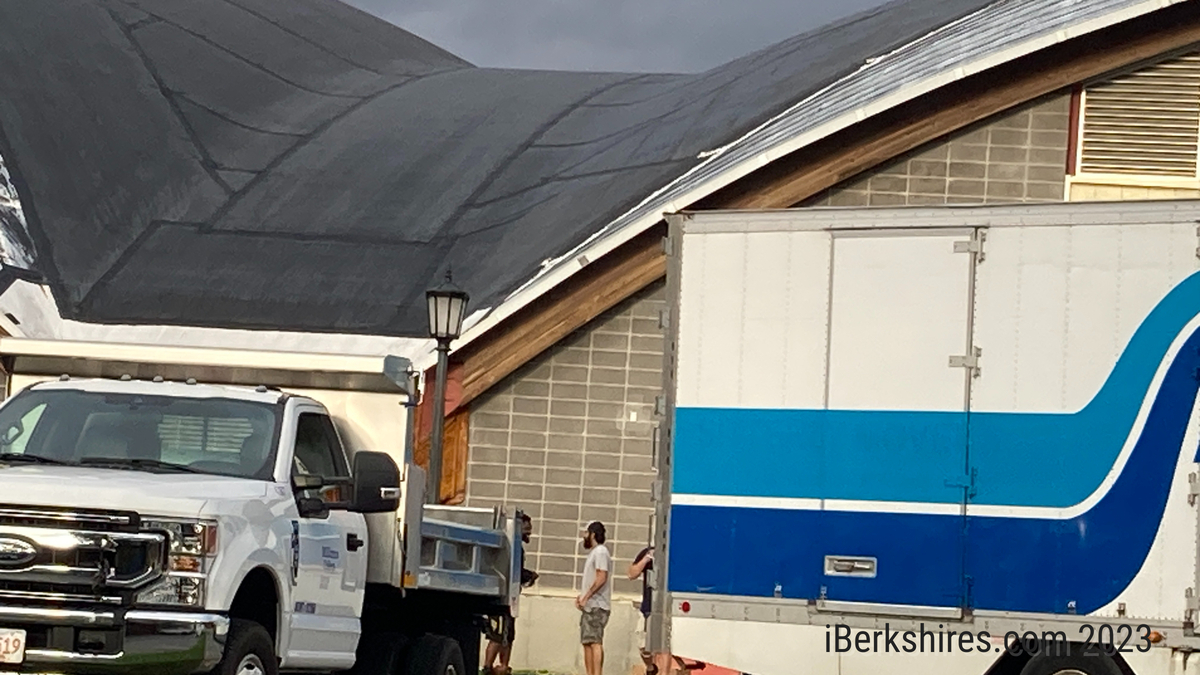
A moving truck last week pulls away from the side door of Williams College's Towne Field House.
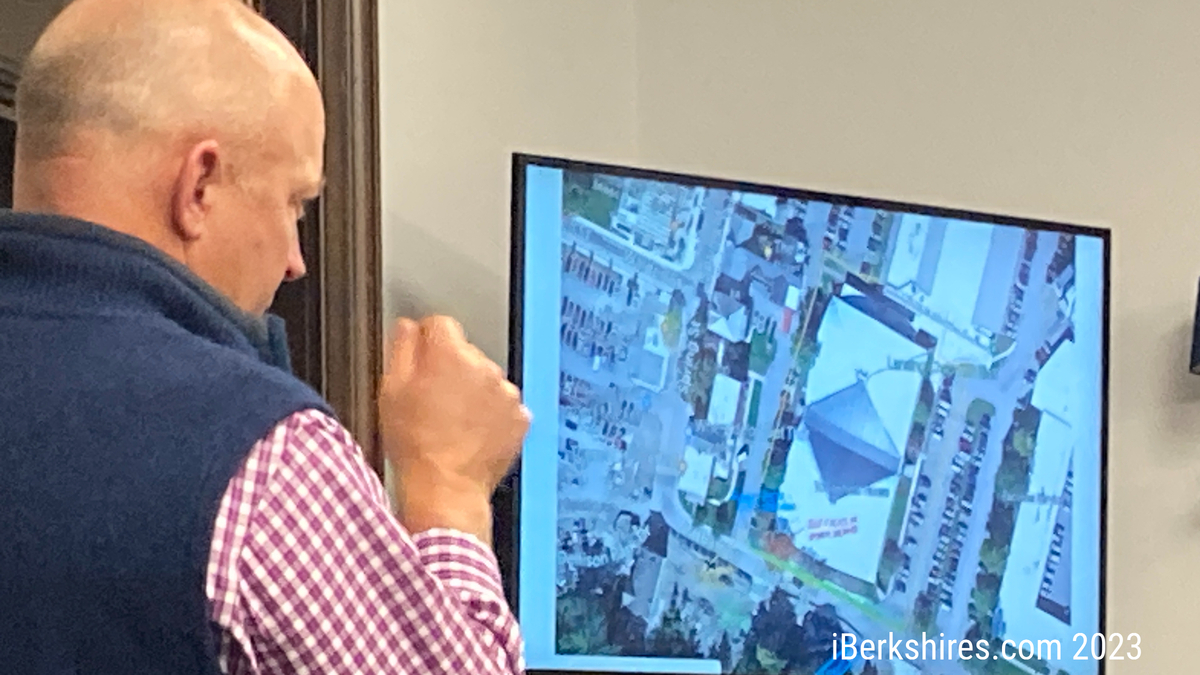
Williams College Senior Project Manager Shaun Garvey talks about the demolition plan before the Conservation Commission.
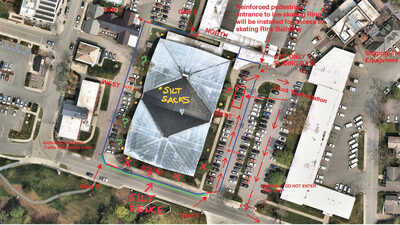
An overhead view of Towne Field House with is labeled with features of the demolition plan as part of the college's application to the town.
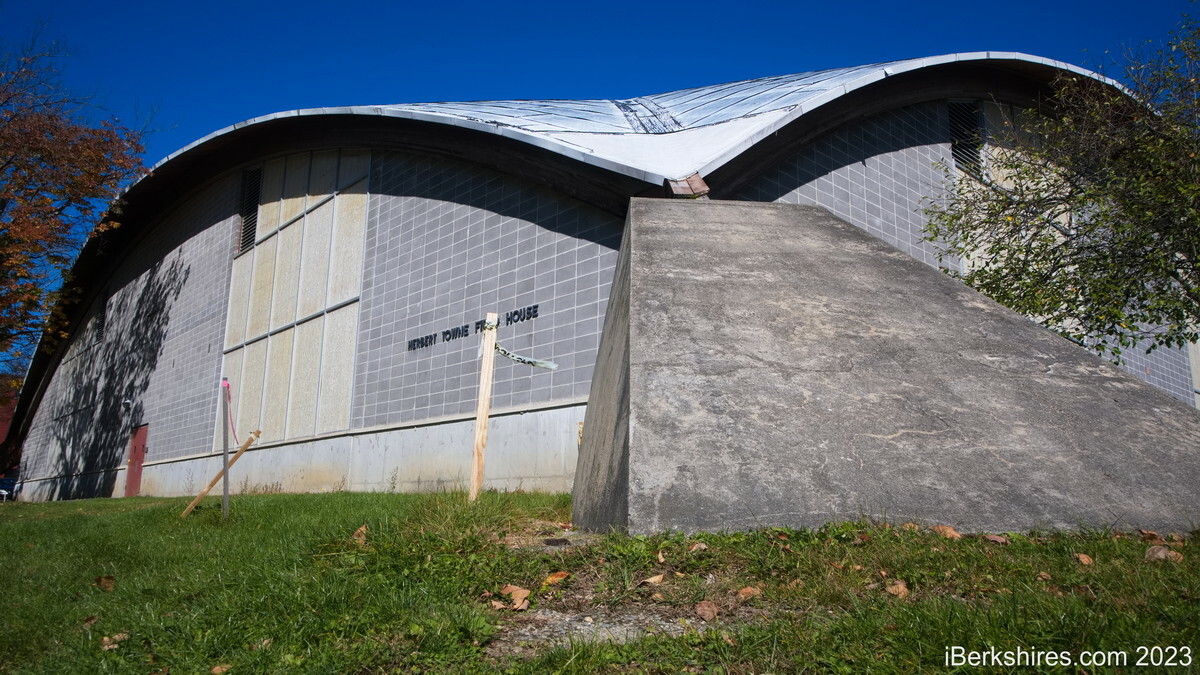
WILLIAMSTOWN, Mass. — The Conservation Commission Thursday gave the green light to Williams College's plan to demolish its Towne Field House.
The college was before the panel to request a negative determination of applicability under the Wetlands Protection Act for the demolition project near Christmas Brook.
The commissioners found that the college, which plans silt sacks in all storm drains and a silt fence along Latham Street, which runs between the field house and the brook, had adequate erosion measures planned.
The plan also calls for a wash area for trucks entering or leaving the demolition site. Williams Senior Project Manager Shaun Garvey said the water from the wash station will be filtered on-site before being discharged.
Prior to the meeting, Garvey said the college hopes to begin demolition on or about Nov. 6 and it hopes to have it wrapped up before the end of the calendar year.
Perhaps the biggest public impact during that time will be the loss of parking spaces around the field house.
Garvey Thursday said that all of the spaces in the western half of the faculty and staff lot adjacent to the field house will be lost as parking spots during the demolition.
The row of spaces nearest to the field house will be inside the fence surrounding the demo site. The second row of spaces will temporarily be part of the driving lane into the parking lot and job site.
Including the permitted spots to the west of the field house, between 60 and 70 current parking spaces will be lost during the demolition.
"Parking is going to be a challenge, but only for about two months," Garvey said. "Once demolition is over, I'll take the fenced-in area in to about the perimeter of the field house itself."
Williams' last home football game against Wesleyan University is Nov. 4, two days before the target date for the demolition project.
Garvey said that the college is recommending people who normally use the lot between the field house and the Facilities Building to plan on parking in the Weston Field/Taconic Golf Club lot, the municipal lot on Spring Street or the former town garage site on Water Street during the demolition.
As for the demolition itself, Garvey explained that the college plans, for now, only to raze the existing Town Field House structure to grade and not do any excavation. In fact, the field house's indoor track will remain in place after the building comes down while the college comes up with a plan for that part of campus.
The track will be fenced in and off-limits to the public, however.
"It won't be like a public playground,'" Garvey said.
If you would like to contribute information on this article, contact us at info@iberkshires.com.
Your Comments
iBerkshires.com welcomes critical, respectful dialogue. Name-calling, personal attacks, libel, slander or foul language is not allowed. All comments are reviewed before posting and will be deleted or edited as necessary.
No Comments
Creative Pause: Venerable WTF Taking Time to Innovate, Strategize
By John TownesSpecial to iBerkshires
The pace and pressures of change have intensified in all sectors of society. The creative economy is no exception.
Non-profit arts organizations have always had to adapt to changing times. Some of these issues are common and perennial, including the need to raise funds, attract audiences, and remain relevant and sustainable.
In addition, while the COVID-19 pandemic was several years ago, it has taken time
to recover from the universal shutdowns of 2020 and their aftermath.
These issues were highlighted in the Berkshires recently with the announcement that two prominent cultural institutions in Northern Berkshire County — the Williams Theatre Festival and the FreshGrass music festival at Massachusetts Museum of Contemporary Art were cancelling their 2026 summer seasons.
Both organizations, which are separate, will use the time to regroup, with plans to return in 2027.
While the announcements raised concerns about the impacts on the cultural tourism economy this summer, the overall slate of cultural attractions and activities in the Berkshires appear to be on track. The cultural sector is not monolithic, and other individual organizations are either proceeding as normal or expanding their offerings.
The season cancellation at WTF was because of a combination of factors, said Raphael Picciarelli, WTF's managing director for strategy and transformation. He shares administrative oversight responsibilities with Kit Ingui, managing director of operations and advancement.
Town meeting will have the levy capacity to approve the FY27 budget as drafted and presented by the town manager on Wednesday, partly because the spending plan for the year that begins on July 1 includes just one noteworthy increase in discretionary municipal spending. click for more
Nolan Booth scored the go-ahead goal with 6 minutes, 22 seconds left in the third, and Ben Harris made 20 saves to give McCann Tech the crown. click for more
The Community Preservation Committee on Tuesday voted to backtrack on a plan to ask town meeting to increase the town's Community Preservation Act surcharge on local property tax bills. click for more