Williamstown Receives Wage Classification Study
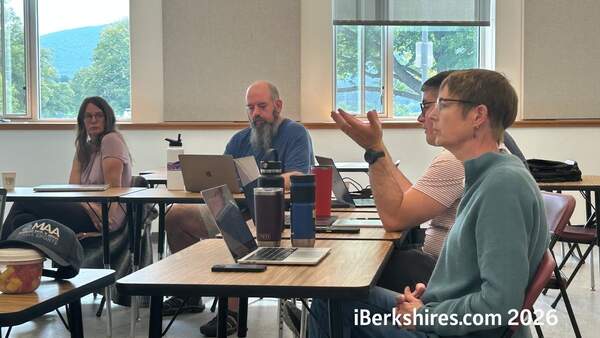
WILLIAMSTOWN, Mass. — The job classification and compensation study commissioned by the town will help the municipality attract and retain employees for years to come, the consultant said on Monday.
"If you talk with comparable communities every year about what they're doing with the general [pay] increase … and if you take your ranges and adjust on average the minimum and maximum amount, you'll stay in the market," Joellen Cademartori told the Select Board at its Monday meeting. "This will last you for a long time — five, 10 years or more."
Cademartori walked the board through a 98-page report by her firm, GovHR, which the town hired to analyze and classify all of its staff positions.
"Across the commonwealth, a lot of communities are doing studies like this because of MEPA, the Massachusetts Equal Pay Act," Cademartori said. "Doing a study like this will allow you to maintain your system for a long time. If you have a question next year and email us, we'll be happy to answer your question. We're happy to help even after the study is concluded."
The study included two main tasks: interviews with town employees and managers to determine how best to group employees in different departments by grade and a survey of similar municipalities to see the range of salaries they are paying public employees.
Cademartori said GovHR received full cooperation and good input from the town employees.
That enabled the human resources firm to classify all town employees in 10 grades with workers in different departments grouped together for the purposes of determining salary range. For example, the town's IT specialist and the highway foreman both were grouped in Grade 6 and the young adult librarian and finance clerk both fell into Grade 4.
The grade of each position was determined by a metric that factored in: preparation and training, experience required, decision making, responsibility for policy development, planning of work, contact with others, supervision exercised, working conditions and use of technology or specialized equipment. Based on a point system, individual jobs were then categorized accordingly.
"The overall skills needed to perform the work is similar enough that they're in the same grade, and what that leads to is pay equity," Cademartori said. "This is a very important part of the study, to make sure that we're complying with the law. That is a big piece of it."
On the other hand, GovHR did not get as much data as it wanted when it came to comparing Williamstown's current salaries with those of like communities.
Cademartori said that GovHR looked at all the towns and cities in Western Massachusetts (Berkshire, Franklin, Hampden and Hampshire Counties) and rated each for compatibility with Williamstown based on metrics like population, property value per capita (using the commonwealth's equalized valuations) and tax levy. That yielded a list of 20 communities that rated 70 on a 100-point scale for compatibility.
The researchers then reached out to those 20 communities to ask for salary data. Just nine returned information: Adams, Dalton, Great Barrington, Hatfield, Lee, Lenox, Montague, North Adams and Wilbraham.
"It was difficult to get data for your study," Cademartori said. "We had enough to do a study, but we wish we'd had more."
Based on a conversation with town hall, GovHR is recommending that Williamstown try to keep its salaries in the 65th percentile of those comparable communities, meaning that 35 percent of the communities pay more and 65 percent pay less for a given type of job.
"It says, ‘We want to have wages that are above average to attract and retain staff," Cademartori said.
"When you look at the calculations, when you go from the 50th to the 60th to the 65th [percentile], you're not talking about a lot of money. It might be $1,000 to $1,500 on a pay range. It's not $10,000."
With one notable exception, the town has been doing reasonably well meeting that goal, Town Manager Robert Menicocci told the board.
Historically, the outlier has been the Milne Public Library, whose trustees appealed to the Select Board earlier this year to address equity issues in its employees' compensation. And the fiscal year 2024 budget that went into effect on July 1 included $50,000 to address that issues and others that might emerge from the compensation study.
"A particular part of the town's staff, at our library, was significantly out of whack," Town Manager Robert Menicocci told the Select Board. "What we did was we prioritized the reserve funding that we had available to make adjustments in that area and get that done as quickly as possible so we could effectuate that change for the fiscal year that started in July.
"Our library staff now is compensated at levels comparable to other staff in town. And I think we also mentioned that, as we were doing this work, we had part-time folks who were being pushed out to 19 hours but not the 20 hours so they could be benefited, and we were also able to make those changes.
"But there's still more work to do."
Andrew Hogeland asked Menicocci how much work — or, put another way, how much more money — was needed to implement the salary adjustments suggested by the study.
"The short answer is, no, we don't [know] in the sense of the immediate needs, which I think are fairly low impact," Menicocci said. "As was indicated, our salaries are pretty much where they need to be. We'll look at a couple of instances to make sure there is equity across classifications. … I think that fiscal impact is fairly minor.
"It's more the long-term strategy of the recruiting needs, where it's really going to get to the bigger issues of: Can we hire, will we be able to hire, should we really be looking at regionalization because the reality is we're not going be able to hire given what the fiscal impact will be and the availability in the labor force? In government, people aren't racing right now to do this work. That's just the reality of it."
Select Board member Randal Fippinger noted later in the meeting that the compensation and classification study relates to the equity and inclusion work addressed by Monday's major agenda item, the release of the Williamstown Community Assessment Research [CARes] project.
That project also touched on a different issue that came up toward the end of Monday's meeting, the "town-gown" relationship between the municipality and its largest landowner and employer, Williams College.
Spring Street merchant Amy Jeschawitz addressed the board during its public comment period to express concern about Williams College's plan to demolish its Towne Field House, which is closely ringed by between 60 and 70 parking spaces that will be out of use during the demo project.
"That is prime holiday shopping season for Williamstown, and the way our businesses work on Spring Street, it requires circulation of traffic and people being able to come and go and park," Jeschawitz said of the demolition period, scheduled to begin on Nov. 6, the Monday after the college's last home football game of the season."
The college has said it plans to tell faculty and staff who normally park in the lot just east of the field house to consider alternative locations, including the lot operated by the town on college land at the south end of Spring Street.
"I know Williams has a lot of parking on campus," Jeschawitz said. "I'm hoping those people can be directed to park anywhere else but the public lot. If you look at the Spring Street lot, there are some empty spaces, but at 10 o'clock in the morning, that's already starting to get full."
Select Board Chair Jeffrey Johnson told Jeschawitz that the town shared her concern and that there was time to have more conversations with the college before the demolition begins.
"We're absolutely here to support you and all our business owners on Spring Street," Johnson said.
In other business on Monday, the Select Board:
• Entered into the record the board's first annual public evaluation of Menicocci, who was praised as a "thoughtful, careful steward of the Town administration and resources."
• Briefly discussed whether it wants to develop a town bylaw on short-term rentals as it was asked to do by the Planning Board last year.
• Noted a number of current vacancies in town boards and committees.
• Accepted a final distribution from the estate of Sarah Campbell McFarland to the Milne Library that brings her total bequest to more than $303,000.
• And heard a heartfelt opening statement from Johnson, who noted that October is, among other things, Domestic Violence Awareness Month.
"Aug. 26, 2023, my sister-in-law, Brittany LaBombard, was murdered as a victim of domestic violence in Nebraska," Johnson said. "Saying that, I've been thrust into many different events. And I just want to say something to my colleagues. First of all, thank you very much. I appreciate your support during this time.
"I cannot guarantee that I will be part of the municipality next year. I say that because I know all of you are. What I'm looking for is for us to be there next year, be more active and more involved. I know all of you share this with me."
Tags: salaries,