Lanesborough Voters Will Be Presented 2 Police Station Options
LANESBOROUGH, Mass. — The Select Board will present two public safety facility designs to voters — though one appears more feasible.
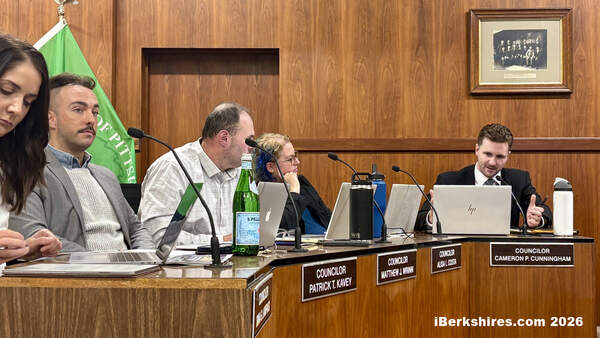
This conversation was continued at last week's joint meeting with the Public Safety Building Committee. The board again voted to advance a $7.3 million combined police/emergency medical services facility and a $6.5 million separate build.
Before it goes to town meeting, there will be another round of community input.
"When we get to town meeting, we don't have to present both of them if we're overwhelmed with people saying, 'Hey, let's just get the Police Department and EMS done," Select Board member Deborah Maynard said.
The 7,222 square-foot combined police and EMS build would cost about $7,365,868. Alternatively, a 4,814-square-foot police station with a separate two or three-bay EMS facility would $6,509,900. In 2023, voters rejected a proposed $5.9 million police/EMS complex but it was brought back because officials feel it is a good design.
All options would be constructed at 405 South Main St., the former Skyline Country Club.
Committee member Eric Harrington pointed out that the standalone EMS would be a Morton building, which is a fabricated metal structure.
"So you're fabricating a building that isn't what it's designed for," he said.
"That would be my concern is rushing to make a decision and put up a building that ultimately is not of the quality you would want to see here. Morton buildings are for vehicles, garage, storage, things like that, animals, not for office space and people. I think, myself, that would be a bad decision."
Selectman Timothy Sorrell wondered if the board should include the separate building proposal after being told that it wouldn't be worth the money.
"Not only does (a town survey) say that 36 percent of the population wants a combined police EMS station but only 6 percent want an EMS facility only," Public Safety Building Committee Chair Mark Siegars said.
"So they've answered that question already. They had a choice and they answered that question."
Sorrell successfully motioned to propose the combined police/EMS facility. Maynard, who prefers the combined facility, then successfully motioned to bring forward separate and combined buildings to give taxpayers a choice.
"I really think the town should tell us, on a vote, in a proper vote, which way they want to go," she said.
Sorrell then motioned for the town to find a mechanism to get community input on the choices, which was supported unanimously.
Glen Storie, deputy chief and Fire Association president, detailed the struggles of having the fire and EMS departments operating out of the station at 180 South Main St., which is owned by the Fire Association.
Heads of both departments recognize it is not a permanent situation.
"It's to the point where when we go down there to try to do something, (EMS) feel the need that they have to pack up and leave while we're at the station doing our meetings and things like that," he explained
"And same when we come back from a call, they're in the areas that we would normally go to de-stress and do things like that so we kind of tiptoe around each other trying to make it work."
Storie said EMS is welcome to stay until they find a suitable place.
"We are not going to ask them to leave," he added. "That would not do anybody any good. Wouldn't do the community any good. We will certainly continue to make it work the best we can until something changes."
EMS Director Jen Weber said she is not able to provide the proper facilities for her staff, explaining that they often feel like guests.
"We are the queens and kings of making do. We really are," she said.
"I mean, EMS gets the short end of the stick in a lot of places where sometimes you're crammed in an ambulance for 24 hours. So we've made do and we can continue to make do until something is suitable but it's really important that the town realizes the timeline of creating a professional department and their responsibility in making sure that they have the proper facilities for that."
Tags: Lanesborough Police Station,