Clarksburg School Officials Mull Deep Budget Cuts
CLARKSBURG, Mass. — The school budget would have to be sliced by up to $150,000 to bring the fiscal 2026 budget down to a 2 percent increase.
It will mean cuts in personnel, professional development and programming.
That's frustrated school officials who point out the operating budget is only going up by 0.67 percent but covering nearly $200,000 for retirees' insurance and FICA is pushing up the budget up to 7 percent.
"What I heard last week is we were tasked with cutting our budget down to 2 percent or maybe 4 percent, I heard thrown out there, too," said Assistant Superintendent Tara Barnes at Thursday's School Committee meeting. "It didn't sound like people were willing on the town side at this point to take the retirees insurance and FICA over onto the town side."
The town's Finance Committee had pushed for the school budget to absorb retiree insurance back in 2018, as well as wage-withholding such as FICA to provide some financial relief to the town. Clarksburg is the only school district to carry those lines in its budget.
"It was done ... because there was an issue at the time, and I'll say that nicely, issue at the time in the town's budget, and they came to us and asked us to help them," said School Committee member Mary Giron. "We did that with the understanding, or with not the understanding that we were going to keep this forever. It was to help them with that situation."
Superintendent John Franzoni said there were some town officials who saw the school choice account as a "slush fund" that could be used to offset the town budget.
"Those individuals got what they wanted, and now it's gone," he said. "They're not here anymore in those positions, but they got what they wanted."
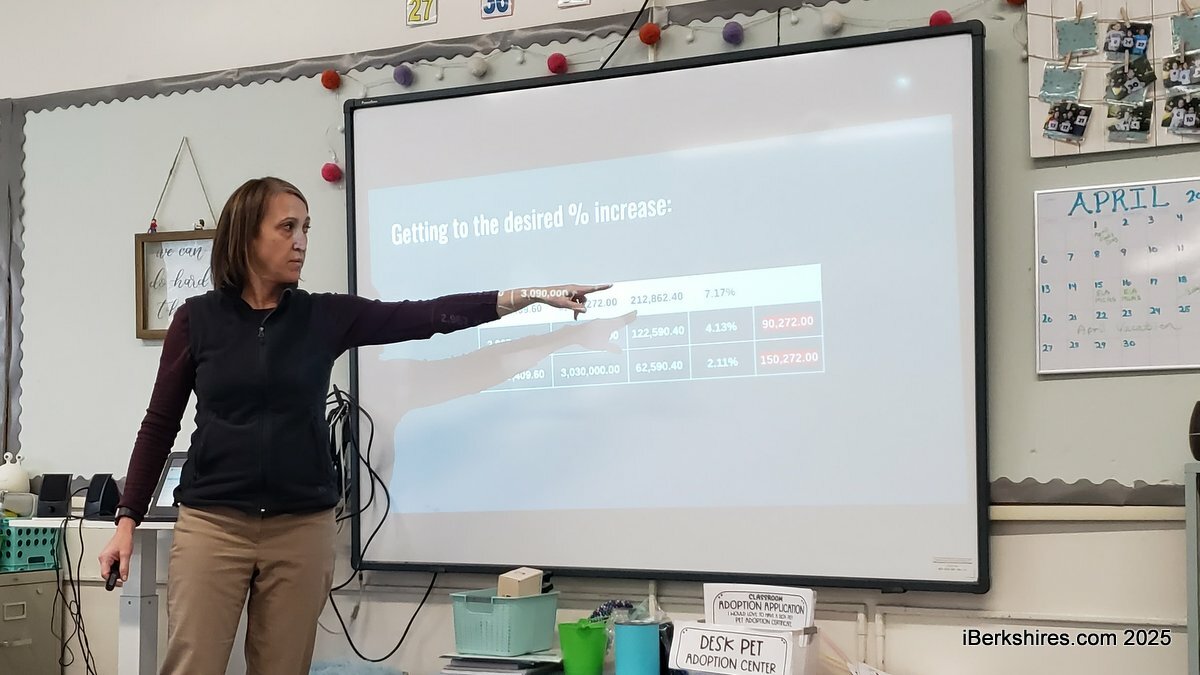
Barnes ran through a "menu" of possible reductions but warned the School Committee that the school choice funds that have been offsetting insurance and FICA are nearly gone.
"What we've been able to piece together so far is that it's in a more dire situation than we thought," she said. "That number that's been budgeted in last week's budget that you got, that $200,000 is not a number that's feasible to work with. ...
"We've got a problem first that we have to fix before we even talk about cutting the other $90,000 or $150,000 that we want to cut."
This year's budget had included $265,000 in school choice funds but there's a shortfall of at least $53,000 in that line. School choice revenue of $187,000 was anticipated for next year but that may come in lower as older school-choice students graduate and no younger ones are coming in as classes are full.
The district estimates it has about $24,000 in school choice funds at the moment.
There's also an anticipated drop of $16,000 in prekindergarten tuition and possibly $80,000 in grants. The school district is getting more in state Chapter 70 education aid because local enrollment is up but school officials pointed out that money is coming in on the town side.
"I could be off by a little bit here, but I don't think in general, it's probably far off from from where we're looking at," said Barnes. "Let's just be super optimistic and say $150,000 we can put up in school choice and that, again, drains us all the way down to nothing at the end."
She said the numbers are not firm and that she and Carrie Burnett, who has come on part time with the departure of Business Administrator Lisa Blackmer, have needed more information from the town's financial team to pin them down.
"I talked to meeting our town administrator early in the week about trying to make sure that we're getting communication from the accountant, and that we really need," said Franzoni, referring to the prior accountant still working with the NBSU schools. "He was going to reach out to that individual to say that we need her to prioritize getting back to our office with some numbers about trying to reconcile some grants and different things.
Barnes said she has been getting responses to her questions.
Potential savings that Barnes laid out included reducing professional development and Chromebook purchases, charging for 4-year-olds in prekindergarten, cutting back on anticipated Drury high school tuition and psychological testing. That came to about $30,000 in savings.
Giron asked what would happen if another student wanted to go to Drury; Barnes said school choice funds but if those weren't available "we might have to have a special town meeting and we might have to ask [the town] for help with the tuition."
Further cuts could mean eliminating the prekindergarten, the interventionist and the dean of students. Barnes offered that the dean could be brought into the central office and be used in part for student support and she would take up a more active role in the financial office.
School Committee member Cynthia Brule was disappointed at town leaders' responses the week before to taking over the insurance and FICA.
"We helped them out when they needed it," she said. "Now we need help."
Tags: clarksburg_budget, fiscal 2026, school budget,