Pittsfield Public Camping Ban Sparks Outrage at Council Meeting
PITTSFIELD, Mass. — A proposal to ban public camping ran into pushback from residents and councilors last week.
The City Council sent a proposed ordinance that bans encampments on any street, sidewalk, park, open space, waterway, or banks of a waterway to the Ordinances and Rules Subcommittee, the Homelessness Advisory Committee, and the Mental Health and Substance Abuse Task Force.
Several community members at the meeting asked city officials, "Where do unhoused people go if they are banned from camping on public property?"
"In a place like America, we fetishize the idea of pulling oneself up by the bootstraps, but what if those people have no boots?" resident Felicia Bell asked.
"How cruel are you to further criminalize the depths of poverty and need, instead of offering a helping hand? Work with the community to find realistic solutions."
Councilors at Large Alisa Costa and Earl Persip III, Ward 2 Councilor Brittany Noto, Ward 5 Councilor Patrick Kavey, and Ward 6 Councilor Dina Lampiasi voted against sending the ordinance to O&R. After agreeing that the subcommittee wouldn't discuss the proposal until it has gotten input from the other two panels, the second and third referrals were unanimous.
"I tried to keep track of how many times the question was asked, 'Where are they supposed to go? and I lost track," Noto said. "I don't think O&R should touch this until we have an answer to that question, or until we have a different approach."
In the agenda, Mayor Peter Marchetti wrote that the proposed ordinance "is to maintain streets, parks and other public and private areas within the city in a clean, sanitary and accessible condition while adequately protecting the public health, safety and welfare of the community."
He said the use of streets and public areas within the city for camping purposes or for storage of personal property "interferes with the rights of the public to use these areas for which they were intended. Such activity can constitute a public health and safety hazard that adversely impacts residential neighborhoods and commercial areas."
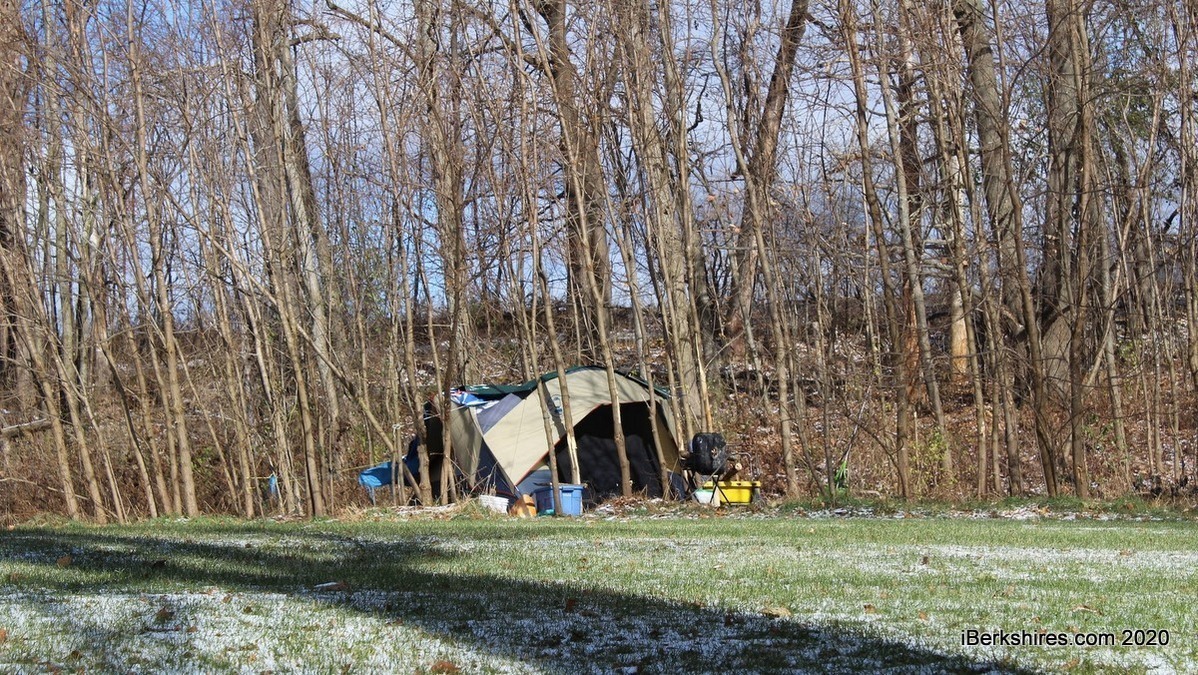
City officials have been grappling with homeless encampments being set up in public parks in recent years.
Costa motioned for the additional referrals, saying, "I think we can do better as a community."
"This is only the start of a conversation, and if we rush to ordinance and roles, I feel we won't have the full impact of bringing the right people into the conversation with experience and the folks who understand the issues better," she said.
"It gives more opportunity for the public and people who couldn't be here tonight to speak, and gives us time to deliberate better."
Over an hour and a half of public comments, residents expressed that they felt this further criminalizes poverty and attacks people who are already vulnerable. People were also concerned about a clause that prohibits camping on private residential property for more than three consecutive days.
The proposal, described as "draconian" by a community member, states that "Any person causing, permitting, aiding, abetting or concealing a violation of this chapter shall be subject to criminal and noncriminal penalties."
"Like some of the other people mentioned here, my kids camped outside. They camped when their cousins came over. Sometimes it went over three days," former city councilor Karen Kalinowsky said.
"I don't get it. I mean, I don't know who put this together, but they didn't really think, or they didn't talk to people, homeowners on this."
Resident Shannon Stephens said she has been asking since last year where the city's safe alternative is if the shelter is full and people aren't allowed to sleep outside, reporting, "I have yet to receive an answer."
"Not only are encampment sweeps costly, dangerous, and ineffective, they are perpetuating poverty by continuing a cycle of stigma, mistreatment, and intimidation, not to mention making people move along to unfamiliar settings makes them more vulnerable to violence. In this ordinance, it is mentioned that tents, huts, vehicles, vehicle outfits, or temporary shelters on streets, sidewalks, and alleys or on improved or unimproved land or parks are unacceptable, and yet you are giving no other option. You are essentially forcing people to break the law, and people shouldn't have to disappear on command," she said.
"…I'm sick of you guys bullying my friends and treating them as if they are less than, and I will not be scared into submission to save face. I will continue to speak up about this. You are taking away what little these people have, and I often wonder how you sleep at night knowing this, but hey, at least you have a bed. If you can't help and you don't have immediate answers, at least stop causing harm, because we can't punish our way out of a housing crisis."
Alexander Herman, who currently resides at the Unitarian Universalist Church in exchange for ground maintenance, reminded everyone that they, too, could become unhoused.
"The people who are unhoused in this city aren't unhoused because they're lazy or they're bad people," Herman said.
"They're unhoused because something bad happened to them, just like something bad has happened to me several times in my life. I'm a mother, that means that I did not dare become homeless, because my children would be taken away from me if I lived on the street."
Another public speaker pointed to a 2014 report by Rethink Homelessness that found it is three times more expensive to enforce anti-homeless laws than it is to treat homelessness as a housing and health crisis.
After exploring data from a group of 107 chronically homeless individuals in Central Florida, researchers found that each person, while homeless, cost $31,065 per year in inpatient hospitalizations, emergency room fees, incarceration, and other systems associated with homelessness. In comparison, the report found that supportive housing for chronically homeless individuals in Central Florida costs just $10,051 per person per year — a 68 percent reduction in community costs.
There is an upcoming Safe Haven shelter in Pittsfield that will have seven beds, and Hearthway Inc. is working on 37 new units of supportive housing, 28 on vacant land on West Housatonic Street and nine at Zion Lutheran Church on First Street.
"This ordinance is nothing short of reactionary and regressive. It is reactionary in that it is a punitive approach to poverty, attempting to restore city streets to a time when homelessness was less visible, pushing them out of sight rather than offering solutions. It is reactionary in that it is intended for the preservation of aesthetics and order, prioritizing appearances and property value over human dignity," said Lucas Marion, a downtown business owner.
"It is regressive because these measures don't apply equally. They fall squarely on the unhoused, pushing them into more precarious and dangerous situations, allowing the immediate seizure of personal property, and establishing civil and criminal penalties for violations without providing any alternatives. It is regressive because it ignores the structural causes of these issues and compounds trauma for those with mental illness or substance use disorders. In reality, this simply makes it harder for social workers, harm reduction teams, or outreach providers to locate and assist people."
Kathy Moody, who lives near Onota Lake, said the ordinance "needs some work," and the city cannot criminalize poverty, but spoke of city parks being contaminated with human feces and garbage, and said she has been threatened by a camper.
"My experience, this is my experiential data, is danger and health hazards," she said. "My experience is sheer panic chasing my toddler who's showing me a needle on the ground and heading to pick it up."
Resident Steven Bigelow said this ordinance will do a lot of harm and asked for the city's assistance rather than taking away people's belongings and not allowing them to sleep.
"We do have predators and stuff in the group. Can the police take them out? We don't like sleeping with them either, but it seems you all like to leave them in there," he said.
"So if the police could work with us, if you guys could all actually talk to us like I was promised once, that would be a thing that would help all of us and it would help everybody in this room, not just the ones that are for but the ones who are against."
There was a similar turnout in council chambers earlier this year when a "median safety" ordinance was proposed, accompanied by a protest at Park Square. The petition has since been filed.
Tags: camping, homeless, public parks,