Pittsfield Subcommittee Backs $1M Funding for BIC, Myrias
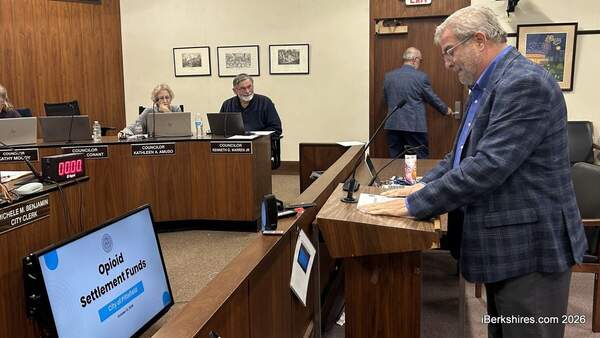
PITTSFIELD, Mass. — The Community and Economic Development subcommittee advanced a total of $1 million in requests for Pittsfield Economic Development funding for expansion at the Berkshire Innovation Center.
On Monday, councilors supported the BIC's request for $500,000 to expand and Myrias Optics Inc.'s request for $500,000 to establish the manufacturing laboratory at the BIC. Last week, it was announced that the BIC will receive a $5.2 million boost from the state for this effort.
"I think that this is the first step in opening the door to bringing a new type of industry to Pittsfield, and from there, we expand. I hear all the time 'When is [General Electric] coming back so all the employees can go back to work?' The answer is never. They're tearing down the buildings," said Mayor Peter Marchetti when speaking about the project's long-term economic impact.
"And I think our strategy has been 50-100 jobs at a time to be able to rebuild a stratosphere in Pittsfield that we can survive longer term, and if we happen to lose one business along the way, we don't lose everything in that process."
The economic development funds would go toward a $11 million specialized nanoimprint lithography (NIL) lab, and bring Myrias to it. The company's biggest customers are "Tier 1 customers" in consumer electronics and augmented/virtual reality (AR/VR) applications.
CEO John Fijol explained that the process for making lenses, which includes spinning material onto a wafer, imprinting it, and pressing it together to create a 3D structure that is then cured.
"That entire process takes about four minutes, and we make 1,500 to 2,000 devices, optics, in four minutes," Fijol said. "We do a little bit of post processing, but it's minutes to do this. So very fast, very cost-effective, very scalable technology."
The Pittsfield Economic Development Fund, or the GE Fund, will have $7.2 million remaining if these allocations are approved by the City Council. The expansion can be built in a year, and if all goes well, the BIC hopes to break ground in the spring.
Councilors queried the project team about its impact on Pittsfield residents specifically, the salary ranges for about 50 jobs it will create, and the company's technology. The average salary will be between $110,000-$120,000 per year. Myrias expects to hire at least 55 people by 2028, and the lowest salary would be around $45,000-$50,000 per year.
Councilor at Large Earl Persip III explained that Pittsfield went through a lot to get these funds and finds them important.
"Our neighborhoods were polluted, and we got these funds. So people don't take it lightly, what we do with these funds," he said.
Last week, the Healey-Driscoll administration and the Massachusetts Technology Collaborative's Innovation Institute announced over $16.3 million in funding and designated 14 state regions as "TechHubs" through the Massachusetts (MA) TechHubs Program. The BIC received a $5.2 million transformation grant — the largest allocation — for an Advanced Optics TechHub within the William Stanley Business Park.
Marchetti reported that the funding requires support from the city.
He recalled the $5 million grant from the Massachusetts Technology Collaborative in 2023 that enabled a research and development initiative between UMass Amherst, Myrias, Electro Magnetic Applications, and the BIC. That was bolstered by support from the city under former mayor Linda Tyer's administration, and EMA was able to expand at the BIC.
"We're here now tonight, on another phase of that journey to be able to continue the success that Pittsfield has seen moving forward. And so I wanted to kind of highlight both, at the same time, $500,000 to the BIC and $500,000 to Myrias," Marchetti said.
"Some people have said to me over the last couple of weeks, ‘Why are you doing this?' Well, it's clear to me that we need a building for this new business to operate in, and so the city needs to be invested in, as it has been from the beginning, making sure that the Berkshire Innovation Center can grow to its fullest potential, and I think this is one of those opportunities."
An advanced optics and photonics corridor has been identified from Rochester, N.Y., to Boston, and Pittsfield is positioned right in the middle.
BIC Executive Director Ben Sosne found architecture plans that show an expansion area on the BIC's original footprint, and that the 7,000-square-foot addition utilizes the existing elevator, bathrooms, and kitchen for efficiency.
He said the tech hubs align industry, academia, and government.
"This is actually very much dependent on bringing jobs and bringing companies. So that's what this proposal is about. We're going to make an efficient build to support private and public labs that can help companies grow," he said.
Sosne added that they envision a specialized optics talent pipeline across the high schools and colleges, and see local plastics manufacturers getting work from it, explaining, "Myrias and the team are going to make a device, but guess what? That's going to be encapsulated into something and integrated into something, and we have a lot of plastics manufacturers, as you know, here, who could see this as a line of business."
These requests will return to the City Council for a vote on Nov. 25.
Tags: BIC, economic development, GE fund,