Champion South County Sculptor Brings Wood To Life
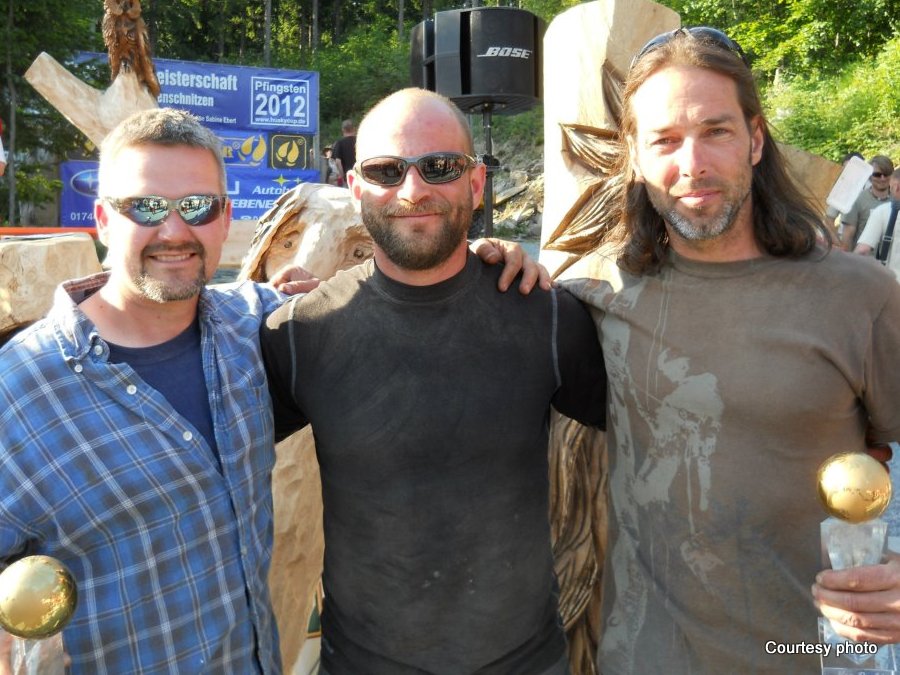 Kenneth Packie of Otis, right, is seen with teammates Tomas Vrba and Jeff Samudosky at the 2012 Husky World Sculpting Championships in Germany this May. |
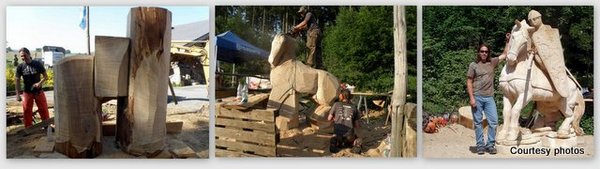
Packie and his teammates defeated teams of wood sculptors from around the world in the five-day competition with their life-size figure of a medieval knight on horseback.
It was Packie's second trip to the world championships, where last year he finished fourth.
On Friday, June 15, Packie's work will be on display in a gallery setting for the first time, when he is featured at the Stanmeyer Gallery in Otis, home to photographs by world-renown National Geographic photographer John Stanmeyer. A reception with the artist begins at 7 p.m. on Friday.
Packie this week took time out to talk with iBerkshires while on a trip to British Columbia for the 2012 Canadian Carving Championships.
Question: When did you get started carving wood sculptures?
Answer: Not that long ago, all things considered. I started in the fall of 2005.
I used to build high-speed networks, telecommunications networks. I was an on-call technician, and my life wasn't my own.
My wife and I went to a show, and I saw a guy carving, and thought, 'Man, that looks like great stress relief.' I didn't know how to use a chainsaw. I'm from North Jersey originally, and in the Berkshires, everyone knows how to use a chainsaw.
So I ended up taking a three-day class in Washington (state). The first day was chainsaw use and chainsaw safety. Then they showed me how to block out a couple of bears — what I call square bears. That didn't really appeal to me. When I got home, I started focusing on more realistic wildlife.
When I realized there were competitions, I figured that was the way to meet the best guys out there. That's when I started competing.
And now you do it carving full time?
I went full time in 2008. It's definitely tough, but it's grown every year. I've been a full-time carver for four years now.
Do you mostly sculpt items requested by your customers?
Everything I do has been commissioned.
How were you able to make the leap to doing this full time?
What happened is that in the summer of 2008, I set up at Hall's General Store in Otis on the weekends to see what the response would be. I went there on weekends a couple of times before I quit my day job. The response was overwhelming.
I get a lot of business from local people, but there are also all these second-home owners who spend a fortune on their gardens and things, and the wood carvings can really make it pop.
I built a Web page. That took a while to get work off of that. Mostly it was just word of mouth locally and a ripple effect from Otis. That surprised me.
I thought, 'I can support my family doing this?' That's a dream.
Everyone's got a hidden talent. It's just a matter of finding it.
I work pretty much every single day, but it doesn't feel like work. And when I'm home, I'm home. I'm not going to have to drive to Vermont to fix a problem.
What sorts of things do you carve?
I've always been drawn to realistic wildlife. Initially it was bears because that's what chainsaw sculptors are known for. Then I started doing owls, herons, foxes, wolves. Gradually, the bear orders started slacking off.
A lot of people like having their pets carved, and I got away from that because I realized that you're doing a portrait, and you can get consumed with doing it right. You can end up working on it for three weeks, but I don't charge them any more because when I quote someone a price that's what I charge them.
Pricing can be the hardest thing about doing this — pricing accurately.
How fast can you do a sculpture?
When you compete, you have to do a main piece over two or three days, but also you can do a quick piece in an hour or an hour or 15 minutes. That's to entertain the crowd.
Anything that comes out of the shop probably isn't chainsaw only. I still like to use a chisel and a torch and sandpaper.
Do certain species of wood work better than others?
You can carve anything, but every area has better woods. I use a lot of eastern white pine. It's big. It's clean. I like to burn patterns into the wood, and it's like a blank canvas. I carved oak for the first time last year in Germany.
Western red cedar is my No. 1 wood. I have a partner from Connecticut who set up a shop in Washington. I'll come out a couple of times a year to the West Coast and carve the red cedar, and I have a customer base out there.
Maple, I don't like, and there's a lot of maple in New England.
Do customers request certain types of wood?
We do what we call stump jobs. I someone has a tree taken down and there's a stump. That would be whatever wood is there. Any wood can be carved, but some are not as much fun. I have carved some maple, but only as a stump job.
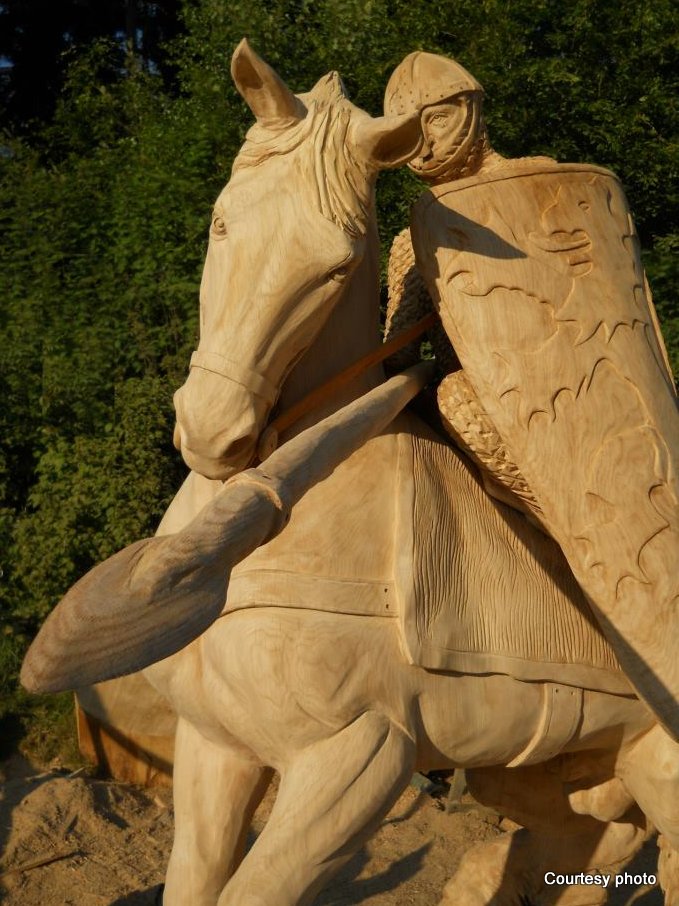 The finished life-size sculpture, 'The Knight,' which, like everything in the competition, was inspired by the historical novel series of author Sabine Ebert. |
I did a bench for the town of Otis that is 12 to 14 feet wide. The center column of it is a big white pine tree that came down in Monterey. ... On the ends I have logs that I carved.
So you are often making sculptures out of multiple pieces of wood.
The one we did in Germany was a life-sized horse and rider. In terms of complexity, that's the biggest thing I've done.
That was 30 pieces of wood. ... Jeff (Samudosky) and I worked on the horse, and (Tomas Vrba) worked on the human figure. Then there was a lance and a sword and a bridle, all these different parts.
How did you meet your teammates?
There's a big gathering in Pennsylvania every year called the Ridgway Rendezvous. So I saw this guy carving in 2005, and that's what got me started. In 2006, I didn't go because I'd only been carving a few months and I was intimidated. In 2007, the guy showed up with these incredible animals, and there were all these people going up to him, so I figured I'd stand back and observe.
In 2008, I had this 15-foot gator that I carved. The guy came up to me and said, 'Thats incredible.' ... He introduced himself and asked how I got started. He was the guy I saw at the show in '05. That was Jeff Samudosky. He was the reason I started carving. We hit it off right away. I went down to his shop in Connecticut, and now we get together every couple of years.
Jeff was named the team captain of the (USA) team this year, and he knew I was good enough so he pulled me on board. We ended up choosing Tomas Vrba who is from Slovakia but is married to an American. He's a classically trained sculptor.
Did you have any artistic training before you got into wood carving?
Not at all. When I was a kid, I always used to draw. Art was my best subject. But my dad was an engineer, and my parents never looked at art as a viable career. And they’re mostly right. It’s a hard thing to make a living at.
But one thing I realized when I saw (Samudosky) carving ... Before my senior year in high school, I did a bunch of career testing at (Stevens Institute of Technology), and my spatial mathematics tested off the chart. They said I should be an architect. Well, I took a drafting class, and I hated it. All those straight lines bored me to no end.
But when I started carving, I realized that's spatial mathematics.
How did you end up in the Berkshires?
I was working in New York City for most of my (15-year) career in telecommunications, and I was just tired of the commute from north Jersey. I took a job in D.C. that enabled me to live in northern Virginia. I was always doing startups, and the startup in D.C. only lasted two years before I had to yank the whole network out because the company went Chapter 11. ... A job opened up with a more established company. The opening was in Vermont, and I loved Vermont as a state. My brother lives up there.
My territory was Western Massachusetts, Vermont and a little bit of eastern New York. After being in the Berkshires for not too long, I realized there is nowhere in Vermont that I liked more. There's always so much going on here, and it's still close to Boston or even New York if you want to go there. We just put down roots there.
What can you tell me about the show coming up in Otis?
It's a mix of pieces. One I really like is a western red cedar totem, a contemporary totem with a little bit of story-telling. There are two owls in the middle and a raven harassing the two owls. It's kind of an abstract piece. Another one I really like is a pouncing fox.
All of the pieces for the show are ones I did for myself. Some I did a couple of years ago and set aside, and i was able to come back to them and finish them this sprinng. They're what I refer to as 'me pieces.'
Tags: chainsaw, championship, sculptor, wood,