Dalton, Hinsdale Start Study for Merged Police Force
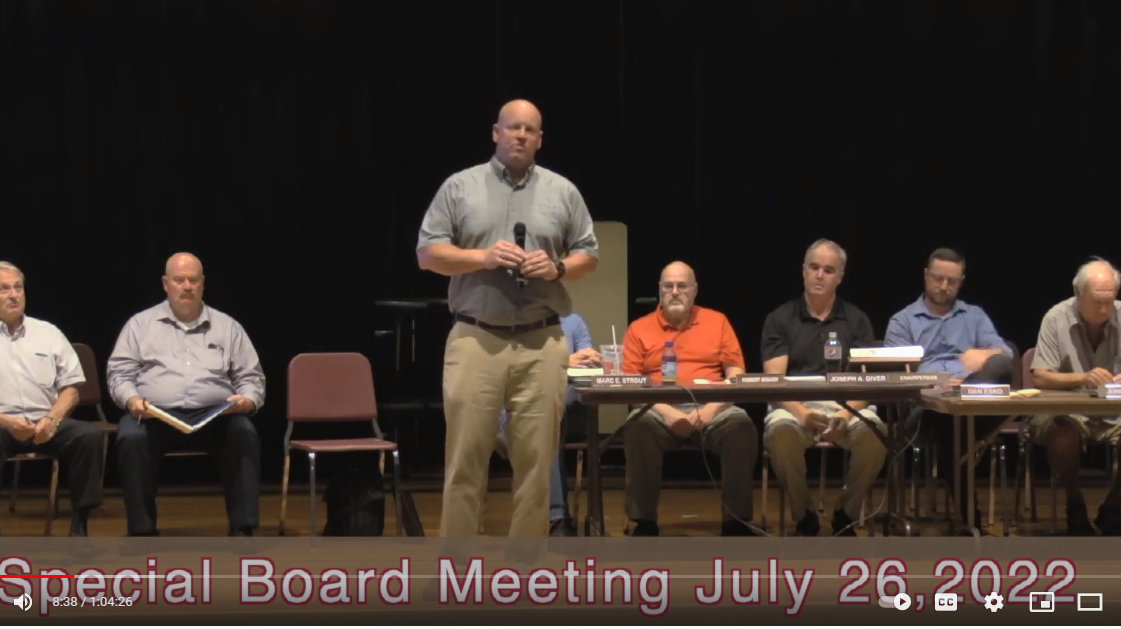
Sean Kelly of Municipal Resources Inc., a consulting firm, explains the feasibility study of the police departments in Dalton and Hinsdale in this screenshot from Dalton Community Television. See the full video here.
Select Board members said they will look into sending a questionnaire to residents to gather more input based on the recommendations of one citizen who raised the concern of lack of attendance and responses from the audience. Only about a dozen or so people attended.
A majority of residents who did attend the meeting were open to the prospect of this merger.
"We're in the infancy stage. Like [Chief Deanna Strout] said, let them do the work. I don't feel like I had the experience to figure out, as a taxpayer, what's more appropriate, let the experts figure out what needs to be done. I just wanted to say that I support our department. I think they're great. It took us a million years to get to a superb chief. I think you're doing a great job," one resident said.
The town hired Municipal Resources Inc., through a grant, to conduct a study that reviews and determines if this is an appropriate option for the towns. The consultants have also done a study for the town on municipal salaries.
"We hope to come out of this with a really good understanding of what kind of regional system would look like, what the options for that are and be able to take that to our town meetings, maybe this year, maybe not this year," said Town Manager Thomas Hutcheson. "But it's the start of a conversation, which would change pretty fundamentally the shape of policing in Dalton and Hinsdale. ...
"We want to make sure we're covering all the bases."
The experience that the consultants had as police chiefs in New Hampshire communities informs how they look at the data and they have traveled across the country helping others determine if this type of strategy is right for them. Sean Kelly is former chief of Weare, Andrew Lavoie retired as the Nashua chief, and David L. Kurz is an FBI Academy graduate and former chief in Durham.
The only concerns that were raised were location and cost, which will be looked into during the study. Hutcheson said Hinsdale is seeing a "substantial" burden because of the police reforms and a merger could work at this time since Hinsdale Police Chief Susan Rathbun is looking at retirement.
"We started out now almost a month ago, with a ridiculously long request for documents from both police chiefs asking for historic data over the last several years of how this department is running in terms of, how many cars do they stop, how many calls for service that aren't law enforcement related are you responding to each year, what do your work schedules look like, what's your population look like, what's your most severe type of calls for service, response, budgets and so forth," said Kelly.
"Now we've had an opportunity, we'll pick some of those documents, not all of them. The team here will assume like those for both departments and kind of the melting pot theory that we're going to take a look at see what that would look like, if there was a combined law enforcement agency."
Officials say pooling their resources will help relieve the strain that the state's police reform law has had on small departments because of new training requirements for part-time officers and will offer more opportunities for officers within a larger force.
Once the feasibility study is done, both towns will have to vote to approve before a merger can happen. How this merger will affect the budgets for both towns is also being studied.
Strout said she couldn't answer questions about costs and operations at this point.
"This is the very beginning of the process and I think there's a misunderstanding out there that people think we're farther along in the process than we are. We're not," said Strout. "It's like the infant stage right now."
Although both Rathbun and Strout of Dalton believe that the reform bill is a step in the right direction they say the implementation could have been better planned during an interview with iBerkshires earlier this spring. Strout described it as an unfunded mandate.
"I am big on training. I am big on standardization. I think every police officer in the state of Massachusetts should have the exact same training, because we're dealing with the same laws," Rathbun said. "I think it's a good thing. I think what happened is that you had an incident that made this come about. And all they did is they put the horse before the cart."
Rathbun believed that it would have been better for the state to wait to get the details "ironed out" and make it effective on July 1 of this year.
"It just would have been a better way better transition, more information for the chiefs, stuff like that," she said.
The reform bill requires all part-time officers to be certified the same as full-time officers. In an effort to certify current reserve officers, the state has created a three-year Bridge Academy.
The academy offers training and testing on firearms, driving, and defense training on top of classroom time. The officers are required to complete 40 hours of firearm training, 40 hours of Emergency Vehicle Operator Course training, 40 hours of defense tactics, and 200 hours of classroom time over the course of the six-month period.
"What the bridge is trying to do is to bring these part-time officers that want to stay with the job and continue with police officers up to the standard of a full-time police officer," Rathbun said.
In the past, individuals could become officers by going to reserve and then part time at a department while also being able to keep a full-time job elsewhere. They could be added to the Civil Service list and, once hired, sent to the full-time academy.
The result of the change is that individuals are not able to keep a full-time job while being certified because of the course time requirements.
To make up for the loss of the reserve officers, the chiefs have been utilizing overtime budgets but there is not enough money. This is another reason for a merger.
"Smaller departments can't absorb that kind of staff shortage, which is why when I took over, I went to the town and I said, 'Listen, we need two more extra full-time officers to cushion that blow. If we lose somebody, it's 18 months to get someone trained and hired," Strout said.
"If we don't have the extra staff, then we immediately have to fill that on overtime. Because our shift minimum is two. And if you're going below that you're contractually obligated to fill those shifts ... And you know Hinsdale is in that same boat, if they lose someone. That means they go without coverage for 18 months, unless the town wants to pay overtime."
"New officers coming in the door, and they have to go to this full-time academy and nobody's going to want to go through that nightmare and work in a part-time capacity. It's just too much, it's very intensive training," Strout said.
"And they would have to give up their other employment to go. So, I just don't think a part-time position — after going through that type of rigorous training — is really a realistic expectation for anyone."
New officers who were not previously reserve officers have to go through an 18-month academy to be certified.
Strout was unaware at first that she was no longer allowed to utilize part-time officers.
"I could chalk it up to maybe it was the transition period when I became chief that I just didn't get the proper notice. But I had no idea there wasn't going to be a reserve academy until, you know, because again, it was a transitional thing," she said. "And there's probably just communication loss. So I won't say that we weren't notified, but I definitely didn't know. So therefore, that officer was in the wind."
In February, Strout hired a person who was 27th on the waitlist for the June academy because it had filled up immediately. The sole Western Massachusetts academy was accepting applicants from across the state despite the fact that there are more programs in eastern Mass.
"I hired our new officer in February. First, she went through the process, she went through the medical, the physical fitness, the psychological. And then once those steps are completed, we can sign her up for that academy, she was immediately waitlisted — the academy was already full," Strout said.
According to Strout, the next academy is probably going to start in January. There's the potential of one in September depending on how difficult it will be for the Municipal Police Training Committee to get instructors but she thinks that is unlikely because the instructors are difficult to come by.
"I will believe that when I see it," she said. "So that means she will probably get to start in academy in January, graduate in May of '23. A four months field training program. So by the end of September of 2023, I can see her on my streets working a normal patrol schedule."
Dalton voted at town meeting to leave Civil Service in order to improve its ability to hire officers; Hinsdale was never part of Civil Service.
A common occurrence for departments that are part of Civil Service is officers from other areas coming to smaller departments so that they can get trained and then leaving two years later to go back to their hometowns, if they can get officers at all.
"We were getting all these candidates from out east who just wanted the golden ticket and then they were leaving after we spent $45,000 on their training," said Strout.
Hinsdale had two officers in the Bridge Academy this year and anticipates two more next year, with the final reserve officer completing training in 2023.
It is costing the towns approximately $6,000 to train these officers. After they have completed training the departments can apply for grants to will cover half the cost.
Another reason for the merger is to provide better advancement opportunities for the officers in the area. A larger department is going to give the towns the capability to create different positions.
"It's very hard for a patrol person to do everything from the call all the way to court, there's just too much involved. So this is a really good thing as far as the officers being able to expand their careers and move on to different positions," said Rathbun. "Because if you come to Hinsdale as a 25-year-old patrol person, you're basically staying for 30 years as a patrol person. So there's no movement within my department. So to me, it's a good thing all around, if we can figure it out, and the assessment shows that it's a good thing."
The number of hires that the department has a year is based on how many leave or retire. The departments are hoping that once a merger is finalized, and Rathbun is retired, Strout will not have to hire and pay for as many people to be trained because Hinsdale's department is young.
Rathbun turns 65 in February and, as part of the state mandate, is due to retire. She received a two-year extension so that she can see a merger through until when Strout takes over.
If the merger happens, the combined department will have 18 officers including Strout.
Tags: police,