Berkshire Census Shows Small, Aging But More Diverse Population
PITTSFIELD, Mass. — The 2020 U.S. Census shows that the county's population is decreasing and aging but is getting more diverse.
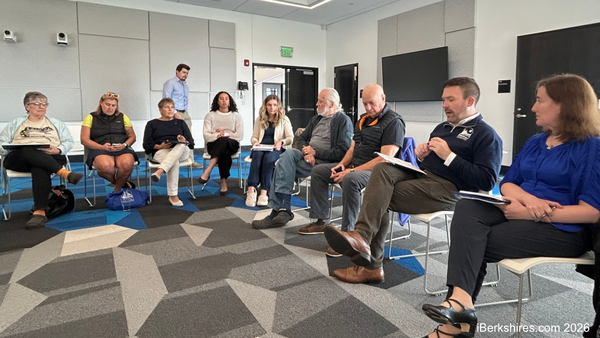
Last week, the Berkshire Regional Planning Commission was presented with a summary of data released in May. More than 63 percent of Berkshire County residents self-responded and the remaining were visited by Census takers and eventually subject to an administrative records review.
"I know is three years after the Census occurred but the Census Bureau just over the last several months have released the bulk of their data," GIS, Data and IT Manager Mark Maloy explained.
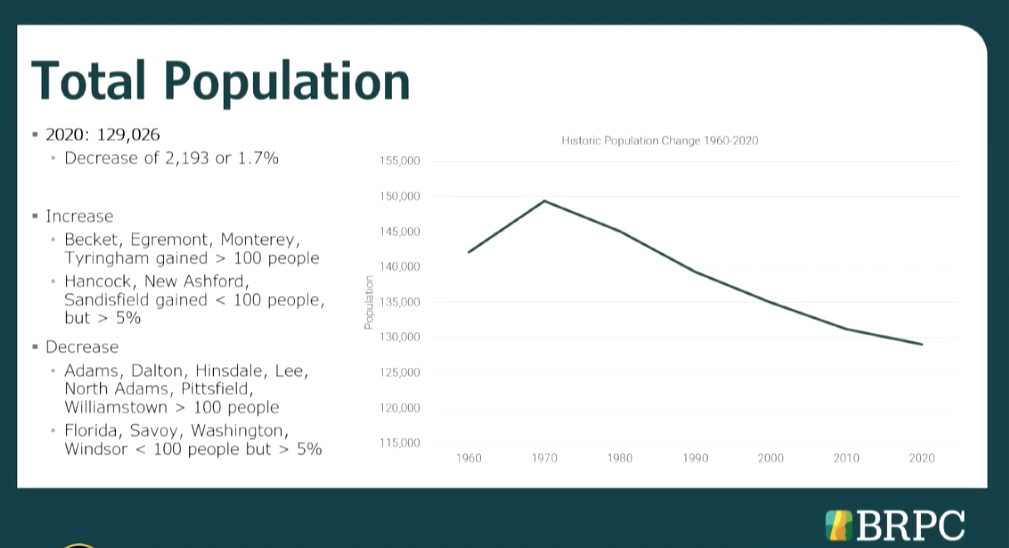
In 2020, the population was 129,026, down from 131,219. This represents a loss of 2,193 people, or 1.7 percent of the population.
Becket, Egremont, Monterey and Tyringham saw an increase of more than 100 people while Adams, Dalton, Hinsdale, Lee, North Adams, Pittsfield and Williamstown lost more than 100.
"These numbers, obviously, communities may debate them," Maloy said. "I know a lot of the town clerks have their own numbers showing different trends but these are the official numbers that the Census Bureau has."
Most county residents are in the 40-to-65 age range, totaling more than 43,200. This is followed by seniors ages 65 and older at more than 31,400. On the younger said, there's more than 29,800 residents ages 20 to 40 and the under-20 crowd make up the smallest demographic at more than 24,800.
"We are getting older as a region," Maloy said.
The median age for Berkshire County has increased by 3.1 years since 2010 and is now 47.8. Alford is the oldest community with a median age of 61.3 and Williamstown the youngest with a median age of 36.1, which is largely driven by Williams College.
Pittsfield and North Adams are not far behind with median ages of 44.2 and 42.6.
Diversity is up 9.4 percent, with more than 19,700 people, or 15.3 percent, classified as Black, indigenous, or a person of color.
Pittsfield is the most diverse Berkshire County community with 22.2 percent BIPOC residents and Peru is the least diverse with only 4.4 percent. Williamstown and Great Barrington are also significantly diverse at 21.6 percent and 18.9 percent, respectively.
The least diverse towns include small rural communities.
Despite the decrease in people, the county saw an increase in households by nearly 1,000 to more than 57,000. But the number of people per household decreased from 2.34 to 2.26.
Williamstown has the largest people-per-household ratio at 2.98 and Mount Washington the lowest at 2.
"So we lost population but we gained households and the result of that is a decrease in the people per household," Maloy explained.
"We have more houses being occupied, more households out there, just fewer people in those households again, with the aging population a lot of the kids have moved out."
About half of the households are single adults, with 20.7 percent single-male households and 30.4 percent single-female households. Another 40.3 percent are married couples and 8.6 percent are cohabitating couples.
For households with children, 56 percent have married couples, 13 percent cohabitating couples, 7 percent single-male households and 24 percent are single-female households.
Some 17 percent of the population are seniors living alone, which is a significant increase over the last decade.
The county has seen a 1.8 percent increase in housing units to more than 69,700. Of the units, more than 12,400 are vacant, and another 7,700 are seasonal units for second homes.
Most second homes are located in Hancock at more than 63 percent and there are also high percentages of second homes in Otis and Becket. Adams has the smallest number of second homes with less than one percent.
Homeownership has decreased by 0.6 percent to just over 38,000, or 66.7 percent, and there are just over 19,000, or 33.3 percent, renters.
Peru has nearly all owner-occupied units with 96.5 percent and North Adams has the most renters with 48.5 percent. Pittsfield is close behind with 41.1 percent renters.
It was pointed out that this information is available on the Berkshire Benchmarks website, which is a data source for Berkshire County.
Tags: BRPC, census, demographics,